






Lifecycle Clarity in HubSpot: The Executive Architecture
Complexity is expensive. Clarity compounds. If there is one principle guiding high-performing growth systems in 2025, it’s that lifecycle clarity is...
I know what I am looking for, and would like to chat.
A team of data-driven marketers obsessed with generating revenue for our clients.
Because the proof is in the pudding.
At Campaign Creators we live by three principles: Autonomy, Mastery, Purpose.
AI is rapidly transforming CRM capabilities through predictive insights, automation, and personalization, but many organizations adopt AI features before their CRM systems are architecturally ready, causing AI to amplify noise instead of delivering meaningful intelligence.
Because AI relies on structured, reliable, and contextual data, a strong CRM architecture is essential to provide the signals models need to produce accurate outputs, ensuring AI improves decision-making rather than introducing confusion.
HubSpot should be viewed not just as a toolset but as a data and lifecycle architecture platform that, when implemented strategically, becomes the operational layer supporting automation, reporting, and AI-driven intelligence; the goal is to create an environment where AI can operate effectively.
Architecting relationship data and context further elevates AI performance by mapping connections between contacts, companies, deals, and custom objects, accounting for parent-child structures, differentiating account-level from contact-level intelligence, and integrating product or usage data.
With this structure in place, automation can be built to support intelligence by reinforcing clean data, structured lifecycle movement, and consistent signals for AI and reporting through workflows like automated lifecycle progression, lead qualification, and data validation and enrichment, which collectively reduce manual errors, maintain data quality, and reinforce architectural consistency.
Moving from an operational CRM to an intelligent CRM requires this architectural maturity, evolving from basic contact and deal management to automated workflows and, ultimately, to AI that optimizes decision-making and forecasting. An AI-ready CRM has clean, standardized data structures, unified lifecycle definitions, well-defined object relationships, and reliable automation signals that enable predictive lead scoring, forecasting insights, intelligent segmentation, and automated personalization.
Perfect data isn’t required, but consistent, structured data is; HubSpot’s built-in AI tools can function without major changes, but their effectiveness is limited without a strong foundation, and preparing a CRM for AI typically takes several months depending on complexity.
Ultimately, AI will increasingly shape how organizations operate, but it depends on CRM architecture rather than replacing it; teams that treat CRM as a strategic system of intelligence, architect before they activate, and ensure the system is structurally ready will see AI multiply clarity and outcomes instead of chaos.
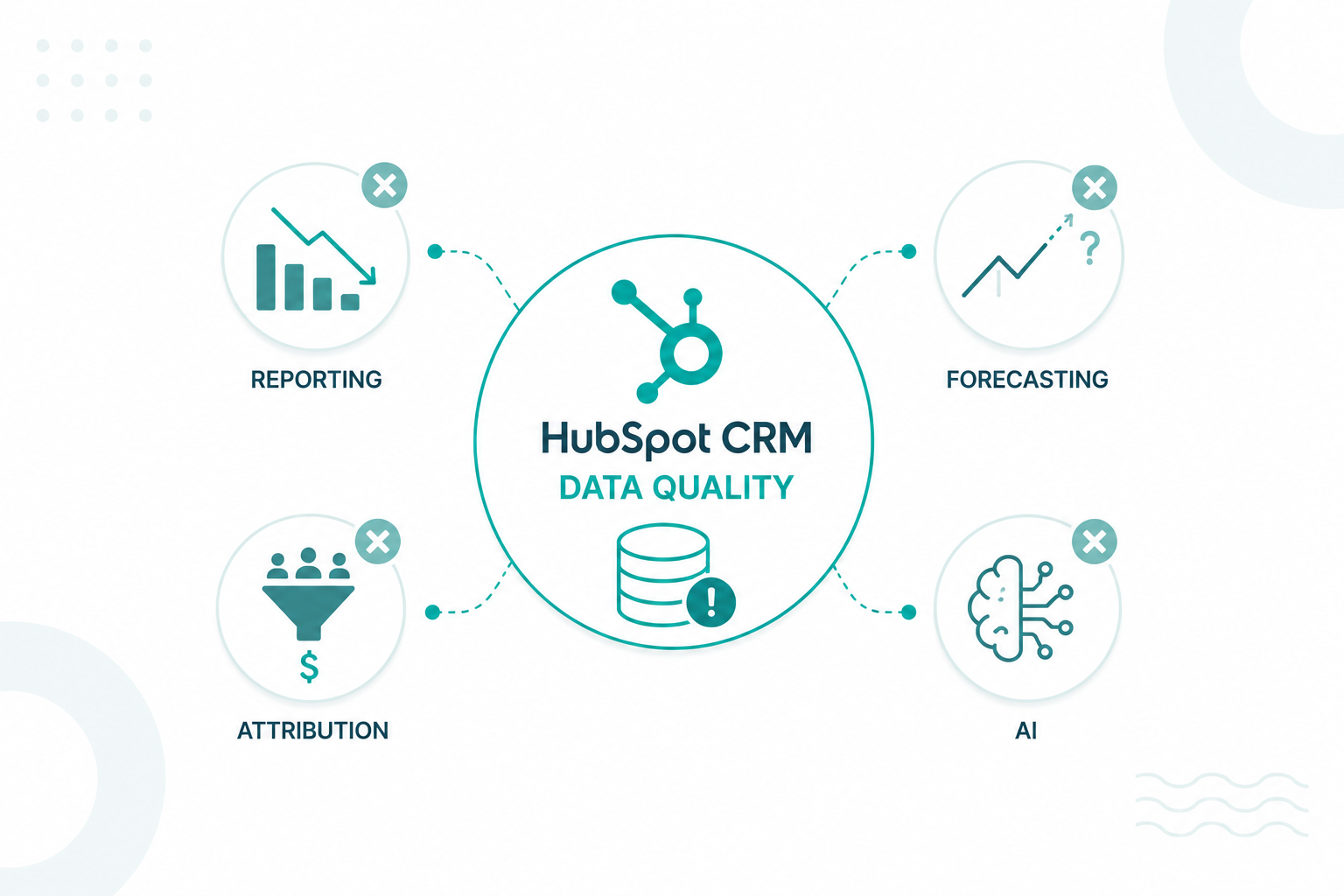
When teams adopt AI before their CRM is structurally ready, intelligence amplifies noise instead of improving decisions. AI relies on structured, reliable, contextual data, CRM architecture becomes the foundation. Without it, models lack the signals they need, automation misfires, and reporting loses credibility.
The priority isn’t just to turn on AI features in HubSpot, but to architect a system where AI can operate effectively and consistently.
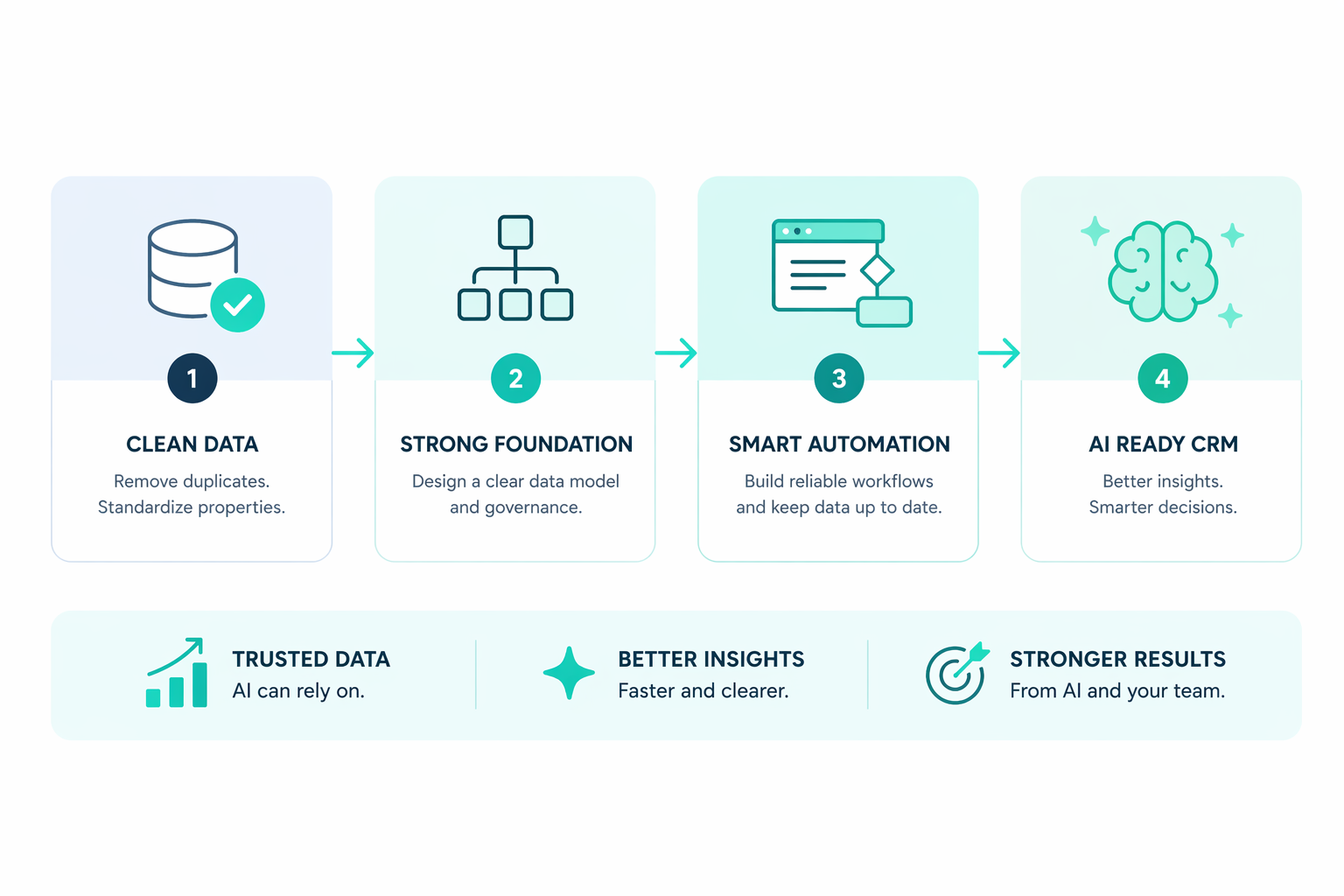
Preparing HubSpot for AI starts with a clean data foundation and a unified lifecycle model.
When these architectural elements are in place, an operational CRM can evolve into an intelligent CRM.
An AI-ready HubSpot environment features clean, standardized data structures, unified lifecycle definitions, well-defined object relationships, and reliable automation signals. In that context, AI can power predictive lead scoring, forecasting insights, intelligent segmentation, automated personalization, and increasingly sophisticated capabilities like AI-driven pipeline forecasting and dynamic journey orchestration.
AI will shape how revenue teams operate, but it will not replace CRM architecture—it depends on it.

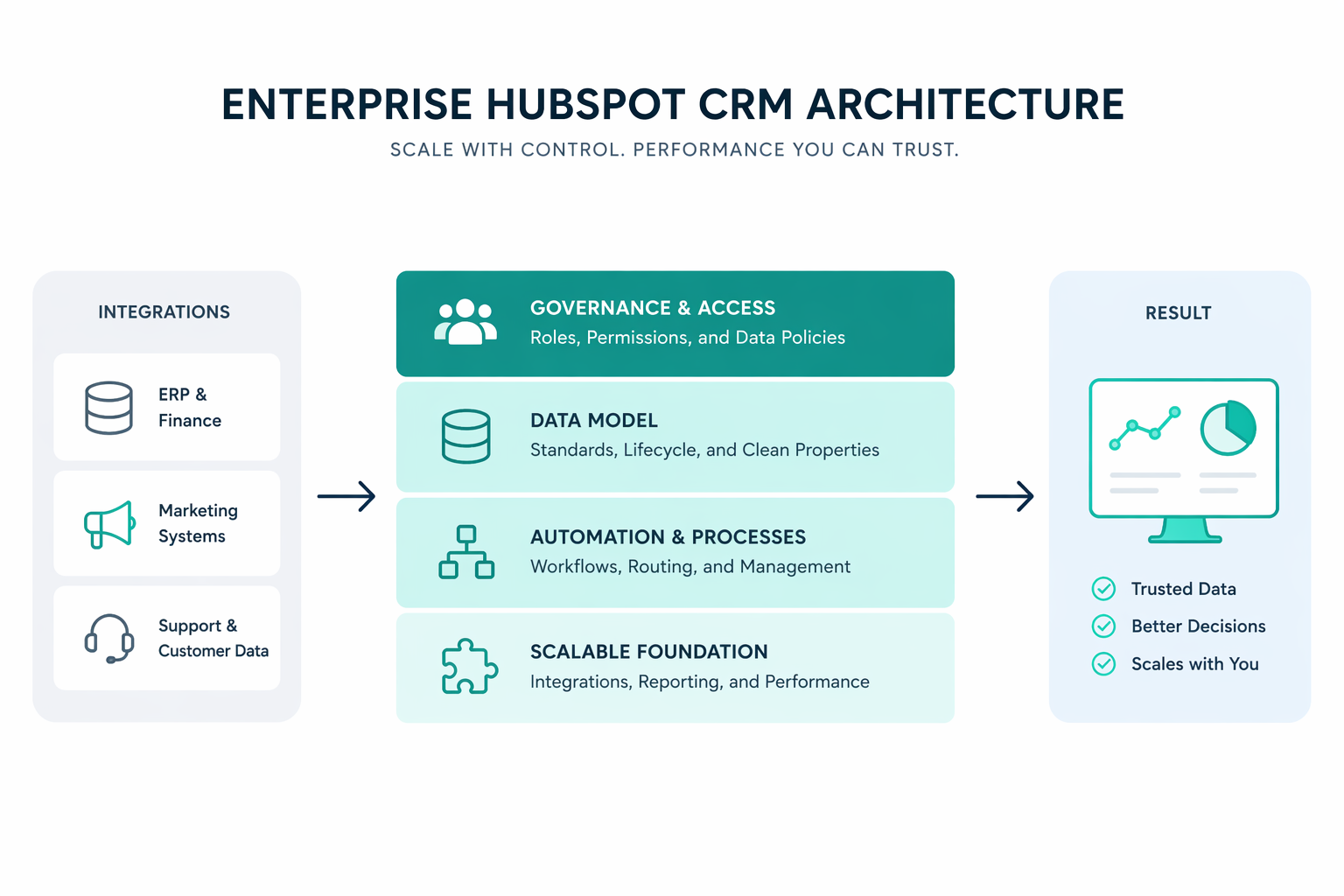
HubSpot should be viewed not only as a collection of tools, but as a data and lifecycle architecture platform at the center of your revenue ecosystem. For enterprise and upper mid-market teams, this distinction matters. When you treat HubSpot as architecture rather than software, the conversation shifts from “What features can we turn on?” to “What system do we need to run the business we’re building?”
When implemented strategically, HubSpot becomes the operational layer that underpins automation, reporting, and AI-driven intelligence across marketing, sales, and service. Every workflow, integration, and dashboard draws from the same governed data structures and lifecycle definitions. Instead of isolated campaigns and siloed objects, you get a connected environment where contact, company, deal, and ticket data all tell a coherent story about your customer journey.
This is especially critical in the context of AI. These tools are only as strong as the signals they receive. If HubSpot is architected as a true data and lifecycle platform—clean properties, unified lifecycle stages, reliable association logic—your AI models can drive meaningful outcomes: better predictions, smarter routing, more relevant personalization, and reporting leadership can actually trust.
The goal, then, is not simply to enable AI features inside HubSpot and hope for the best. The goal is to create an environment where AI can operate effectively and consistently over time. That means prioritizing architecture first: designing lifecycle frameworks, governing data, validating integrations, and aligning teams around the same definitions of “lead,” “customer,” and “opportunity.”
When you approach HubSpot this way, AI stops being a bolt-on experiment and starts functioning as a true intelligence layer on top of a stable system.
.png?width=900&height=600&name=CC%20Blog%20Images%20(1).png)
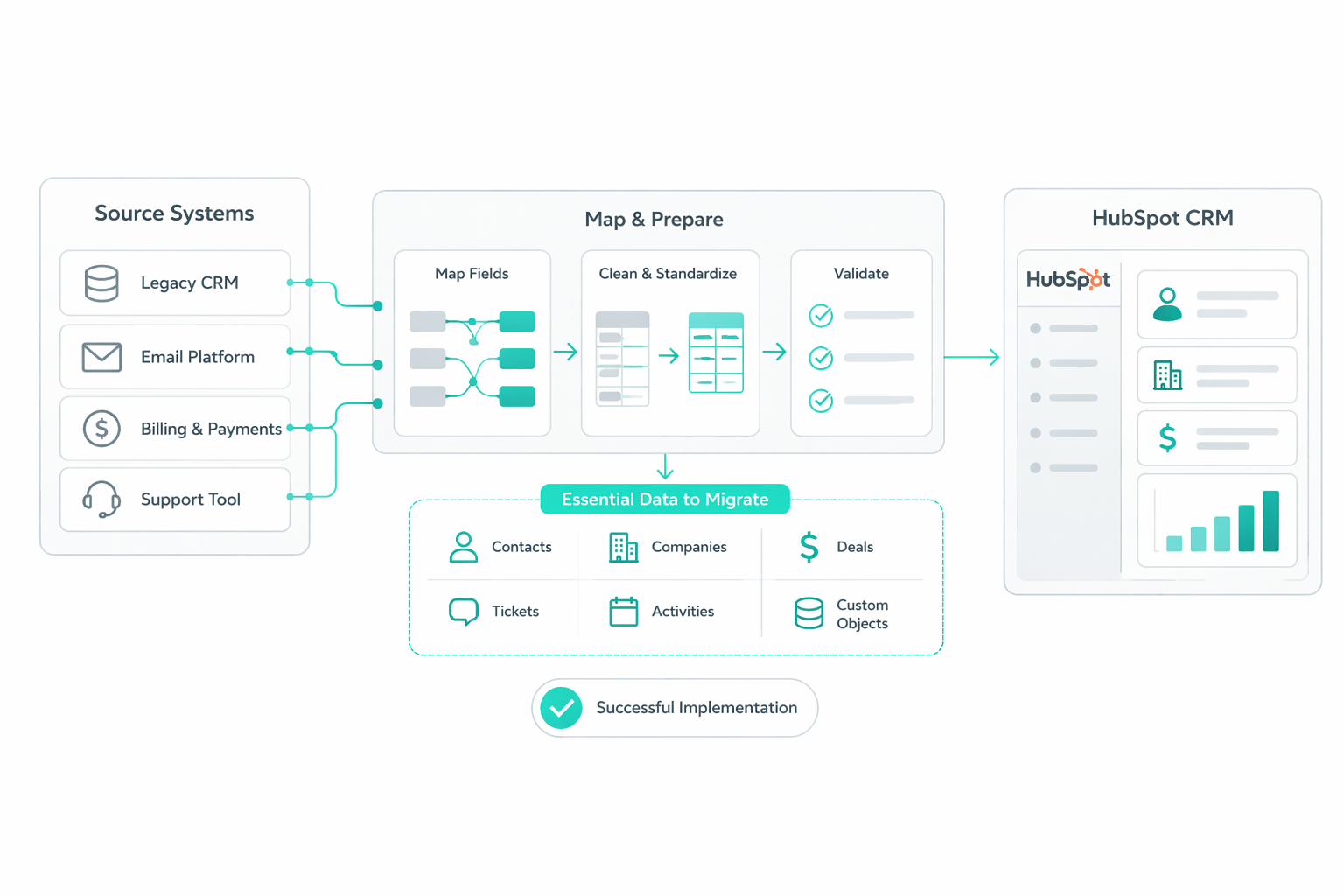
Start by standardizing your core CRM objects in HubSpot—contacts, companies, deals, and any required custom objects. Using Custom Objects, you can extend HubSpot’s standard data model to represent additional entities while maintaining consistent property structures across teams.
Align property definitions across marketing, sales, and service so everyone uses the same fields the same way. Put governance in place to control duplicates and property sprawl by implementing Property Validation Rules, which enforce formatting standards, required fields, and consistent naming conventions.
To maintain long-term data integrity, regularly monitor duplicate records using the Manage Duplicates Tool, which allows teams to identify and merge records based on email, domain, and other matching signals.
Together, these practices create reliable data signals that automation, reporting, and future AI models can depend on.
Align marketing, sales, and customer success around a shared lifecycle framework that everyone uses consistently.
In HubSpot, Lifecycle Stages provide a structured way to represent the customer journey—from lead to customer and beyond. These stages should reflect the real progression of customer relationships rather than internal departmental steps.
Establish clear, documented criteria for how contacts move between stages so that lifecycle progression is predictable and measurable. This alignment enables accurate attribution, improves reporting visibility, and creates reliable signals for automation and AI-driven insights.
AI becomes significantly more powerful when it understands how records relate to one another.
Use Object Associations to intentionally map relationships between contacts, companies, deals, and other entities within your CRM. When standard objects are not enough, Custom Objects can be introduced to represent more complex business relationships.
A strong relationship architecture should account for:
Designing these relationships carefully ensures AI models can interpret behavioral patterns, organizational context, and engagement signals with far greater accuracy.
Automation should reinforce clean data and structured lifecycle movement.
Using Workflows, teams can automate processes that maintain data quality, reduce manual errors, and create consistent operational signals across the CRM. When automation is designed around a well-structured data model and lifecycle framework, it continuously reinforces architectural consistency.
Examples of effective automation in an AI-ready HubSpot environment include:
By structuring automation around clean data and clear lifecycle movement, organizations create the reliable operational signals that AI models—and decision-makers—depend on.
Many organizations rush to implement AI tools without first addressing the underlying CRM architecture. When AI is treated as a standalone feature rather than an integrated system layer, it ends up amplifying existing problems instead of generating insight. In this scenario, models are trained on inconsistent, incomplete, or poorly structured data, which leads directly to inaccurate predictions, broken automation workflows, and unreliable reporting that leadership cannot trust. The issue isn’t the AI itself—it’s the lack of a stable, governed CRM foundation that AI can reliably sit on top of.
In parallel, a lot of teams over-customize their HubSpot instance in an attempt to “solve” complexity with more configuration. They create excessive custom properties, workflows, and objects without a clear governance model or long-term architecture in mind. Over time, this fragments the CRM into disconnected mini-systems. The impact shows up as data duplication, conflicting automation logic that’s hard to untangle, and a platform that becomes increasingly difficult to scale or adapt as the business evolves.
Another common failure pattern is misalignment on lifecycle definitions between marketing, sales, and customer success. When each team defines stages like “MQL,” “SQL,” “Opportunity,” or “Customer” differently—or uses them inconsistently—data quickly becomes unreliable. Automation built on top of those stages breaks, handoffs fall through the cracks, and AI models receive mixed signals about where a contact or account actually sits in the journey. The result is a system that looks sophisticated on paper but behaves unpredictably in practice.
Finally, many organizations attempt to automate their way out of operational problems without fixing the underlying process or data model. Automation, in this context, doesn’t solve the issue—it scales it. Flawed workflows route poorly qualified leads to sales, trigger campaigns based on incorrect lifecycle data, and propagate inaccurate or duplicate records across the CRM. Instead of creating leverage, automation multiplies inefficiency, making it harder to diagnose root causes and eroding trust in both the system and any AI layered on top.
.png?width=900&height=600&name=CC%20Blog%20Images%20(2).png)
As revenue teams scale, their CRM typically evolves through distinct stages of maturity. Early on, the focus is simply on getting everything into one place; over time, the priority shifts to automation, orchestration, and eventually intelligence. Understanding where you are on this spectrum is critical if you want AI initiatives to create leverage instead of chaos.
The shift from an automated CRM to a truly intelligent CRM is where most teams stumble—and where architecture becomes non‑negotiable. Moving into stage three requires more than turning on AI features; it demands clean data structures, unified lifecycle models, and trustworthy automation signals. When those foundations are in place, AI stops amplifying noise and starts amplifying clarity, giving leaders the confidence to make faster, more informed decisions.
An AI-ready CRM isn’t defined by how many features you’ve turned on; it’s defined by how reliably it can feed clean, contextual signals into your automation and AI models. When the underlying architecture is sound, every contact, company, deal, and interaction contributes to a coherent picture of the customer journey. That’s what allows AI to move beyond surface-level insights and start driving real revenue decisions.
An AI-ready CRM environment typically includes:
When these elements are in place, AI can do far more than generate generic recommendations. It can support:
The more intentionally you design these architectural elements, the less your team has to “fight” the system and the more your AI efforts compound over time. Instead of constantly cleaning up after misfires, you’re able to trust the signals in your CRM—and let automation and AI scale the strategies that work.
As AI capabilities mature, your CRM has the potential to become far more than a system of record—it can operate as the central intelligence layer for revenue operations. In that role, HubSpot doesn’t just store data; it continuously interprets signals across marketing, sales, and service to guide where your teams focus, how pipeline is managed, and which customers receive what experience next. This is the future many revenue leaders are aiming for, but it’s only achievable when the underlying architecture is clean, unified, and governed.
Future capabilities in an AI-driven CRM can include:
However, all of these outcomes are contingent on architectural readiness. Without clean data structures, unified lifecycle definitions, well-modeled relationships, and reliable automation signals, AI will amplify noise instead of clarity. The organizations that win in this future state won’t just be the ones who adopt the latest AI features—they’ll be the ones who invest in making their CRM a stable, governed system of intelligence first, so every new AI capability has a strong foundation to build on.
.png?width=900&height=600&name=CC%20Blog%20Images%20(3).png)
AI will increasingly shape how organizations operate, but it does not replace CRM architecture—it depends on it.
Organizations that treat CRM as a strategic system of intelligence rather than a simple database will gain the greatest advantage from AI.
Before implementing more tools, more automation, or more AI features, the most impactful step is often ensuring the CRM itself is architected to support intelligence.
When the foundation is sound, AI does not create chaos—it multiplies clarity.
Perfect data is unrealistic, but AI requires consistent and structured data to produce reliable outputs.
They can function, but their effectiveness is limited without a strong CRM foundation.
Preparation timelines vary, but establishing core architectural improvements often takes several months depending on system complexity.
No. Early architectural discipline helps smaller organizations scale without introducing complexity later.
Complexity is expensive. Clarity compounds. If there is one principle guiding high-performing growth systems in 2025, it’s that lifecycle clarity is...
It is an unfortunate fact that even in modern company culture, sales and customer service teams are often framed as independently functioning-- and...
Re-platforming your CRM is no small feat, especially when transitioning to a platform as robust and comprehensive as HubSpot. For enterprise...