






HubSpot Replatforming Strategy for Unified Systems
Why HubSpot Replatforming Feels Risky The Migration Fear That Creates Stalemate Executives rarely reject HubSpot because they doubt the platform. The...
I know what I am looking for, and would like to chat.
A team of data-driven marketers obsessed with generating revenue for our clients.
Because the proof is in the pudding.
At Campaign Creators we live by three principles: Autonomy, Mastery, Purpose.
8 min read
Campaign Creators
:
03/16/26
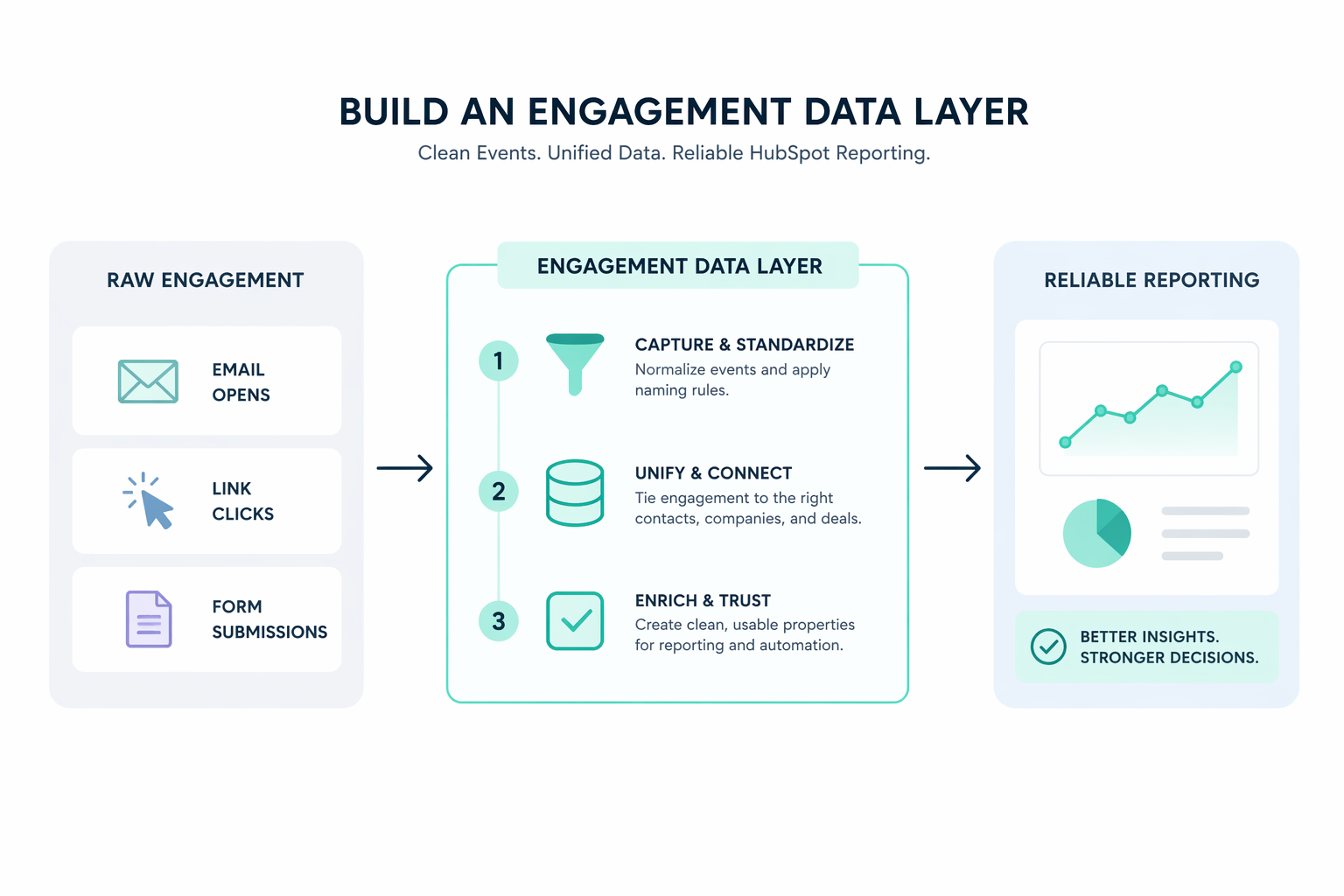
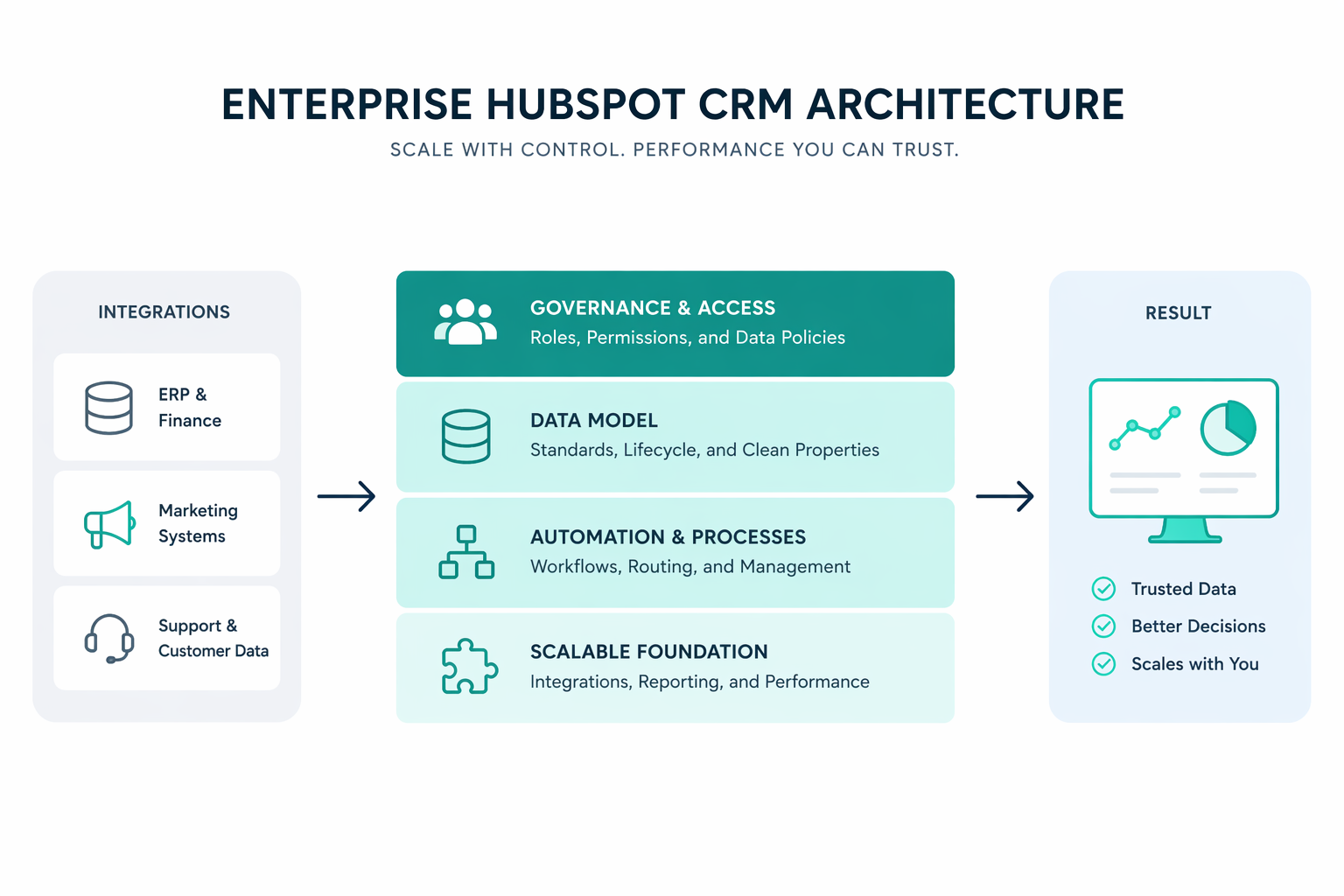
Consistent and accurate HubSpot reporting starts with the structure behind the dashboards. Attribution reports, lifecycle metrics, and pipeline analytics all depend on the engagement data layer that connects CRM records and activity across the platform.
This engagement data layer organizes events, properties, associations, and synchronization rules into a shared schema. As a result, marketing activity, sales pipeline data, and customer engagement signals connect to the same underlying data model.
That shared structure prevents reporting conflicts across dashboards because every system reads from the same definitions. Instead of reconciling different reports, teams gain a consistent view of pipeline activity, lifecycle progression, and customer engagement.
The sections below explain how to design this engagement data layer, so HubSpot reporting, workflows, and analytics operate on the same structured data foundation.

Alt Text: crm-analyst-reviewing-hubspot-reporting-dashboard
Teams often experience recurring reporting friction in CRM environments without a structured engagement data layer. Common signals include:
These issues appear because different systems interpret the same data fields in different ways.
For example, a marketing automation platform may assign Lead Source based on the first website interaction. A sales team may later update the same field during deal creation. If an integration then overwrites the property during synchronization, the CRM stores multiple interpretations of the same signal.
Reporting tools that reference this field produce different pipeline attribution results across dashboards.
Similar problems occur with lifecycle stages. One workflow may promote a contact to Marketing Qualified Lead after a form submission, while another process assigns the same stage during deal creation. Multiple systems controlling lifecycle progression create inconsistent stage transitions, which disrupts conversion reporting.
HubSpot Data Model Builder helps administrators visualize how objects, properties, and associations connect across the CRM environment. This view makes structural conflicts easier to identify during system design.
To open the Data Model Builder:
A structured engagement layer starts with the operational questions your CRM needs to answer. These questions determine how the data model should be designed.
Common questions include:
Clear answers to these questions guide the structure of the engagement data layer. Teams can then translate those requirements into standardized definitions through a CRM data dictionary.
A data dictionary documents the structure that governs how engagement data is stored and interpreted across the CRM environment. Rather than allowing teams to create fields independently, the dictionary provides shared definitions that ensure reporting consistency across marketing, sales, and operations.
A data dictionary usually includes several structural elements.
HubSpot’s data governance framework highlights similar practices that maintain consistent metrics across teams. Organizations centralize definitions, document field usage, and assign ownership to protect the integrity of reporting structures.
Standardized definitions create the structural rules that guide the engagement data layer. Once those definitions exist, the system architecture can reliably capture engagement signals and support consistent reporting across the CRM environment.
A HubSpot engagement layer combines four structural components: events, properties, associations, and synchronization rules. Together, these components determine how engagement activity enters the system, how it connects to CRM records, and how it moves between platforms.
Events capture meaningful behavioral signals across the customer lifecycle. HubSpot supports enrichment of event data with object property snapshots so reports preserve contextual information such as lifecycle stage, company attributes, or deal status at the moment the event occurs.
This makes it possible for teams to analyze engagement patterns with historical context. A form submission event, for example, can include the lifecycle stage and company size that existed when the submission occurred.
A structured event architecture typically focuses on milestone events. Typical events tracked inside engagement architectures include:
Engagement data becomes easier to analyze and connect to lifecycle progression when events represent meaningful moments within the customer journey,
Properties define the attributes that power segmentation, automation, and reporting. Because CRM systems evolve continuously as teams create new fields, property governance plays a central role in maintaining reporting consistency.
Without governance, CRM environments accumulate duplicate or conflicting properties that fragment reporting metrics.
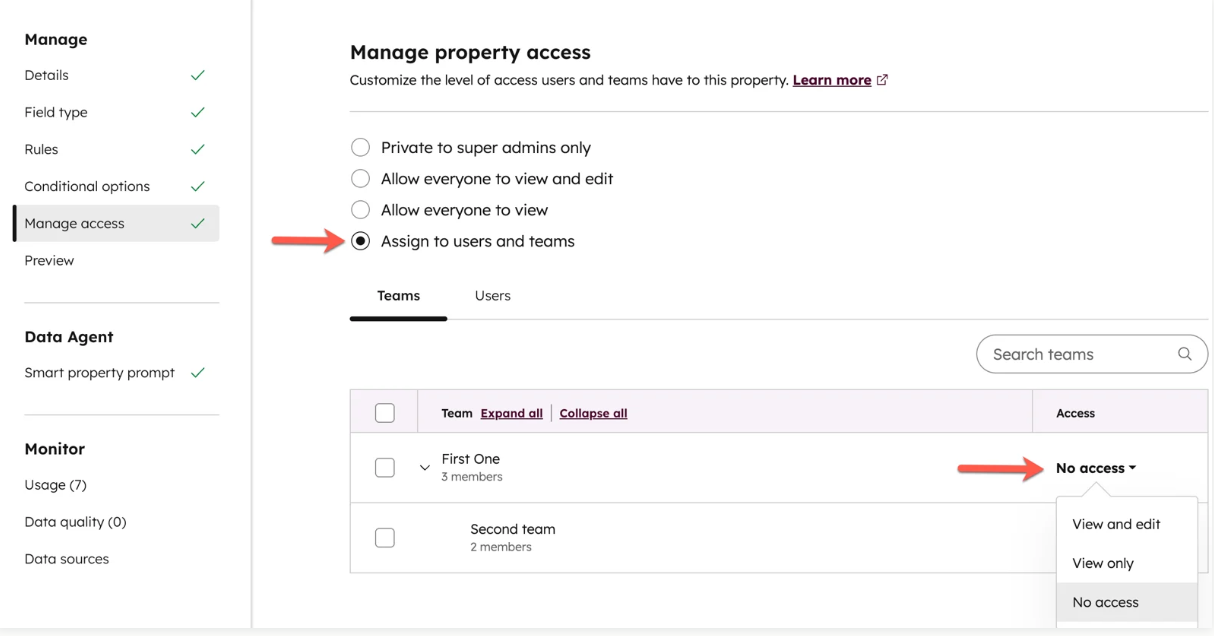
HubSpot enables administrators to restrict view and edit access for properties so that schema changes occur under controlled governance. To restrict view and edit access for existing properties:

Alt Text: manage-property-access-in-hubspot-crm
HubSpot also supports calculated stage properties that automatically track how long deals or contacts remain in specific stages. These properties standardize metrics such as sales cycle duration or lifecycle velocity across reports.
Governed properties preserve consistent metrics across dashboards and prevent schema fragmentation.
Associations define how records connect across CRM objects. These relationships enable engagement signals, revenue activity, and stakeholder interactions to connect across records.
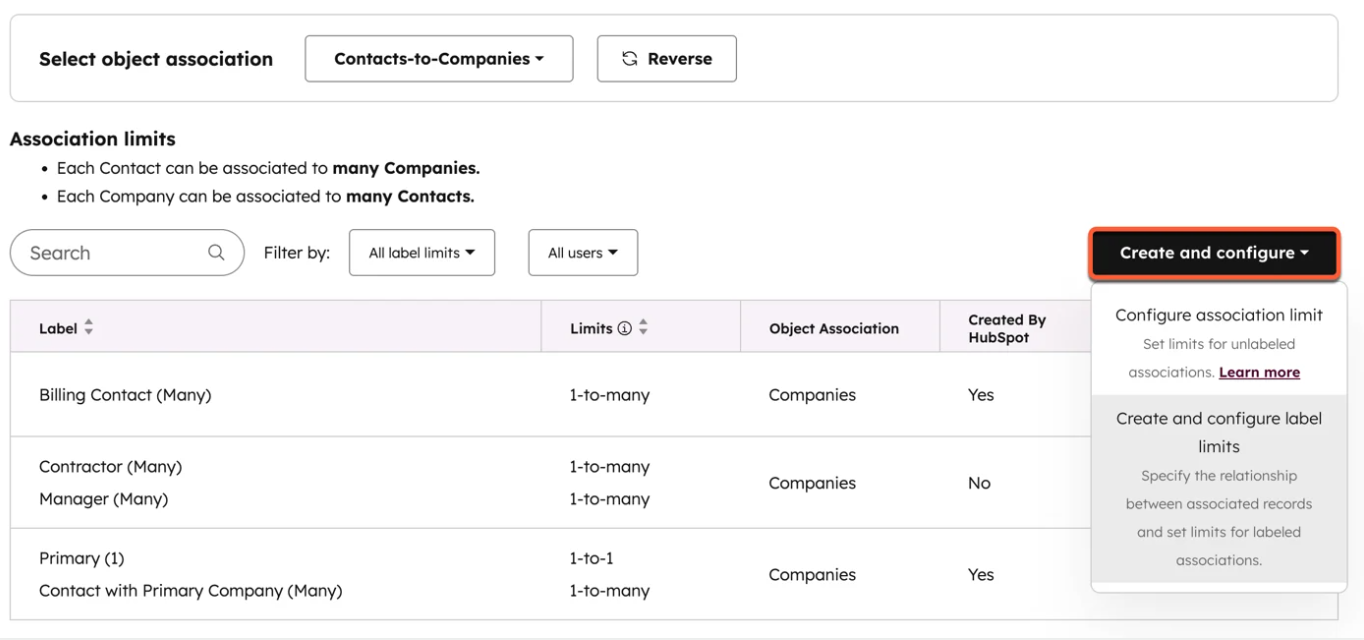
HubSpot’s association label system helps administrators to define labels and apply them to relationships between contacts, companies, and deals.
To create association labels in HubSpot:

Alt Text: create-association-labels-in-hubspot-crm
HubSpot also supports buying groups that organize stakeholders into structured purchasing committees within the CRM environment. Buying groups provide visibility into which roles participate in each deal across accounts.
This supports teams to track stakeholder influence across the revenue process and understand how engagement spreads across buying committees.
Most revenue operations environments include multiple platforms alongside HubSpot, including marketing automation tools, analytics platforms, data warehouses, and customer support systems. For these environments to operate effectively, engagement data must remain synchronized across systems.
Operations Hub provides Data Sync functionality that connects these platforms and maintains consistent data across integrations.
Data Sync configuration typically includes several steps:
Through this, HubSpot operates as the engagement hub that centralizes behavioral activity, whereas external warehouses or analytics platforms maintain historical datasets and advanced modeling.
HubSpot’s AI Data Agent analyzes CRM activity to generate insights and summarize account behavior using structured data such as lifecycle stages, deal progression, and engagement events. These systems cannot generate meaningful analysis without consistent underlying data.
Clean engagement layers provide the signals that enable reliable AI interpretation:
AI systems can analyze engagement patterns across accounts and pipeline stages when these elements remain structured and consistently defined. This improves automation reliability and accelerates operational insight across the CRM environment.
Once the engagement layer operates consistently across the CRM environment, it enables a coordinated operational model across revenue teams.
Unification begins with shared structure: one schema, one glossary, and one identity model across the CRM environment. Lifecycle stages, engagement events, and stakeholder relationships follow the same definitions across teams and systems.
Integrations that send engagement signals into this shared structure transform HubSpot into a single engagement record. The CRM then reflects a consistent view of where the pipeline originates and how accounts progress through lifecycle stages.
The impact of this alignment is measurable. Research from HubSpot shows that organizations using integrated tools and coordinated processes report stronger marketing ROI and faster revenue cycle times in the State of Marketing 2026 report. In contrast, research from Gartner estimates that poor data quality costs organizations an average of $12.9 million per year, often due to inconsistent definitions and fragmented systems.
A unified engagement layer removes much of that cost because every team reads from the same structured data foundation.
Lifecycle transitions, engagement milestones, and account events trigger workflows, task routing, and messaging that align teams around the same customer context.
For example:
These operational signals help marketing, sales, and customer teams respond to the same engagement data in real time. Instead of manually interpreting reports, the CRM communicates lifecycle progress directly through automated workflows.
Clean engagement data supports automation systems that analyze patterns across accounts and pipeline stages. Tools such as HubSpot AI Data Agent use structured CRM signals to summarize account activity, highlight opportunities, and identify operational risks.
Structured engagement data also improves the accuracy of:
These capabilities improve as the engagement layer becomes more structured and consistent across the CRM environment.
Organizations that rebuild their CRM architecture with governance often see operational improvements quickly. Internal benchmarks show that 98% report clearer pipeline visibility within 90 days after restructuring their data model and engagement event library.
“Migration isn’t about moving data, it’s about aligning people, process, and performance.”
This perspective reflects a core principle of CRM architecture: complexity is expensive, but clarity compounds.
If you want to operationalize this architecture, start with a Portal Audit Checklist to evaluate your current data model, establish governance through HubSpot Onboarding Services, and maintain continuous optimization through a Modular Retainer that supports the engagement framework over time.
A well-structured engagement data layer turns HubSpot from a collection of activity logs into a system that explains how customers move through your revenue process. When the structure is clear, your reports stop raising questions and start helping you make decisions.
This makes it easier for you to understand what actually drives pipeline and revenue. You can see where deals start, which stakeholders influence decisions, and which engagement signals move contacts through lifecycle stages.
That same structure also supports long-term system stability. As your CRM evolves, new tools and integrations can operate on the same data framework without introducing conflicting metrics.
An engagement data layer in HubSpot refers to the structured way the CRM stores and connects customer interactions, records, and attributes across objects such as contacts, companies, and deals.
The main components of the HubSpot CRM data model are objects, records, properties, and associations. Objects represent entities such as contacts or deals, records store individual entries, properties store the data fields on those records, and associations connect related records across objects.
You should create custom objects when your business needs to track data or relationships that do not fit within HubSpot’s standard objects, like contacts, companies, deals, or tickets. Custom objects help you to define new entities with their own properties and associations to model business-specific processes or datasets.
Integrations affect the engagement data layer because external systems can create, update, or sync CRM records and properties across platforms. When integrations update the same objects, properties, or associations, they directly influence how engagement data is stored and interpreted in HubSpot reporting.
Businesses typically track engagement events such as emails, calls, meetings, messages, and other recorded activities associated with CRM records. These activities represent interactions between the business and contacts or companies and help provide a history of engagement across the customer relationship.
Why HubSpot Replatforming Feels Risky The Migration Fear That Creates Stalemate Executives rarely reject HubSpot because they doubt the platform. The...
Artificial Intelligence (AI) is redefining the marketing world in ways few could have imagined just a decade ago. We're living in an era of...
Many HubSpot CRM environments grow as more teams begin using the system. Marketing adds contacts, sales builds pipelines, service teams manage...