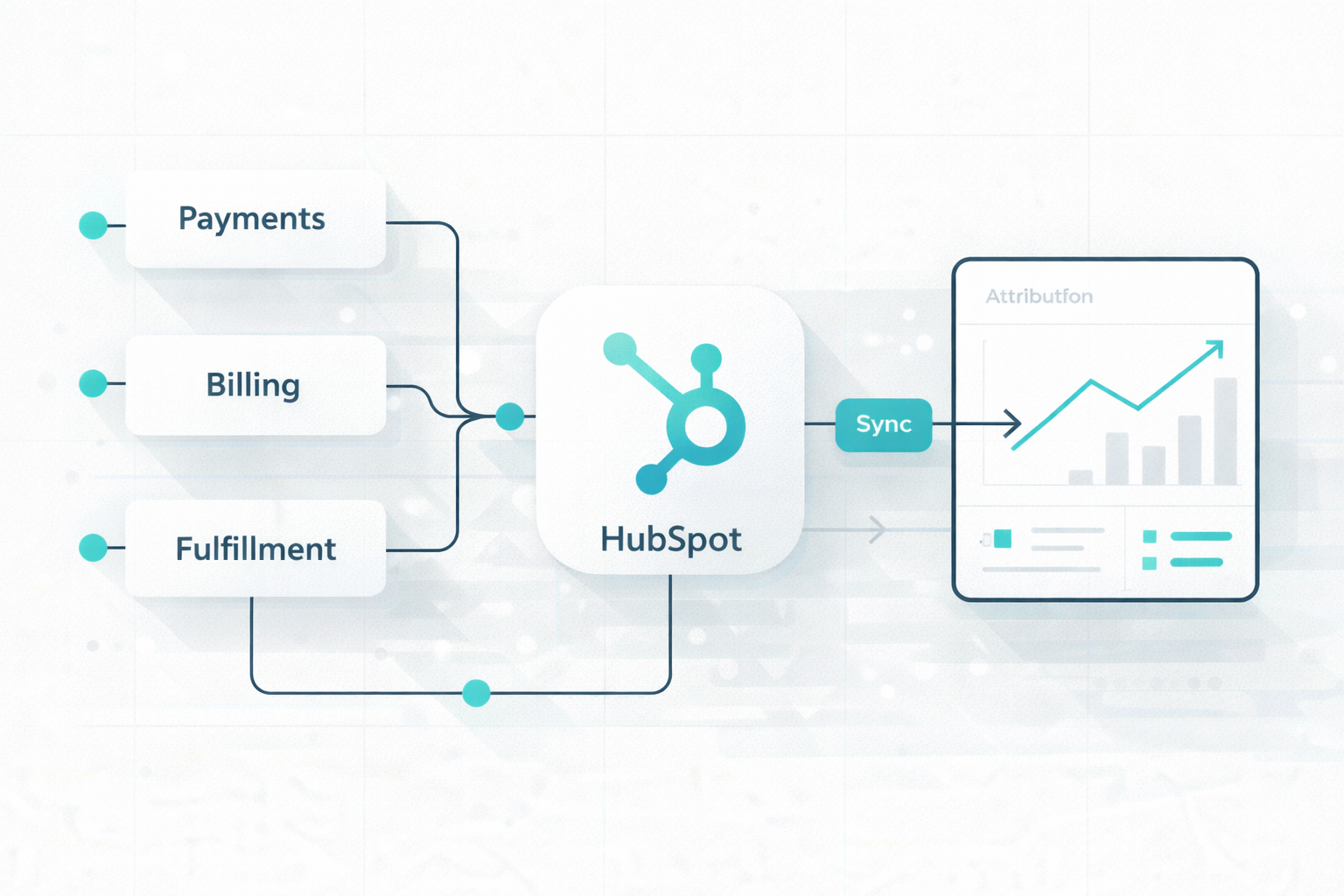







HubSpot Integration Architecture for Payments, Billing, and Fulfillment Systems
The modern enterprise tech stack has shifted from a single system to a mix of specialized SaaS tools. That shift creates a problem: CRM, payments,...
I know what I am looking for, and would like to chat.
A team of data-driven marketers obsessed with generating revenue for our clients.
Because the proof is in the pudding.
At Campaign Creators we live by three principles: Autonomy, Mastery, Purpose.

The subscription economy moves fast and depends on accuracy, yet many organizations still operate with siloed finance data and disconnected quote-to-cash processes. When billing is separate from the CRM, sales teams lack visibility into payment status. This leads to delayed revenue and a poor customer experience.
Revenue leaders need to connect these systems so front-office and back-office operations work together, creating a more predictable growth path.
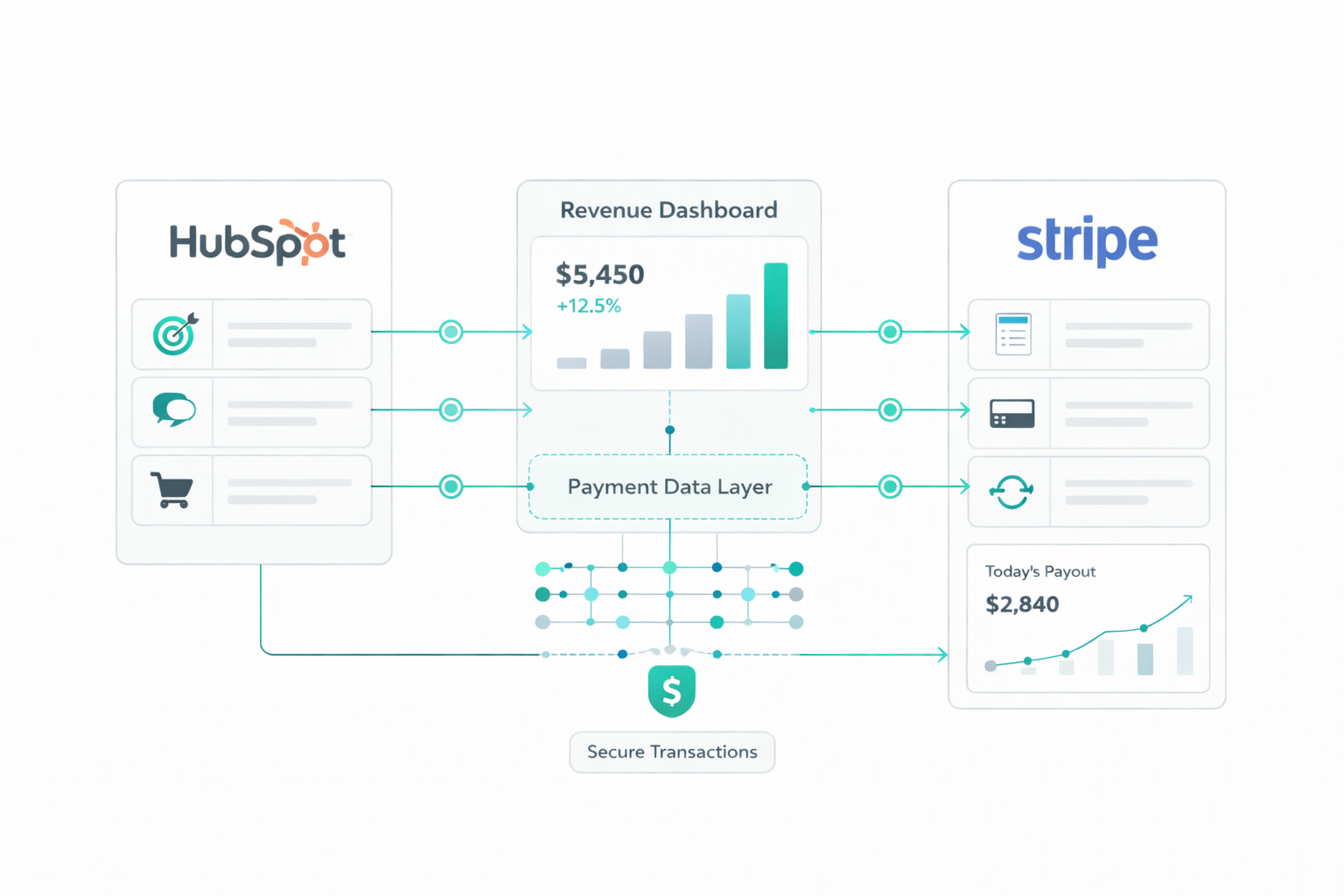
Integrating Stripe and HubSpot provides a unified source of truth by connecting customer acquisition directly with financial execution. This replaces manual handoffs with technically enforced workflows that automate the entire subscription lifecycle, from initial invoice creation to failed payment recovery.
The HubSpot Stripe integration provides revenue leaders with the tools needed to scale recurring revenue operations with precision.

The integration creates a direct bridge that eliminates data gaps between the CRM, billing, and finance systems.
It ensures that every transaction, subscription, and invoice lives in the environment where sales and finance teams already perform their daily work. Leaders no longer need to reconcile separate system exports because pipeline and payment data exist in a unified manner.
Automation shortens billing cycles and improves time-to-value by streamlining the quote-to-cash process. Sales representatives can generate branded quotes and embed Stripe payment links dynamically, which enables customers to pay immediately upon approval.
It removes manual handoffs between sales and finance, as "Closed Won" deals in HubSpot can automatically trigger subscription creation or invoice generation in Stripe. This reduces operational overhead and prevents revenue leakage caused by missed updates or manual entry errors, an issue that can cost companies up to 5% of earnings.
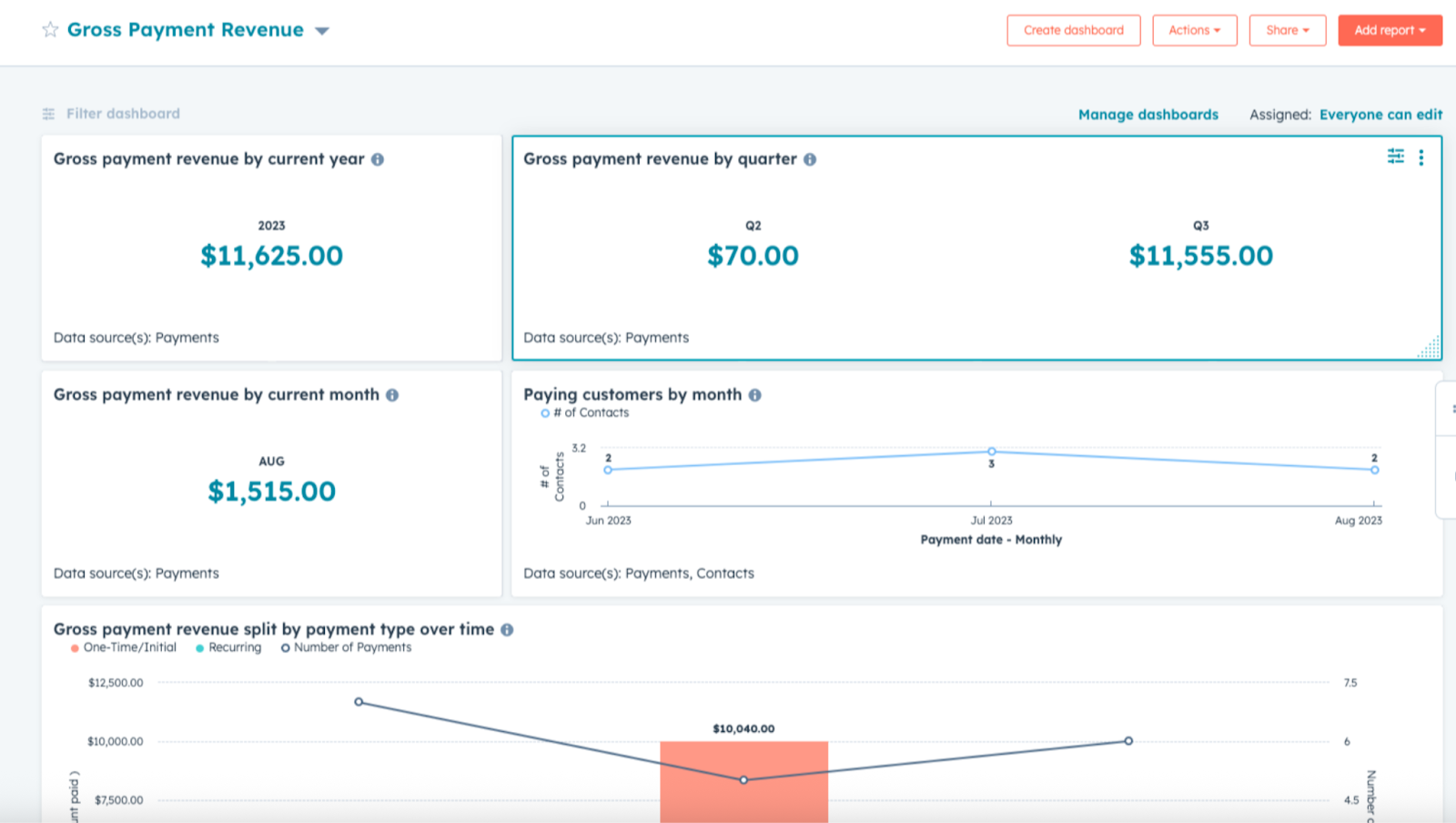
Connecting these platforms gives you clear insight into pipeline-to-cash conversion and expected growth. You can track MRR, ARR, gross payment revenue, and collection rates alongside marketing and sales KPIs in one place.

Gross payment revenue shows the total payments processed before refunds, disputes, or fees. This helps you see actual cash flow, not just booked or projected revenue.
With shared visibility, you can monitor customer health and renewal risk in real time. Standardized data also supports metrics like NRR and GRR directly inside the CRM, giving you a full view of revenue performance from collection to retention.
Stripe and HubSpot integration enables teams to automate critical touchpoints from initial acquisition through long-term expansion. This ensures that every department operates with a financial context and removes the operational friction that typically slows down growth.
Sales representatives can generate branded quotes directly in HubSpot that embed dynamic Stripe payment links, enabling customers to pay via credit card, ACH, or digital wallets immediately upon approval.
When a deal moves to Closed Won, HubSpot workflows can automatically trigger the creation of a subscription or invoice in Stripe. Throughout the process, reps maintain full visibility into payment status, failed charges, or outstanding balances directly on the contact timeline, ensuring they never walk into a call without knowing an account's financial standing.
Furthermore, automation handles complex billing updates, such as plan upgrades, by capturing sales-side changes in HubSpot and instantly reflecting them in Stripe for accurate proration.
Marketing teams leverage live billing data to move beyond generic outreach and deliver hyper-personalized experiences. Marketers can segment contact lists based on actual revenue metrics, such as current MRR, subscription tier, or purchase behavior, to fuel highly targeted campaigns.
Successful payments can automatically enroll contacts into tailored welcome sequences or onboarding pipelines, ensuring a seamless post-purchase journey. Conversely, the system can technically enforce cross-functional coordination; for instance, marketing can automatically pause upsell campaigns if a customer has an active failed payment or is struggling in the onboarding stage.
For accounts that have churned, the integration powers automated win-back sequences triggered the moment a subscription status changes in Stripe.
By syncing Stripe subscription states with HubSpot deal stages, finance teams gain real-time visibility into pipeline-to-cash conversion and collection rates. Automation also improves forecasting accuracy by accounting for renewals, upgrades, and mid-cycle downgrades as they happen.
Standardizing churn logging, including required churn reasons, within HubSpot creates a clean feedback loop for leadership to understand the root causes of revenue loss.
RevOps must choose a path based on whether they prioritize speed to deployment, billing flexibility, or data complexity.
The native connection offers two distinct pathways depending on which system serves as the primary engine for commerce.

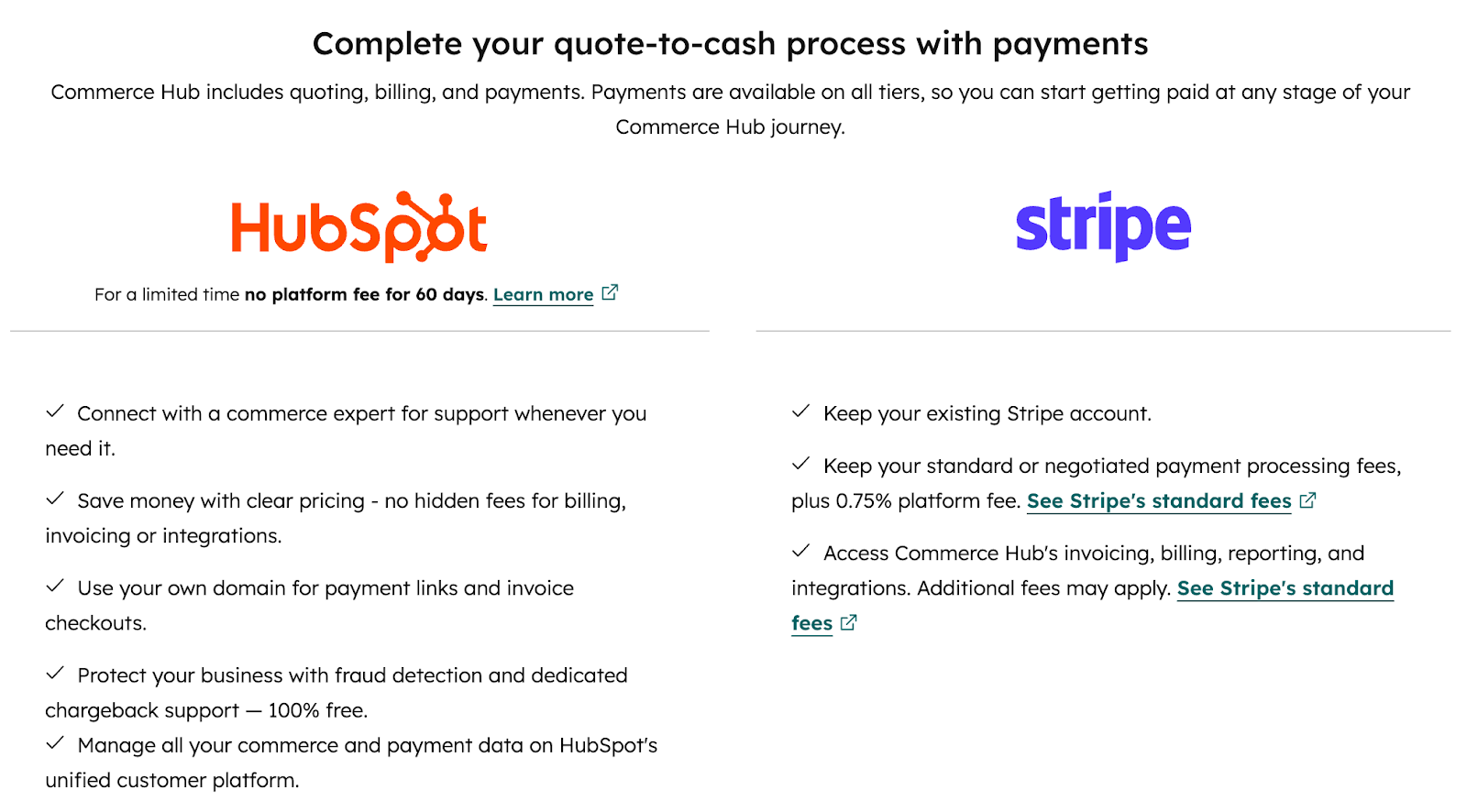
HubSpot Commerce Hub positions the CRM as the source of truth for all commerce activity, utilizing Stripe purely as a secure payment gateway for transactions. In this model, HubSpot manages the subscription lifecycle, meaning Stripe does not generate its own subscription or invoice objects.
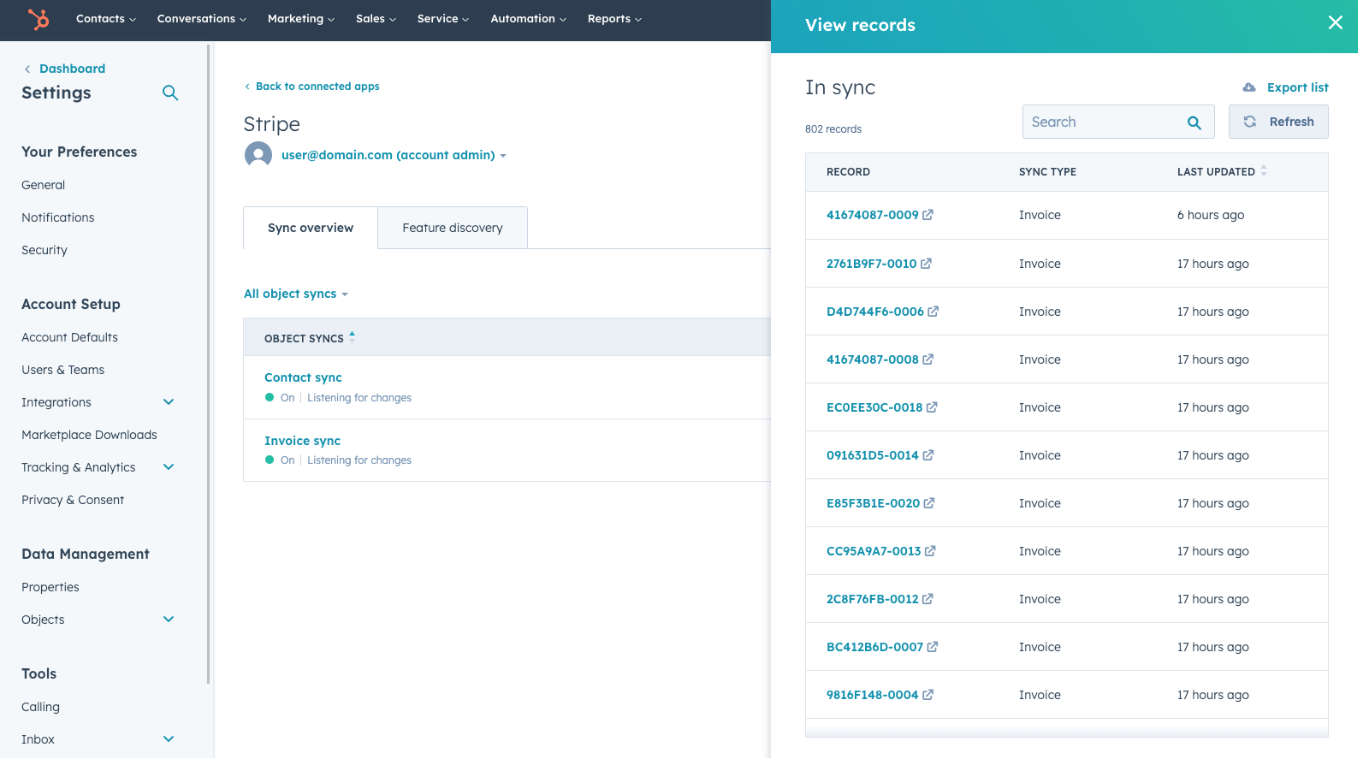
Data Sync integration functions as a connector that pulls existing Stripe customer records and payment history into HubSpot. This pathway preserves Stripe as the billing system of record while providing sales teams with financial context directly on the contact timeline.
Use Commerce Hub to centralize billing and subscription management within the CRM, and choose Data Sync when mirroring complex billing data already established in Stripe.
Third-party automation platforms serve as a bridge for custom workflows that native connectors do not currently support. These tools synchronize deal and contact data by responding to specific Stripe Webhooks or HubSpot API triggers.
Revenue teams often employ these tools to address gaps in data mapping for custom deal properties or to associate Stripe data with HubSpot company records. Despite their flexibility, these platforms often encounter reliability issues when scaling beyond 500 to 1,000 customers.
Use these tools for simple, low-volume tasks or to prototype specific workflow logic before investing in a more robust architecture.

Advanced architectures utilize HubSpot Data Hub to act as a central nervous system, pulling data from external warehouses or proprietary applications into unified customer records. This design prevents CRM bloat by keeping heavy analytical data in a warehouse while syncing only critical operational data into HubSpot.
Specialized middleware applications also provide deep synchronization specifically for SaaS companies, tracking upgrades, downgrades, and proration with built-in MRR reporting. These platforms provide a scalable way to handle historical data migrations that native tools cannot perform.
Custom API-based integrations are purpose-built solutions that provide complete control over data transformations and business logic. This becomes necessary when a company uses custom objects for complex business processes, creating data relationships that standard connectors cannot recognize.
Custom development is essential for enterprise environments with multi-supplier vendor management, legacy system replacements, or specific industry compliance needs. While this method requires higher upfront investment and ongoing technical maintenance, it results in a more stable environment for high-volume operations.
Use custom integrations when the organization must technically enforce sophisticated revenue models that exceed standard field mapping capabilities.
This stage defines how revenue enters the system and ensures that every closed deal is ready for billing before anything is created in Stripe.
When a deal reaches “Closed Won,” it does not immediately trigger billing. Instead, the system evaluates whether the deal is complete and structured correctly. Several required conditions must be met before the workflow continues:
If any of these conditions are missing or inconsistent, the workflow stops. The deal remains in its current stage until the required data is completed. This prevents incomplete or incorrect billing from being created.
Once validated, billing is created based on the deal structure:
Each line item is mapped directly to Stripe, which ensures that the pricing in HubSpot matches what is billed. There is no need for manual adjustments after the deal is closed.
Quotes act as a control layer before billing. After approval, pricing and structure are locked. This prevents changes that could create discrepancies between what was sold and what gets invoiced.
After billing is created in Stripe, payment data flows back into HubSpot. Invoice status, balances, and transaction history are updated at the deal and company level. This gives full visibility into revenue without switching systems.
Without this structure, issues tend to appear, such as deals marked as won but never billed, duplicate customer records, or invoices that do not match the agreed pricing.
Once billing is active, the system shifts to maintaining alignment between subscription data in Stripe and customer records in HubSpot.
Every subscription created in Stripe is tied to deal records and lifecycle stages in HubSpot. When a subscription becomes active, the customer lifecycle updates automatically. If a subscription is paused, canceled, or marked as past due, those changes are reflected in HubSpot at the same time.
Plan changes are initiated from HubSpot, not Stripe. When a deal is updated to reflect an upgrade, downgrade, or contract change, that update syncs to Stripe and adjusts the subscription. Pricing, billing frequency, and contract terms are updated without manual intervention.
Renewals are handled proactively. Before a contract ends, the system generates renewal deals using current subscription data, including pricing and billing structure. This keeps the pipeline accurate and avoids last-minute tracking.
Failed payments follow a defined recovery process. When Stripe marks a subscription as past due, it triggers actions in HubSpot, such as:
Operational events such as refunds, disputes, and cancellations are also synced back into HubSpot. These updates adjust deal values and lifecycle stages so that account records reflect the current state of the subscription.
Without this alignment, subscription data and customer status drift apart, making renewals harder to manage and increasing the risk of missed churn signals.
This stage focuses on how billing and subscription data are used to drive customer engagement and internal prioritization. Key revenue and subscription properties are synced from Stripe into HubSpot, including:
These properties update continuously and act as the foundation for segmentation. Examples of segmentation include:
These segments update automatically as soon as the underlying data changes. Billing events also act as triggers for engagement. A successful payment can initiate onboarding steps, product activation, or upsell signals. A failed payment can pause marketing communication and shift the customer into a recovery flow.
Each team works from the same dataset:
This alignment prevents conflicting messaging and ensures that every interaction reflects the customer’s current financial relationship with the business.
This layer defines how the system maintains data quality and prevents errors from entering the workflow.
Each platform has a clear role:
To keep both systems aligned, key fields are standardized and required before actions can proceed. These include:
This approach keeps the dataset clean and reliable as the system scales.
The final stage connects all parts of the system into a continuous feedback loop, using real billing and subscription data to improve decision-making.
Revenue data from Stripe flows back into HubSpot and updates key metrics in real time, including:
Churn is tracked using structured fields such as reason codes and timing. This allows patterns to be analyzed across different segments, including plan type, contract length, and acquisition source.
Expansion signals are also captured. Indicators such as increased usage, plan upgrades, or approaching limits can trigger workflows that:
Forecasting becomes more accurate because it reflects both pipeline activity and active subscription changes. Instead of relying only on projected deals, forecasts adjust based on actual billing behavior and contract updates.
Over time, this creates a system that improves through usage. Data feeds back into workflows, segmentation becomes more refined, and teams make better decisions based on real customer behavior.
Once your workflow is in place, performance depends on how consistently revenue moves from pipeline to cash and how it grows or contracts over time. These metrics help you understand where your system may be breaking or performing well.
With these metrics, you can directly link performance changes to specific parts of your system, whether it is deal validation, billing execution, or lifecycle management.
Executing a successful integration requires a phased approach that prioritizes data integrity and strategic alignment.
Organizations must first identify the critical metrics required to measure growth and financial health. Leaders should prioritize investor-grade KPIs such as Monthly Recurring Revenue, Annual Recurring Revenue, and Net Revenue Retention.
Defining these metrics early ensures that the system is configured to capture the necessary data points for automated reporting. This stage also involves establishing the requirements for Sales Velocity metrics, including lead volume, conversion rates, and the time spent in each sales stage.
Teams must decide which platform serves as the single source of truth for specific data, typically positioning HubSpot for customer relationship management and Stripe for financial execution.
Detailed mapping should link HubSpot Deals and line items with Stripe Subscriptions, while ensuring Stripe Invoices and payment events sync back to HubSpot contact timelines. Leaders must also identify if custom objects are necessary to manage complex SaaS relationships, such as renewals and health tracking, that standard objects cannot accommodate.
Selecting the appropriate architecture depends on the complexity of the organization's billing model and its requirement for speed to deployment. HubSpot Commerce Hub positions the CRM as the billing engine, utilizing Stripe purely as a secure payment gateway. While the Stripe Data Sync path preserves Stripe as the billing system of record.
For enterprise environments with highly specific data transformations or custom object relationships, custom API-based integrations or specialized middleware may be required.
Automation provides the ability to eliminate manual handoffs and prevent revenue leakage. Revenue teams should configure triggers that automatically create Stripe subscriptions once a HubSpot deal moves to "Closed Won".
It is equally critical to build dunning sequences that initiate the moment a Stripe payment fails, enrolling the contact in a personalized recovery workflow within HubSpot. Further automation should handle subscription lifecycle events, such as auto-creating renewal deals on a set schedule or triggering win-back sequences when a cancellation is scheduled.
Before rolling out the system fully, teams should validate everything within a sandbox environment where workflows, integration logic, and permissions can be tested without affecting live data. This includes running transactions across different payment methods, confirming that proration and mid-cycle plan changes accurately reflect in MRR, and ensuring that refunds or disputes correctly update deal values in the CRM.
Ongoing monitoring then becomes part of the process, with data health dashboards used to catch duplicate records, sync failures, or inconsistencies early, helping maintain reliable and consistent revenue data over time.
When HubSpot and Stripe are connected, revenue starts becoming a live signal you can act on. You’re no longer guessing which deals will actually turn into cash or where friction exists between “Closed Won” and payment. Instead, you see exactly where revenue stalls, accelerates, or leaks.
The integration becomes a control layer that ensures every deal is billable, every payment updates the system, and every team operates from the same financial truth. That’s how you move from reporting on revenue to shaping how it’s generated, collected, and retained.
If you need help setting this up, our HubSpot Integration Services focus on getting the structure right so your data, workflows, and billing stay aligned as you scale.
No. HubSpot only allows one Stripe account per portal, which affects how you structure multi-brand or multi-entity setup.
It depends on your architecture. HubSpot Commerce Hub centralizes billing, but Stripe-led setups keep subscriptions native in Stripe.
Yes. Transaction data, payment status, and records sync back to HubSpot for visibility and workflows.
You need enforced deduplication rules and consistent use of unique identifiers like Stripe customer IDs.
They sync back as payment events, but how they affect reporting depends on your workflow setup.
The modern enterprise tech stack has shifted from a single system to a mix of specialized SaaS tools. That shift creates a problem: CRM, payments,...
Why HubSpot Replatforming Feels Risky The Migration Fear That Creates Stalemate Executives rarely reject HubSpot because they doubt the platform. The...
Marketing teams are expected to generate a pipeline faster and prove revenue impact. At the same time, many teams still rely on manual processes that...