






I know what I am looking for, and would like to chat.

A team of data-driven marketers obsessed with generating revenue for our clients.

Because the proof is in the pudding.

At Campaign Creators we live by three principles: Autonomy, Mastery, Purpose.

8 min read

Data Contracts in HubSpot: Fix Property Sprawl and CRM Data Drift

Data Contracts in HubSpot: Fix Property Sprawl and CRM Data Drift

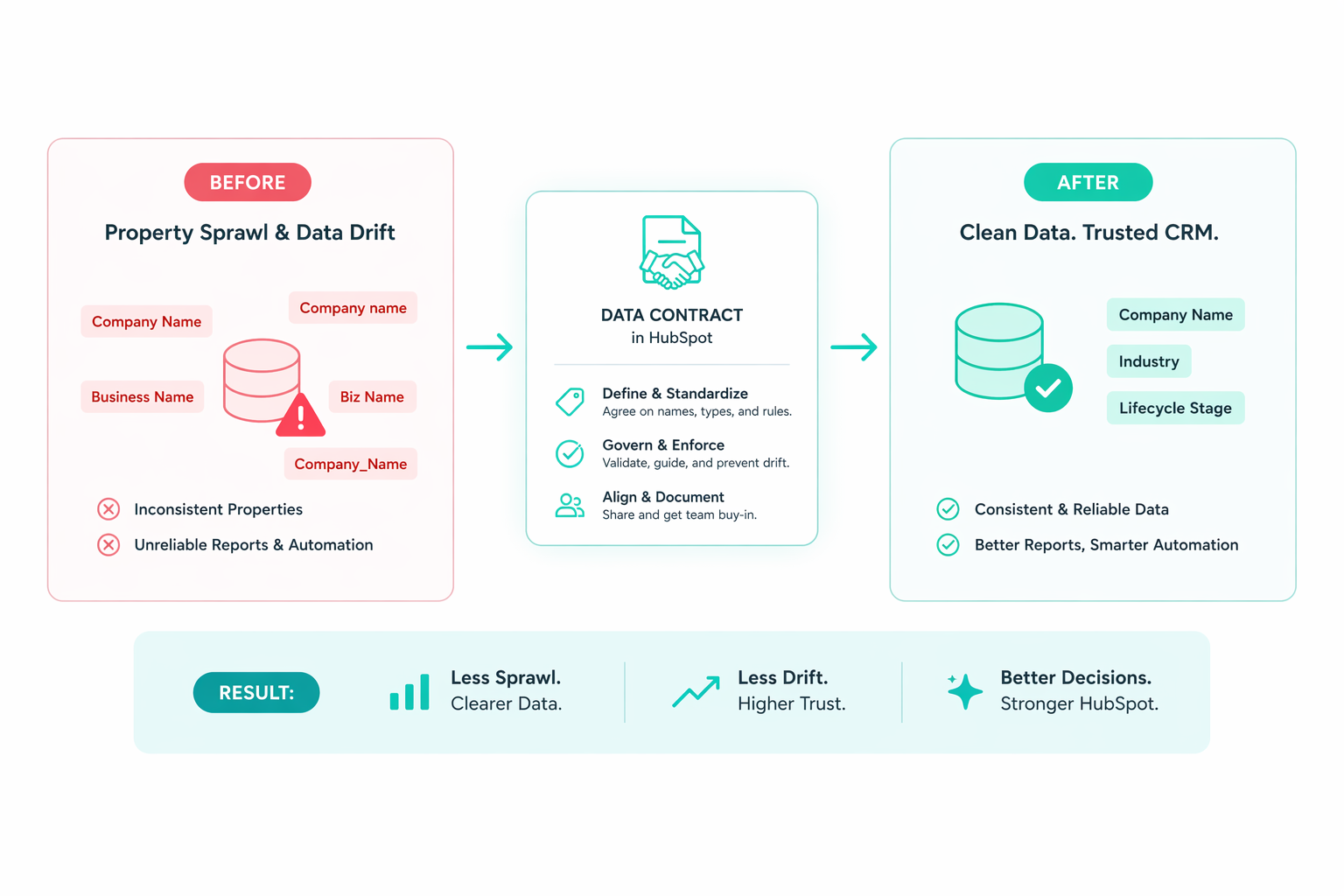
Most CRM environments evolve without a defined schema strategy. Teams create properties to solve immediate problems, integrations introduce new fields, and lifecycle updates rely on manual edits or loosely defined workflows. Eventually, the meaning of core fields begins to drift. The same metric can represent different things depending on the property referenced or the team interpreting it.

This is where data contracts become valuable. A data contract defines how a piece of data should behave across systems. It establishes the structure of the field, the meaning behind the value, the system responsible for maintaining it, and the rules that determine when that value can change.

In HubSpot, these contracts are defined by property definitions, validation rules, lifecycle workflows, and integration policies that control how records are created and updated.

The Cost of Property Sprawl

woman-reviewing-duplicate-properties-in-hubspot-crm

Properties are often created as different teams add fields to solve immediate needs. This growth leads to property sprawl, where the CRM schema becomes difficult to manage.

Several issues begin to appear:

  • Duplicate properties that track the same information but use slightly different definitions
  • Dropdown fields with inconsistent values
  • Multiple interpretations of lifecycle stages
  • Segments or reports that stop working correctly

Most properties begin with a reasonable purpose. Marketing may add a field to track campaign sources. Sales operations may introduce a qualification property for pipeline reporting. An integration may automatically create additional fields when it connects to the CRM.

These additions rarely create problems on their own. The difficulty appears when they occur without coordination. As properties accumulate, the same concept begins to appear in multiple places with slightly different meanings.

At that point, the schema becomes fragmented. Multiple fields begin describing the same concept, each with slightly different definitions. Once this happens, the CRM no longer operates on a single, shared data structure.

Why Data Governance Matters

Governance defines the rules that determine how data is created, updated, and used across the system. These rules often include:

  • Clear naming standards for properties

  • Defined ownership for each field

  • Documentation explaining how properties should be used

  • Data quality controls that prevent inconsistent values

These problems appear when property governance is not maintained:

  • Conflicting Funnel Definitions: Sales and marketing may begin using different definitions for funnel stages. One team might mark a contact as qualified after a form submission. Another team might require a discovery call. Once definitions differ, pipeline metrics lose credibility.
  • Analysts Spend Time Fixing Data: They often end up carrying the operational burden. Instead of analyzing trends or identifying opportunities, they spend hours cleaning datasets, merging duplicate properties, and checking lifecycle assignments before creating reports.
  • Leadership Loses Confidence in Reporting: Meetings that should focus on growth strategy or pipeline development often shift toward reconciling numbers. Leaders begin questioning whether reports reflect actual performance or inconsistent data definitions.

Research highlights how expensive these problems can become. Gartner estimates that poor data quality costs organizations $12.9 million per year on average, often through lost productivity, delayed decisions, and missed revenue opportunities.

Strong governance removes much of this operational friction. When the data schema clearly defines how information should be created and maintained, everyone works from the same structure.

How to Implement CRM Data Governance

1. Start With Meaning

Governance begins with a clear definition of the properties that describe your business. Your canonical schema should define properties that represent:

  • Ideal customer profile (ICP)
  • Segmentation attributes
  • Buying roles
  • Intent signals
  • Lifecycle proof points

A canonical schema gives the organization a shared vocabulary. Reporting becomes easier to interpret, and automation behaves more predictably when marketing, sales, and operations refer to the same definitions.

2. Create a Canonical Data Dictionary

For each critical property, document:

  • Purpose
  • Owner
  • Allowed values
  • System of record
  • Where the property is populated (form, integration, workflow)

A property owner should maintain the definition of the field, manage approved data sources, and determine how updates occur when multiple integrations write to the same field.

3. Standardize and Simplify the Model

Governance also involves reducing unnecessary complexity in the CRM schema. Schema simplification consolidates overlapping fields so each concept appears only once in the system.

What you need to do:

  • Archiving duplicate or redundant properties that no longer support active workflows
  • Normalizing picklists so a single concept has one consistent label
  • Consolidating fields that represent the same idea across multiple objects
  • Renaming properties to match clear naming conventions

These changes reduce confusion for users entering or reviewing data. Workflows and integrations perform more consistently when they reference a single authoritative property instead of several variations of the same field.

Architecture decisions made at the schema level ultimately determine how reliable analytics becomes. A simpler schema produces cleaner segmentation, more stable workflows, and clearer reporting.

A practical starting point is to baseline the current structure of your portal. The Portal Audit Checklist helps identify duplicate properties, inconsistent lifecycle definitions, and unused fields that often accumulate over time. Governance guardrails can then be established during HubSpot Onboarding Services, ensuring the CRM schema remains stable as the system grows.

Once the property schema is governed, the next layer of CRM governance focuses on identity.

Identity Governance Process in the CRM

Identity governance establishes clear rules that determine how CRM records relate to each other. This ensures teams operate from consistent customer profiles.

Define How Records Relate

Governance should clearly define how records connect across the CRM. Common identity controls include:

  • Deduplicating contacts at entry points
  • Normalizing company naming conventions
  • Establishing association rules between contacts, companies, deals, and tickets

These controls support effective customer data management, which focuses on organizing customer information so that every team works from a unified profile. When identifiers become fragmented, segmentation and reporting begin to break down because the CRM can no longer determine which record represents the true customer relationship.

Organize Identity Around Accounts and Buying Roles

Once identity relationships are defined, organizations can structure the CRM to support account-level engagement. In many organizations:

  • Companies serve as the anchor for account-level strategy
  • Contacts carry labeled buying roles
  • Association labels define relationships such as decision maker, evaluator, or champion

This improves coordination across teams.

Govern How Data Enters and Changes

Centralizing customer data increases visibility across marketing, sales, and service teams. However, these benefits appear only when governance controls how data enters and moves through the system.

For example, a marketing automation tool may update lead source properties, a sales integration may write new company details, and enrichment tools may update firmographic attributes. Without defined rules, these updates can change records unpredictably.

This often creates several operational issues:

  • Sales representatives receive leads with incomplete or conflicting information
  • Marketing segments contacts using outdated attributes
  • Reports produce inconsistent results depending on which fields are referenced

Governance frameworks reduce these risks through standardized identifiers, deduplication processes, and defined property ownership. Each critical field should have a clearly defined system of record and an overwrite policy. Integrations then follow these rules instead of modifying data without control.

How Lifecycle Governance Works in HubSpot

Effective lifecycle governance focuses on three areas: defining lifecycle concepts, configuring stages to match the customer journey, and establishing clear rules for stage progression.

Lifecycle Stage vs Lead Status

Many organizations mix lifecycle stage and lead status even though they represent different parts of the customer journey. If used interchangeably, funnel reporting and automation logic often become inconsistent because relationship progression and sales activity are recorded in the same field.

  • Lifecycle Stage describes the relationship between a contact and the business. It reflects where a person sits in the overall customer lifecycle, such as subscriber, lead, marketing qualified lead, sales qualified lead, opportunity, or customer.
  • Lead Status describes the current state of sales engagement. It captures the sales team’s interaction with the lead, such as new, open, in progress, connected, or unqualified.

Keeping these properties separate preserves a clearer view of funnel movement. Lifecycle stage shows how contacts progress through the customer journey, while lead status reflects the ongoing sales activity associated with that contact.

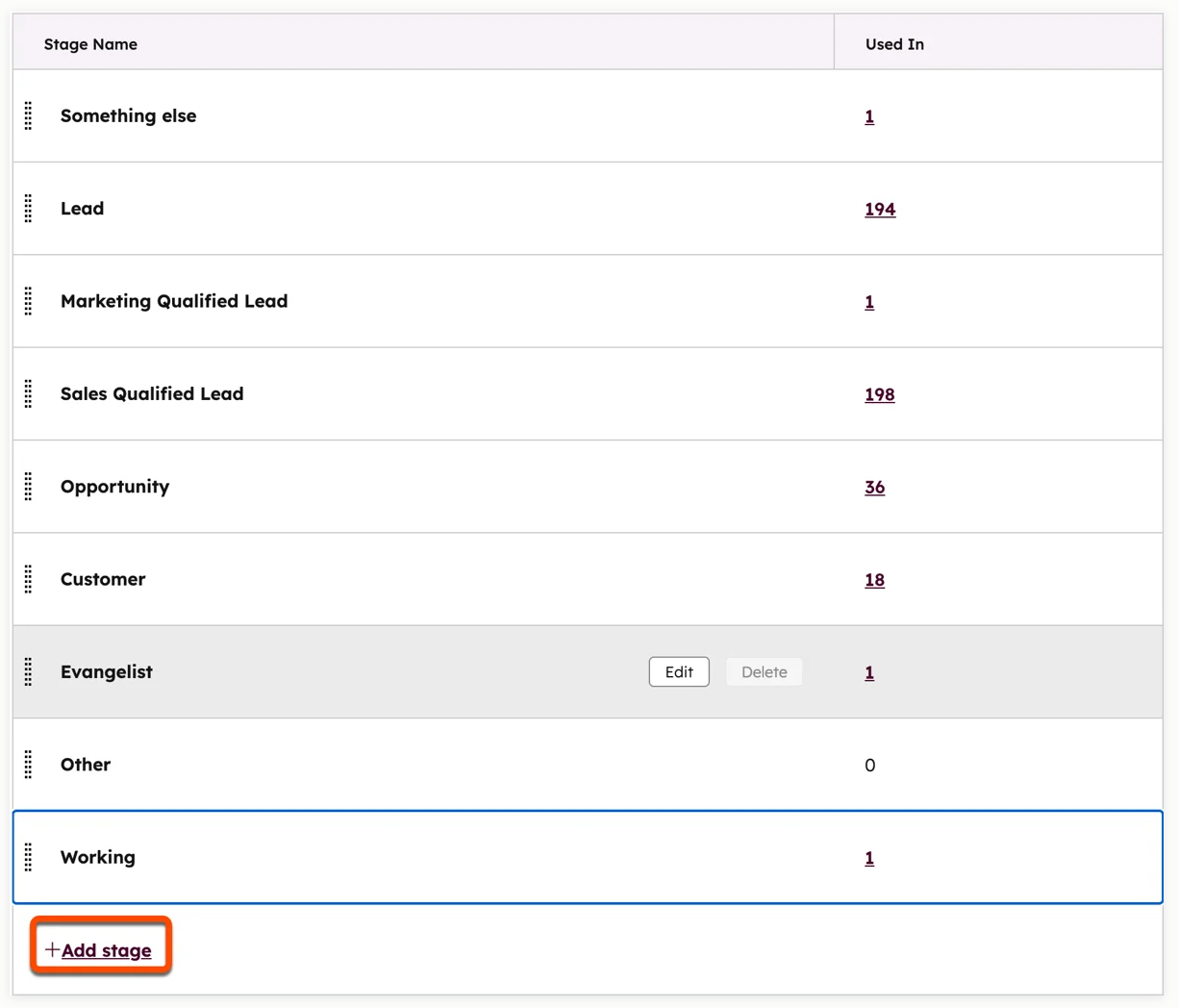
Setting Up Lifecycle Stages in HubSpot

HubSpot makes it possible for teams to customize stages when the default funnel does not match the business model.

To create or edit lifecycle stages for contacts or companies:

  1. In your HubSpot account, click the Settings icon in the top navigation bar.

  2. In the left sidebar menu, go to Objects and select Contacts (or Companies if you want to configure stages for company records).

  3. Open the Lifecycle Stage tab.
    lifecycle-stage-tab-in-hubspot
  4. Click Add stage.

  5. In the right panel, enter a name for the new stage.
  6. To edit a stage, hover over a stage and click Edit. In the dialog box, click Confirm, enter the updated name in the right panel, then click Edit lifecycle stage.

Require Proof at Stage Transitions

Lifecycle changes should be supported by evidence rather than manual updates.

Without defined proof requirements, lifecycle progression often becomes subjective. Sales representatives may update stages based on expectations rather than confirmed activity, which leads to inflated funnel metrics and unreliable conversion analysis.

Governed lifecycle models define clear proof points that represent meaningful engagement or qualification milestones.

Examples include:

  • A discovery meeting is scheduled with a sales representative
  • A qualified opportunity created in the pipeline
  • A signed agreement or contract
  • A product trial activation or onboarding milestone

Behavioral signals can also act as lifecycle proof points. Engagement events such as pricing page visits, product usage milestones, or high-intent form submissions may trigger lifecycle progression when they represent genuine buying signals.

Mapping these events to lifecycle transitions ensures funnel reporting reflects actual customer movement through the pipeline.

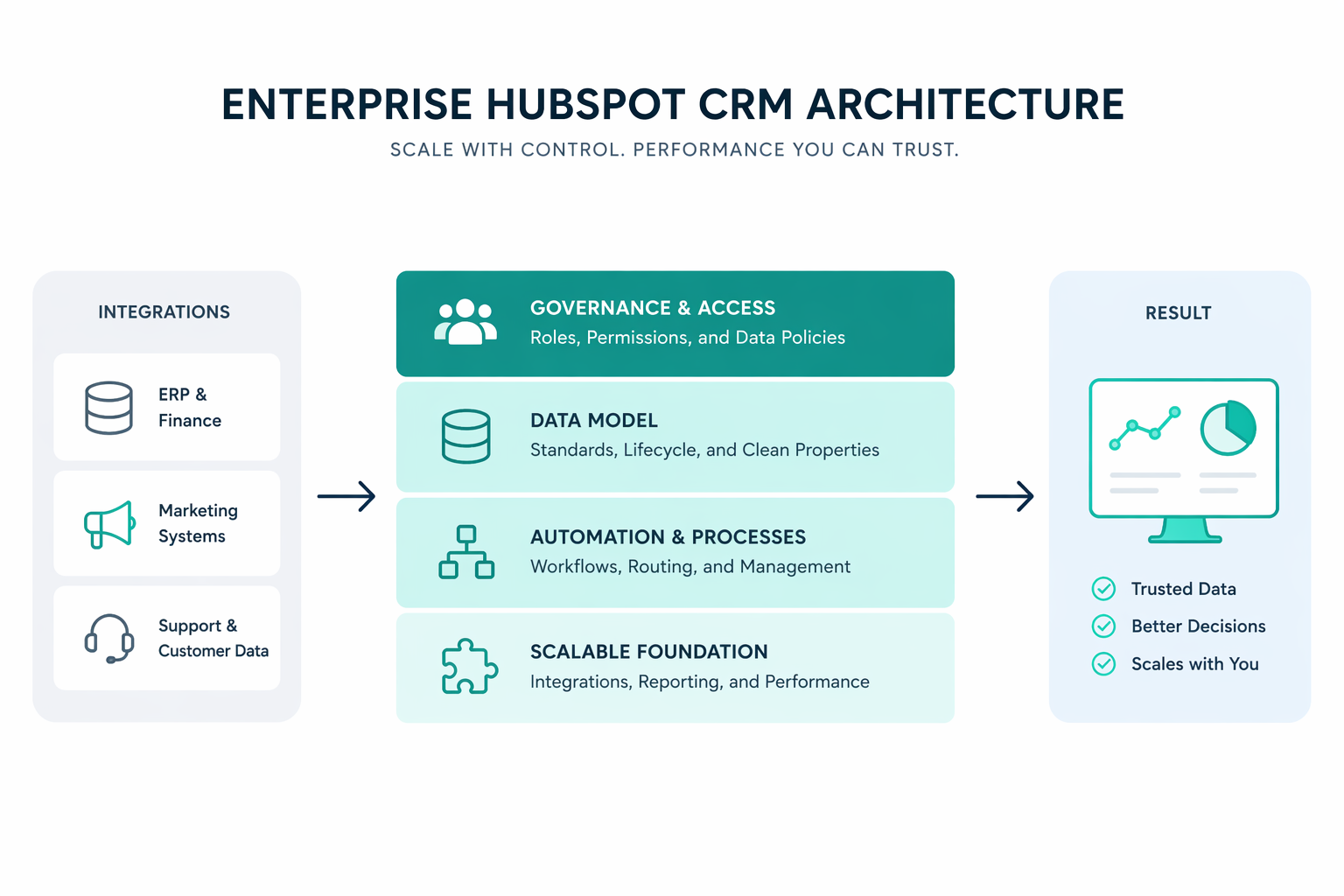
The Integration Architecture for Governed CRM Data

Unify → Communicate → Automate with AI

Governance becomes powerful once it drives system integration. In practice, integration follows three operational stages.

Unified Data Model

Integration begins with a shared schema across the core CRM objects:

  • Contacts
  • Companies
  • Deals
  • Tickets

Lifecycle definitions, segmentation properties, and key identifiers should remain consistent across these objects. This unified perspective improves collaboration and decision-making because customer data is synchronized across tools rather than stored in disconnected silos.

Lifecycle-Aware Automation

Once the data model is consistent, automation can operate with greater precision. Governed properties and lifecycle stages create stable signals that workflows can rely on. Automation rules can reference these signals to trigger communication, task assignments, and operational processes.

Examples include:

  • Lifecycle-stage nurture campaigns that introduce prospects to relevant product information based on their level of buying intent
  • Service-level agreement timers that notify sales representatives when new leads require follow-up
  • Role-specific outreach sequences targeting decision makers, evaluators, or champions within an account

Lifecycle stages also support deeper funnel analysis. Organizations can track how contacts move between stages, identify conversion bottlenecks, and evaluate which marketing programs generate qualified opportunities. Automation becomes more effective when these lifecycle signals remain consistent across the CRM.

AI-Driven Automation

Once CRM governance stabilizes the data model, advanced capabilities such as AI become far more reliable. AI systems rely on historical patterns in CRM data to generate predictions, insights, and recommendations.

Common AI applications in CRM environments include:

  • Predictive lead scoring that identifies high-intent prospects
  • Automated sales call summaries and activity analysis
  • Anomaly detection that identifies unusual data patterns or operational issues

These capabilities depend on consistent signals within the CRM. Governance keeps lifecycle stages, engagement activity, and property values structured. This enables AI systems to interpret the data more accurately and produce reliable insights.

The Business Case for Data Contracts

Organizations that operate with governed data models often experience measurable operational improvements, including:

  • Reduced duplicate records
  • Higher property completion rates
  • Faster response times for sales engagement
  • Clearer funnel metrics and pipeline visibility

Research supports this relationship between process discipline and performance. Gartner estimates poor data quality costs organizations $12.9 million annually.

Our benchmark across implementations shows 98% of clients improve pipeline visibility within 90 days after introducing a governed property model.

Data contracts transform CRM data from a collection of fields into a reliable foundation for forecasting, automation, and revenue decisions.

Building a HubSpot CRM You Can Depend On!

Data contracts align three elements inside the CRM: people, process, and technology. They define how data enters the system, who maintains it, and which signals automation and analytics can rely on. When these rules are clear, your CRM begins to reflect how your business actually sells and supports customers, not just how data happens to enter the system.

Migration alone does not create better reporting. Many organizations expect new tools or integrations to fix visibility problems, but reliable analytics appear only once the underlying schema is governed. Clear property definitions, lifecycle rules, and ownership remove ambiguity across teams and stabilize automation. Eventually, that clarity carries through every report, workflow, and decision.

To keep that structure intact as your system grows, governance needs regular attention. Our Modular Retainer supports this work through quarterly schema reviews and monthly instrumentation sprints.

Explore how we turn HubSpot into a performance engine!

Frequently Asked Questions

1. Which HubSpot properties should always have a defined system of record?

Properties that drive reporting, segmentation, and automation should always have a defined system of record. These typically include lifecycle stage, lead source, ICP attributes, and firmographic fields such as company size or industry.

2. What happens when multiple systems try to update the same HubSpot property?

Conflicts occur when integrations overwrite each other’s updates, which leads to inconsistent values and unreliable reporting. Defining a single source of truth and an overwrite policy prevents integrations from changing fields unpredictably.

3. How many custom properties should a typical HubSpot CRM have before the schema becomes difficult to manage?

There is no fixed number, but schemas often become difficult to manage once hundreds of unused or overlapping properties accumulate. The real issue is redundancy and unclear ownership rather than the total property count.

4. How do you identify duplicate or redundant properties in HubSpot?

Review property usage across workflows, forms, reports, and integrations to see which fields capture the same concept. Properties with similar names, identical picklists, or low usage often signal duplication.

5. What data validation rules should exist for CRM data entry?

CRM validation rules should enforce standardized formats, required fields for critical attributes, and controlled dropdown values instead of free text. These constraints help maintain consistent data that supports reliable segmentation and reporting.


How to Build an Engagement Data Layer for Reliable HubSpot Reporting

How to Build an Engagement Data Layer for Reliable HubSpot Reporting

How to Build an Engagement Data Layer for Reliable HubSpot Reporting Consistent and accurate HubSpot reporting starts with the structure behind the...
Read More
Advanced Data Strategies for Seamless HubSpot Implementation

Advanced Data Strategies for Seamless HubSpot Implementation

A successful HubSpot implementation is more than just setting up a CRM platform—it’s the foundation for transforming the way your business works,...

Read More
Lifecycle Clarity in HubSpot: The Executive Architecture

Lifecycle Clarity in HubSpot: The Executive Architecture

Complexity is expensive. Clarity compounds. If there is one principle guiding high-performing growth systems in 2025, it’s that lifecycle clarity is...

Read More