






A HubSpot Elite Solutions Partner built to help organizations unify strategy, systems, and execution. We design HubSpot systems that scale.

See how we've solved complex HubSpot challenges across migrations, integrations, CMS, automation, and optimization.

Join a team building smarter HubSpot systems. We value strategic thinkers who move proactively, care about quality, and want to do meaningful work.

11 min read

What to Know About Multi Hub CRM Implementation Partners

What to Know About Multi Hub CRM Implementation Partners

Buying more than one HubSpot Hub is now the norm. In Q2 2026, 64% of new Pro-and-above HubSpot customers purchased multiple Hubs, and HubSpot's leadership has called multi-Hub adoption its standard buying pattern.

The challenge is not turning the Hubs on. It is making them work together as one CRM. Each added Hub increases the number of shared properties, data flows, handoffs, permissions, and reports your teams depend on. A decision made in one Hub can affect processes in another, making the right implementation partner critical. You need a partner who can see the entire portal, understand cross-Hub dependencies, and build a system that supports how your teams actually work.

This guide explains what to look for when choosing a multi-Hub implementation partner, including the experience, technical capabilities, and approach needed to support your entire CRM.

Key Takeaways

  • A multi-Hub implementation connects two or more HubSpot Hubs into one CRM with shared data, automation, and reporting.
  • The need for a partner grows with data volume, integrations, cross-team processes, and migration complexity, not with the Hub count alone.
  • Verify multi-Hub experience by asking which Hubs a partner has implemented together and not which ones they support.
  • HubSpot accreditations in areas like CRM Implementation, Data Migration, and Custom Integration are stronger evidence than certifications.

What Is a Multi-Hub HubSpot Implementation?

A multi-Hub HubSpot implementation is the process of setting up and connecting two or more HubSpot Hubs. The work aligns your data model, processes, automation, reporting, and customer experience across every Hub your business uses, in place of configuring each one on its own.

HubSpot now sells seven Hubs, and one carry name that changed recently.

Alt Text: hubspot-hubs

  • Marketing Hub for campaigns, lead nurturing, segmentation, and marketing automation
  • Sales Hub for pipelines, prospecting, deal management, and sales automation
  • Service Hub for tickets, support, knowledge base, and customer communication
  • Content Hub for website and content management
  • Data Hub for data sync, programmable automation, and data quality.
  • Revenue Hub for quoting, invoicing, subscription billing, and payments.
  • Agent Hub for AI-powered agents that handle customer-facing tasks across marketing, sales, and service workflows.

Revenue Hub was renamed from Commerce Hub in June 2026. The capabilities remain focused on managing the revenue process, but the new name better reflects its role in connecting quoting, billing, payments, and other revenue operations within HubSpot.

How Does a Multi-Hub Implementation Work?

A multi-Hub implementation starts by defining how each team and Hub should work together. The partner then designs the CRM architecture, connects shared data, builds cross-Hub workflows, and sets up processes that keep every team working from the same customer record.

Picture a prospect entering through Marketing Hub, moving into Sales Hub once they meet qualification criteria, becoming a customer, and then being handed off to Service Hub for support. A well-designed build carries that record and its history across the full journey without duplicate entries or manual re-keying at each stage.

Timelines scale with that scope. A focused single-Hub setup can wrap in four to eight weeks, while a multi-Hub Enterprise implementation often runs three to six months depending on data and integration complexity.

Why Is a Multi-Hub Implementation More Complex?

Using multiple Hubs increases the number of relationships that have to be designed and maintained. The difficulty is keeping the Hubs operating as one connected system as teams, records, and integrations pile up.

Six areas carry the extra weight.

  • Data architecture covering which records, properties, and sources each Hub uses
  • Automation covering how workflows trigger actions across teams and Hubs
  • Integrations covering how HubSpot exchanges data with outside systems without creating conflicts
  • Permissions covering who can see and edit what, by team responsibility
  • Reporting covering shared metric definitions across departments
  • Customer lifecycle covering how handoffs between marketing, sales, and service happen every time

CRM implementations can struggle when teams lack clear processes, shared definitions, ownership, or adoption. A multi-Hub build can amplify that risk because more teams depend on the same data, workflows, and governance decisions.

When Does Your Business Need a Multi-Hub Implementation Partner?

These signals indicate that you need a multi-Hub implementation partner: signals-you-need-a-multi-hub-implementation-partner

  1. Your Hubs share customer data. Two Hubs running in parallel is manageable. Two Hubs that depend on each other to move a customer through their lifecycle are a design problem.
  2. Your customer journey crosses several teams. Marketing generates the lead, sales closes it, service owns the relationship afterward, and each team needs information the previous one created.
  3. You are migrating from another CRM or several systems at once. The data has to support marketing, sales, service, reporting, and automation from day one, which is a different job from importing contacts.
  4. One Hub's action needs to trigger another Hub's process. A closed deal starting onboarding, or a service issue changing segmentation, requires planning around triggers, ownership, timing, and exceptions.
  5. You have complex integrations. An ERP, ecommerce platform, payment system, data warehouse, or internal app raises questions about data ownership, sync direction, and conflict handling that touch every Hub.
  6. Your CRM data has become hard to trust. Duplicates, inconsistent properties, and competing definitions of a qualified lead spread quickly once several teams pull from the same records.
  7. Leadership wants reporting across departments. Questions like how many marketing-sourced leads became customers require consistent definitions before any dashboard can answer them.
  8. You are rebuilding HubSpot around new business processes. New markets, a new customer success function, merged business units, or consolidated CRM environments all reset what the architecture has to support.

One of these on its own is manageable. Three or four together usually means the build needs someone who has designed this kind of system before.

Does Every Business Using Multiple Hubs Need A Partner?

No. Running multiple Hubs does not automatically call for outside help. A company with a straightforward setup, limited data, few integrations, and simple workflows can often configure its Hubs internally.

The need climbs alongside the number of Hubs, users, data sources, integrations, automations, and cross-functional dependencies in play.

Implementation complexity

Typical need

One Hub with basic configuration

Internal setup is usually enough

Two Hubs with limited interaction

Internal team can manage it

Multiple Hubs with shared customer processes

Partner support adds real value

Multiple Hubs plus complex automation, integrations, and migration

Specialized implementation partner is often worth it

Enterprise-scale, multi-team CRM architecture

Dedicated strategic and technical partner is strongly recommended


Use the table as a gut check before you start shortlisting. If your project sits in the bottom three rows, an internal-only build tends to cost more in rework than it saves in fees.

What Does A Multi-Hub Implementation Partner Do?

A partner connects business strategy, CRM architecture, data model, automation, integrations, and user processes into one operating system. Depending on scope, the engagement can include the following.

  • Auditing the current environment for data, process, and system problems
  • Designing the CRM architecture across the relevant Hubs
  • Defining shared properties, records, associations, and lifecycle stages
  • Planning integrations and sync rules between HubSpot and external systems
  • Building cross-Hub automation that mirrors real business processes
  • Migrating and cleaning data from existing systems
  • Configuring permissions and governance by team
  • Building reporting and dashboards with consistent cross-functional definitions
  • Testing full customer journeys before rollout
  • Training teams and documenting processes so the system survives after launch

Some firms build their entire practice around this scope. Campaign Creators, for example, is a HubSpot Elite Solutions Partner that works on HubSpot implementation, change management, and support. We hold eight HubSpot Advanced Accreditations covering Onboarding, CRM Implementation, CRM Data Migration, Solutions Architecture Design, Custom Integration, Service Implementation, Content Experience, and Advanced CMS.

That spread lines up with what a multi-Hub build demands, and it is a useful pattern to look for in anyone you shortlist.

What Should You Look for in a HubSpot Partner?

The right HubSpot partner brings the technical expertise, strategic experience, and implementation process needed to build a CRM that fits how your business runs.

For a multi-Hub project, they also need to understand how Hubs interact so data, automation, integrations, and customer processes stay connected.

What Experience Should A Partner Have?

Look for a partner who has implemented HubSpot for businesses with requirements close to yours. Relevant experience includes CRM migrations, multiple Hubs in one portal, complex workflows, custom integrations, data cleanup, cross-functional reporting, and enterprise CRM architecture.

Ask for project examples that show how they solved problems spanning several teams, systems, and processes. A list of services tells you what they sell. A project story tells you how they think.

Should A Partner Understand Your Business Processes?

Yes, and they should ask about your processes before proposing a configuration. A sales pipeline should reflect how your reps sell, not a generic HubSpot template. The same applies to lead management, onboarding, support, reporting, and internal handoffs.

During discovery, a strong partner asks how your teams generate leads, qualify opportunities, manage customers, handle support, share information, and use external systems. A partner who recommends specific tools before understanding any of that is selling software, not solving a problem.

What Should Their Implementation Process Look Like?

A reliable partner works from a defined methodology. A typical sequence runs discovery, solution design, data preparation, configuration, development, testing, training, launch, and post-launch optimization.

Names and order vary. What should be consistent is a clear explanation of what happens at each stage, what they need from your team, and how decisions get documented and approved.

What Training And Adoption Support Should Be Included?

Look for user training, process documentation, and enablement resources built into the scope. Training works best when it is role-specific. Sales teams need their pipelines and activities, marketing teams need campaigns and automation, and service teams need tickets, customer history, and handoffs.

Does The Partner Offer Ongoing Support?

Your CRM keeps changing after launch as new teams, integrations, processes, and HubSpot features arrive. Ask what support exists afterward and how requests get handled.

Post-launch options can include technical support, portal audits, optimization sprints, data-quality reviews, additional development, training, and strategic consulting. A relationship that ends at go-live leaves you owning every future decision alone.

What Questions Should You Ask A HubSpot Partner?

Before choosing, ask questions that expose how they handle complexity.

  • How many multi-Hub implementations have you completed?
  • Which Hubs do you specialize in?
  • Have you migrated data from our current CRM or systems?
  • How do you approach CRM architecture and data modeling?
  • How do you handle integrations and data synchronization?
  • How do you test workflows and integrations before launch?
  • How do you manage scope changes?
  • What training do you provide?
  • What support is available after launch?
  • Can you share client examples similar to our project?

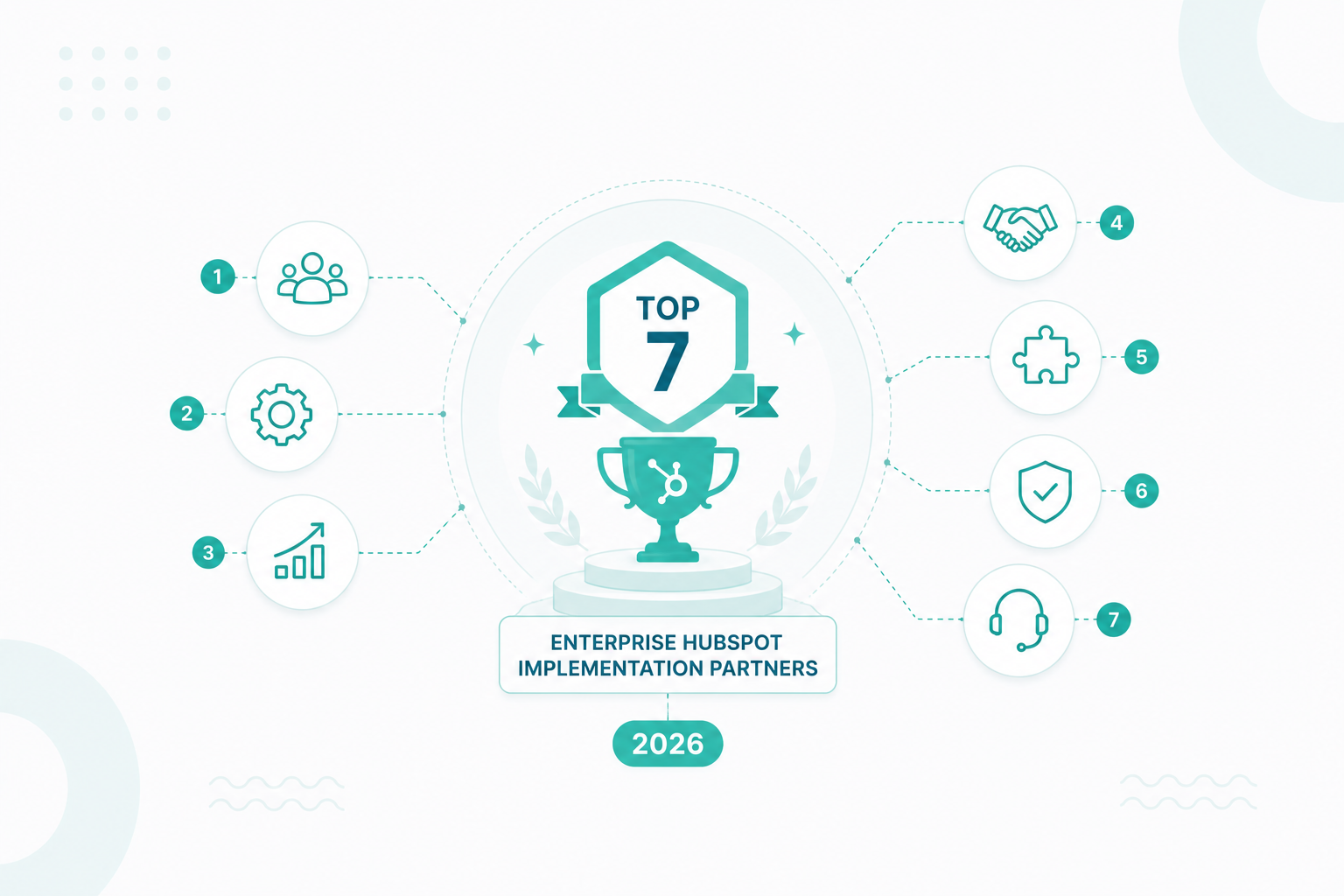
Their answers should give you a clear read on both technical capability and business judgment. Once you know what to look for, you can compare firms more confidently in our guide to the Top 7 Enterprise HubSpot Implementation Partners in 2026.

Which HubSpot Hubs Should Your Partner Support?

Your partner should support the Hubs you run today and understand the ones your CRM strategy may add later. For a multi-Hub implementation, depth across your specific Hubs beats broad familiarity with all six.

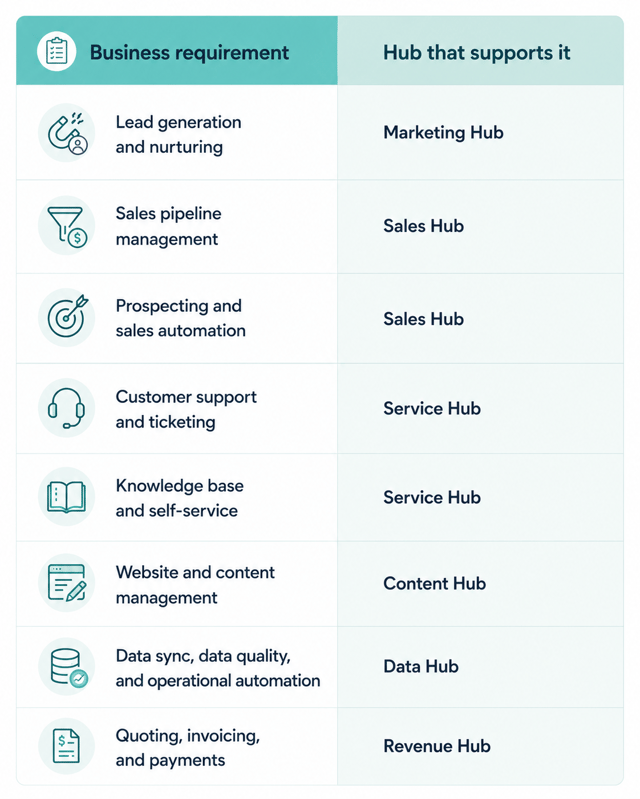
How Do You Know Which Hubs Your Business Needs?

Start with what your teams need to accomplish, then map Hubs to those requirements.

matching–hubspot-hubs-to-your-business-needs

A partner should also tell you which Hubs you do not need yet. Recommending the full suite before understanding your customer journey is a sales reflex, not an architecture decision.

What If A Partner Specializes In One Hub?

A Hub-specific specialist can be a strong choice for a focused project. For a multi-Hub build that spans several teams, that depth may not stretch far enough.

A partner with deep Marketing Hub experience may build excellent automation and still lack fluency in sales operations, service processes, data architecture, or integrations. The more interconnected your implementation, the more their cross-Hub track record counts.

Should Your Partner Have Expertise Outside HubSpot?

For complex implementations, yes. Your partner may need working knowledge of ERP platforms, ecommerce systems, customer portals, payment processors, data warehouses, or internal applications that connect to HubSpot.

Someone who views HubSpot in isolation will design around it and hand you the integration problems later. Look for a team that can speak to your whole technology ecosystem.

How Do You Evaluate a Partner's Multi-Hub Experience?

You can assess a HubSpot partner's multi-Hub experience through their implementation history, accreditations, technical expertise, case studies, references, and ability to explain how they would connect your Hubs into one architecture.

1. Look at the Hubs They Have Implemented Together

Do not focus only on which Hubs a partner supports. Find out which Hubs they have implemented together in the same portal and for the same customer lifecycle.

Ask them to show you an example that uses the same Hubs you plan to use. The number of projects they have completed matters, but relevant experience matters more. A partner with dozens of single-Hub projects may have less useful experience than one with a few complex multi-Hub implementations.

2. Use Certifications and Accreditations as Supporting Evidence

Certifications show that a partner understands HubSpot tools, but they are common. HubSpot accreditations require a higher level of experience and cover areas such as Onboarding, CRM Implementation, Custom Integration, Data Migration, Solutions Architecture Design, and Advanced Implementation. They require a Platinum tier or higher, a dedicated team, prerequisite certifications, and documented case studies reviewed by HubSpot.

Partner tiers such as Gold, Platinum, Diamond, and Elite reflect factors including revenue and client retention. Accreditations provide more insight into technical delivery capabilities. Consider both alongside the partner's actual implementation experience.

3. Look for Detailed, Relevant Case Studies

Look for case studies that explain the problem, the Hubs involved, the systems connected, the architecture, the work completed, and the results. A case study that only says a company successfully implemented HubSpot gives you little to evaluate. A detailed example of a legacy CRM migration, duplicate data cleanup, and multiple integrations gives you much more insight into the partner's capabilities.

Campaign Creators has a case study library organized by technology and industry. You can review examples such as Salesforce migrations, Zendesk-to-Service-Hub projects, and healthcare implementations that are relevant to your needs.

What Are the Warning Signs of Limited Multi-Hub Experience?

Certain signs can show that a partner's capabilities do not match the complexity of your implementation.

  • They cannot produce relevant multi-Hub examples.
  • They talk about individual Hub features and skip the CRM architecture.
  • They cannot explain clearly how data moves between Hubs.
  • They have thin integration or migration experience.
  • They have no defined testing process.
  • They cannot describe how they handle data governance.
  • Their case studies contain little technical or operational detail.
  • They recommend adding tools before tying them to a business requirement.
  • They promise a timeline before seeing your data.
  • They avoid discussing risks or platform limitations.

Several of these signs together may indicate that the partner is not equipped to handle the complexity of your implementation.

How Much Does a Multi-Hub HubSpot Implementation Cost?

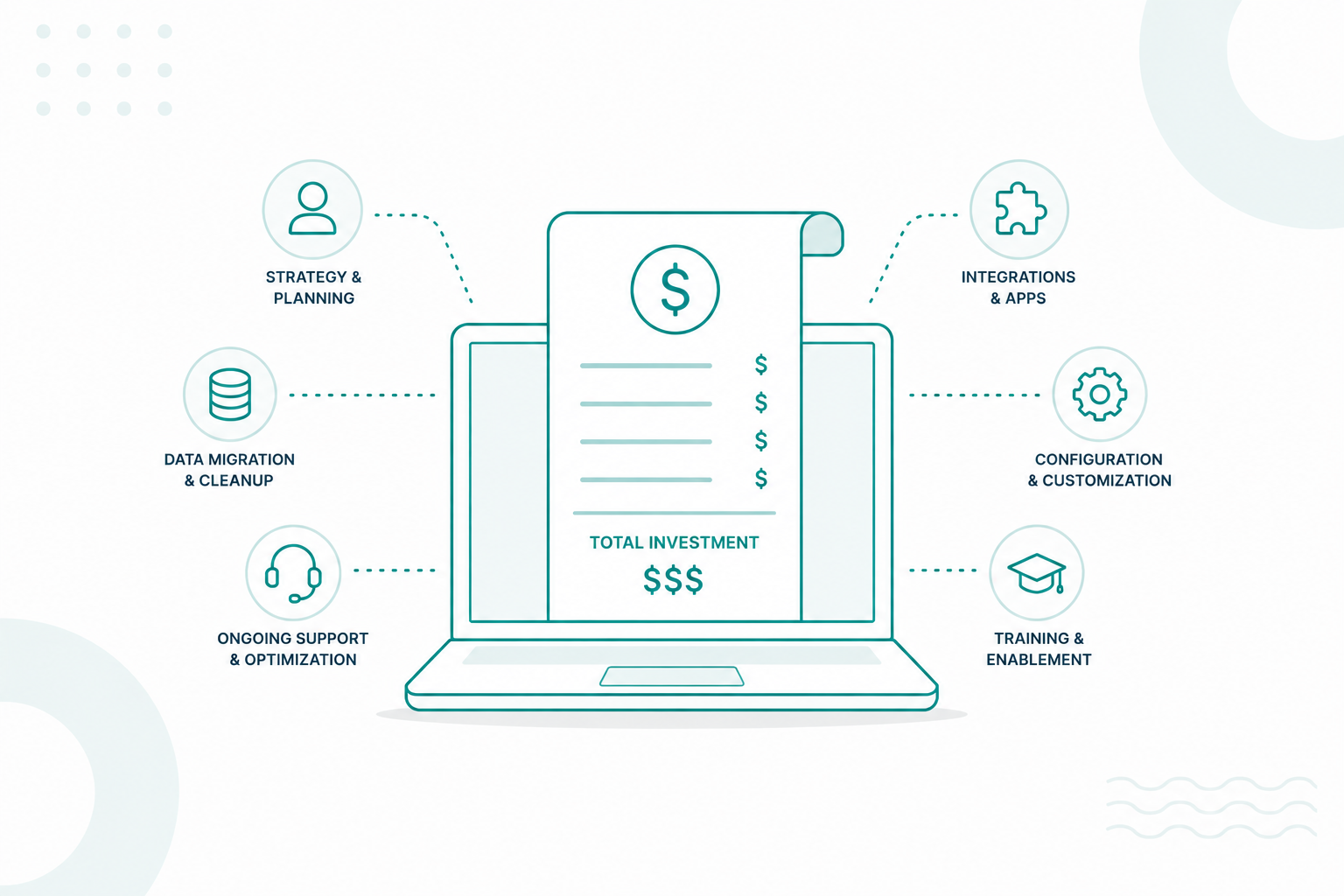
Costs can range from a few thousand dollars for a small, straightforward build to six figures for complex enterprise implementations. The final cost depends on the mix of strategy, configuration, migration, development, integrations, and team enablement.

The ranges below show the relative investment for common project profiles.

Implementation profile

Relative investment

One or two Hubs, clean data, few integrations, light automation

Lower end

Two or three Hubs, mid-market team, some migration and cleanup

Lower to mid range

Several Hubs with a full CRM migration, cleanup, and reporting rebuild

Mid to upper range

Several Hubs plus custom integrations, custom objects, governance, and a multi-team rollout

Upper end

Enterprise architecture spanning business units, markets, or regions

Highest, often a multiple of an upper-end mid-market build

Learn what you’ll actually pay for HubSpot Implementation beyond subscription fees with this guide.

What Drives The Cost?

Scope and complexity set the price far more than Hub count does. A three-Hub build with straightforward processes can cost less than a two-Hub project carrying a messy migration, custom integrations, and heavy automation.

The main cost drivers are the number of Hubs, users, and teams, the complexity of your CRM architecture, migration and cleanup requirements, automation volume, external integrations, custom development, reporting needs, permissions and governance, training, and post-launch support.

How Do Data, Integrations, And Automation Change The Price?

Data migration becomes more expensive when you have large datasets, multiple source systems, duplicates, inconsistent properties, complex associations, historical records, or custom objects. Importing contacts is much simpler than rebuilding a connected data model across Hubs.

Integration costs vary based on the work involved. Native connectors usually require less effort, while custom integrations may require APIs, data transformation, business logic, error handling, and monitoring.

Automation costs depend on how complex the process is. A basic notification is simple. A workflow that connects multiple Hubs, records, teams, and external systems requires more design and development.

How Do You Compare HubSpot Partners Before Making a Decision?

Use the criteria below for every finalist so you can compare them fairly.

Evaluation area

What to look for

Multi-Hub experience

Similar implementations connecting the same Hubs

Technical capability

Architecture, data, automation, integrations, migration, reporting

Business understanding

Ability to translate your processes into CRM requirements

Methodology

Clear discovery, design, build, testing, and launch stages

Proof of work

Case studies and references with comparable complexity

Communication

Documented decisions, early risk flags, visible progress

Proposal clarity

Transparent scope, assumptions, exclusions, and change process

Enablement

Training and documentation for each team

Ongoing support

Post-launch optimization and technical help

Compare scope, assumptions, and timelines and not just the headline price. Ask each partner to outline what is included, what is excluded, estimated effort, implementation phases, payment structure, your team's responsibilities, testing milestones, launch criteria, and potential additional costs.

A large price difference often means the proposals cover different scopes. Compare them side by side before choosing based on price. The same applies to timelines. A very short timeline offered before the partner reviews your data and integrations may indicate that the project has not been fully scoped.

And that is how you compare HubSpot partners based on what they can actually deliver and not just what they promise.

Map Your Requirements Before You Shortlist

Before contacting partners, document the Hubs you need, your integrations, your most complex cross-team processes, and the reports leadership needs. This gives every partner the same starting point and makes it easier to compare their approach, scope, and capabilities.

Campaign Creators has more than 15 years of experience working in HubSpot, including multi-Hub implementations, migrations, and integrations for organizations with complex data and multiple teams. If you are planning a multi-Hub build or fixing one that is not fully connected, talk with our team about what your CRM architecture needs to support.

Frequently Asked Questions

How Long Does A Multi-Hub HubSpot Implementation Take?

Focused single-Hub setups often finish in four to eight weeks, while multi-Hub Enterprise implementations commonly run three to six months or more.

Can You Implement Multiple Hubs Without A Partner?

Yes, if your data is clean, your integrations are few, and your workflows are simple, though complexity in any of those areas quickly raises the cost of doing it alone.

Is HubSpot Onboarding Required?

HubSpot requires paid onboarding on Professional and Enterprise purchases, and the fee can be waived when a certified Solutions Partner delivers the implementation.

What Is The Difference Between Onboarding And Implementation?

Onboarding is time-boxed guidance while your team handles configuration, and implementation is a partner who builds the architecture, migrates the data, and connects the systems for you.

Do You Need a Data Hub For A Multi-Hub Implementation?

Not always, though it becomes valuable when HubSpot syncs with external systems or when several teams rely on the same records staying accurate.

Can You Change Partners Mid-Implementation?

Yes, but the transition costs time and money, which is why documentation standards and decision records are worth confirming before you sign.