



 Campaign Creators
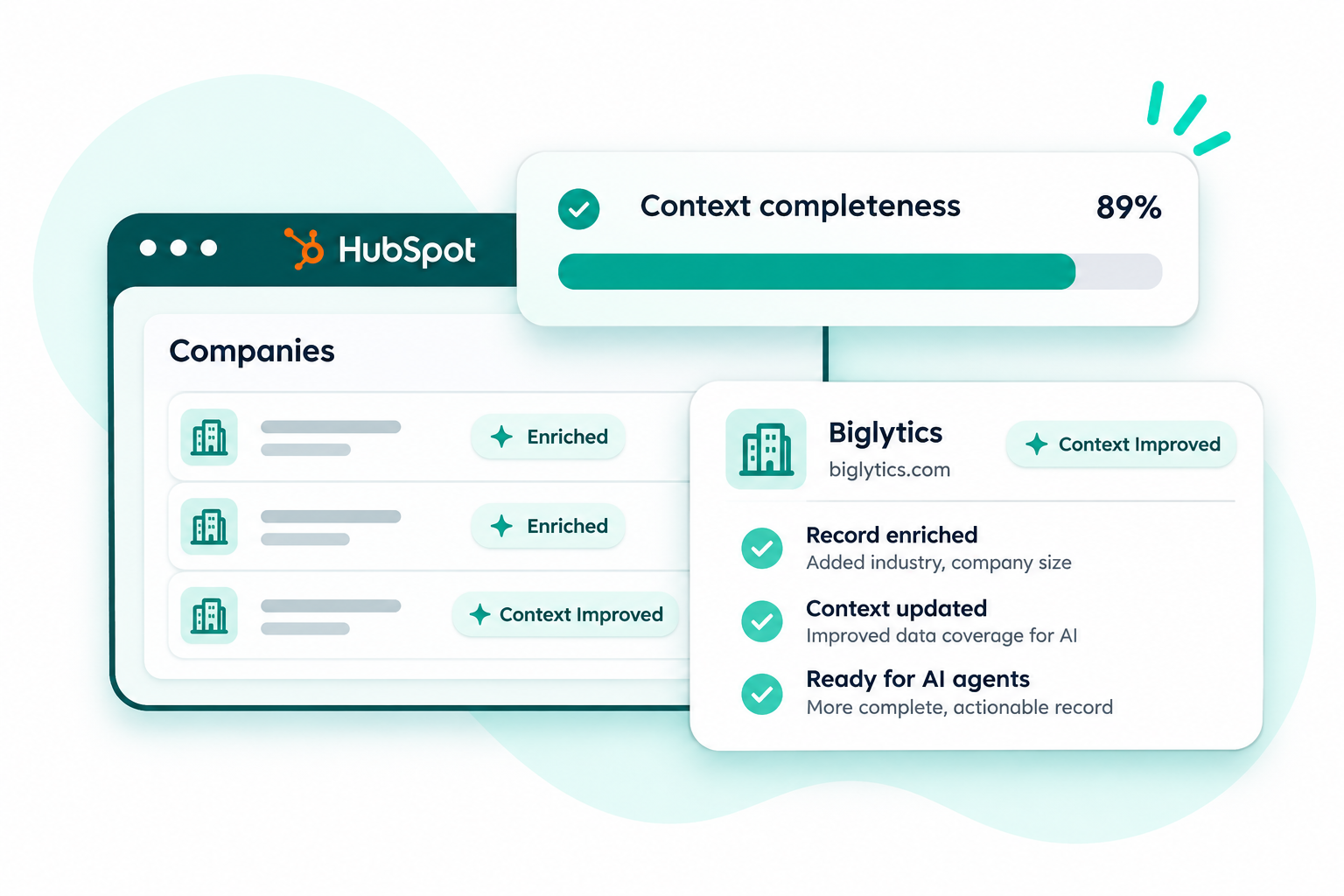
HubSpot's context completeness score is the score in Context Home that shows how complete your context foundation is and where the gaps are. It reflects how fully you've described your business, customers, and team for HubSpot's AI tools. A higher score means Breeze Assistant and agents work from fewer gaps, but the score measures completeness, not accuracy.
Every AI tool in HubSpot reads from the same context, so one thin section shows up in prospecting emails, campaign plans, and customer replies at the same time. The score points you to those thin spots, but deciding what to write there, and keeping it current, is still your team's job.
If you're getting a portal ready for Breeze agents, our HubSpot AI agent implementation team builds that context foundation before any agent goes live.
Key Takeaways
- Context Home launched on September 16, 2026, and gives every HubSpot portal a score for how complete its AI context is, along with where the gaps are.
- The context you add in Context Home covers five editable areas (Business, Customers, Team & Processes, Personal, and Custom), and HubSpot's AI tools draw from all of them.
- Most context edits need Super Admin or Partner Admin permission, but any user can update their own profile and email personalities.
- A complete score doesn't mean your context is accurate, so review what each section says and not just how full it is.
Table of Contents
- What Is HubSpot's Context Completeness Score?
- Where Do You Find Your Context Score in HubSpot?
- What Does the Context Score Measure?
- What Context Gaps Hurt HubSpot AI Performance Most?
- How Do You Improve Your Context Completeness Score?
- How Is AI Context Different From Knowledge Vaults?
- Is a 100% Context Score Worth Chasing?
- How Can Campaign Creators Help You Build Your AI Context Foundation?
- Frequently Asked Questions
What Is HubSpot's Context Completeness Score?
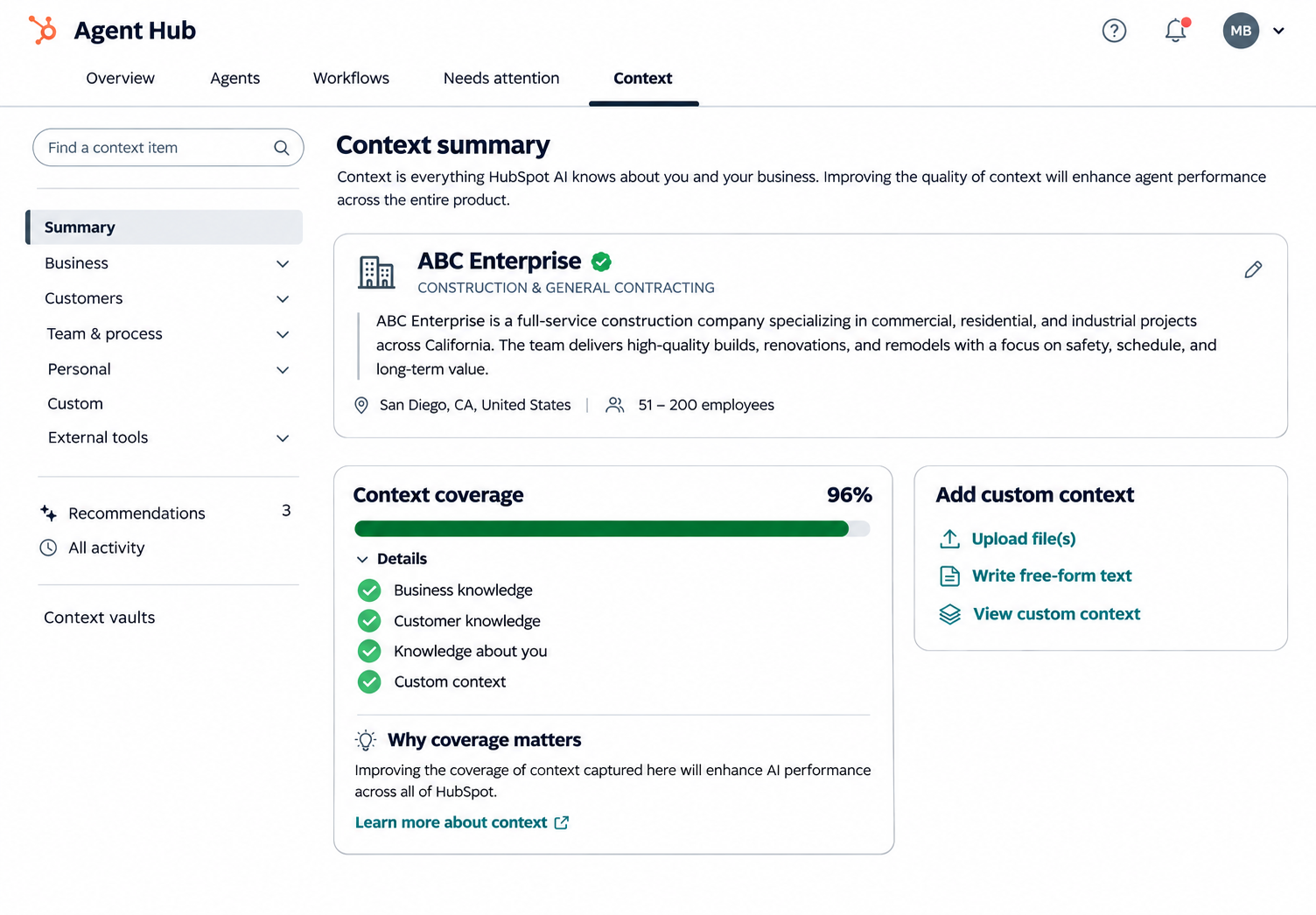
HubSpot's context completeness score is a rating in Context Home that tells you how much of your business, customer, and team context is filled in, and it shows where the gaps are. The score has no formal name in HubSpot's documentation, so most teams call it the context completeness score or the Context Home score.
Where the Score Comes From
Context Home arrived in the Fall 2026 Spotlight on September 16, 2026, as part of a release built around Growth Context. Growth Context is HubSpot's term for a working understanding of your business, your customers, and your team. The new Smart CRM captures part of that context on its own by syncing calls, emails, and meetings. Context Home is where you control the rest.
Where Do You Find Your Context Score in HubSpot?
You can find your context score in Agent Hub, on the Context tab. Context Home is available on all HubSpot products and plans, so even Free and Starter portals have one.
- Go to Agents, then Agent Hub, in your HubSpot account.
- Click the Context tab.
- Review the Summary and Recommendations tabs in the left sidebar to understand where your context stands.
- Open each section (Business, Customers, Team & Processes, Personal, and Custom) to fill in what's missing.
Who Can Edit Context
You need Super Admin or Partner Admin permission to update most context details. Users with Prospecting Agent Admin permission can also edit Products & Services. Any user can update their own profile and create email personalities. Plan for this before a working session, since a marketing manager without admin rights can read the score but can't close most of its gaps.
What Does the Context Score Measure?
The context score measures how complete your context is across the sections of Context Home. Each section feeds a different kind of AI work, from on-brand copy to deal qualification.
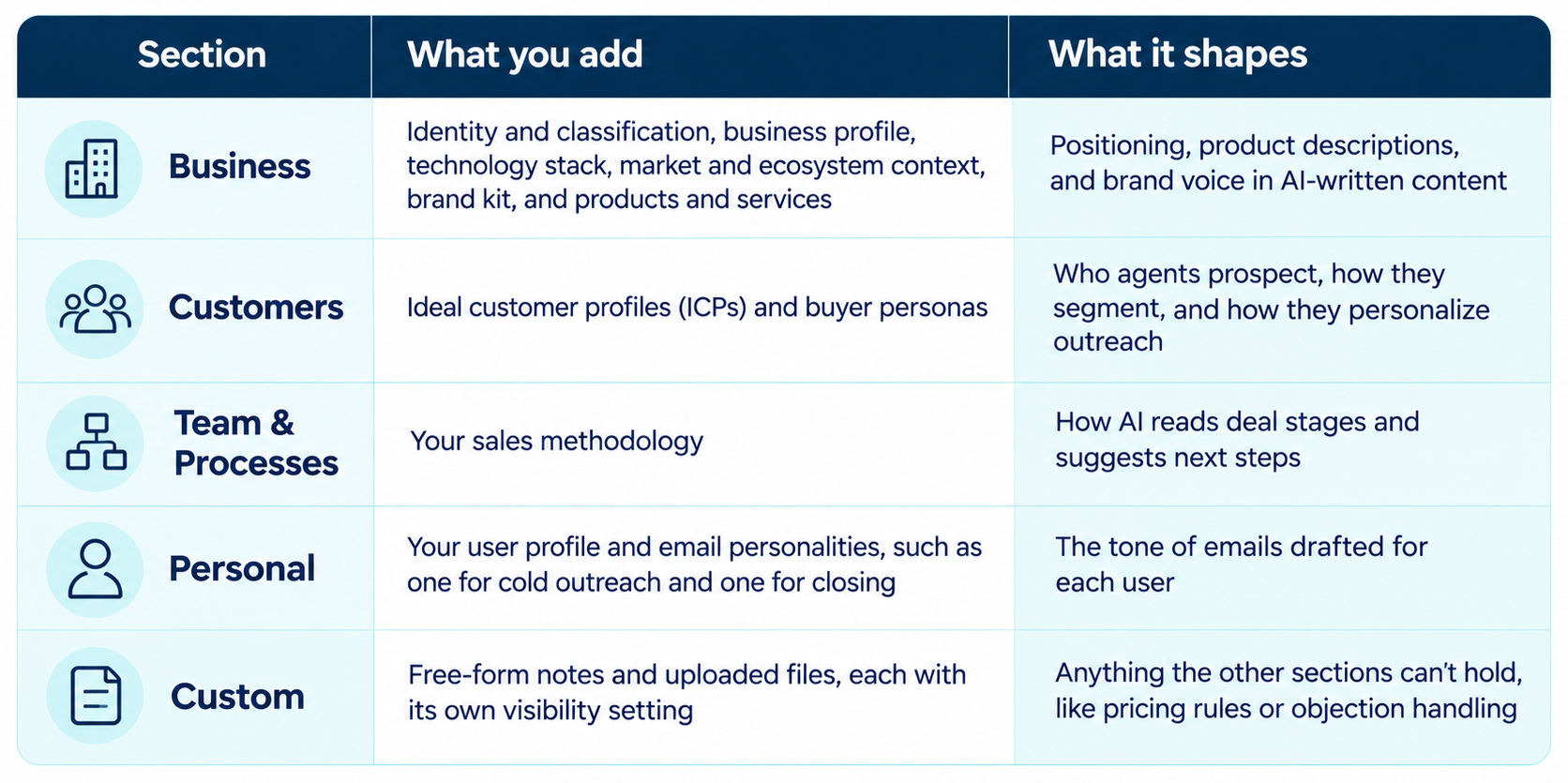
The sections above match the Context tab layout as of October 5, 2026.
What the Score Doesn't Measure
Nothing HubSpot has published ties the score to record quality. Don't expect it to flag duplicate companies, lifecycle stages that mean different things to sales and marketing, or workflows nobody owns. Those problems still change what an agent does, so a high score and a messy portal can sit side by side.
What Context Gaps Hurt HubSpot AI Performance Most?
The gaps that hurt AI output most are a vague ICP, a missing sales methodology, and thin product descriptions. In the portals we review, these three explain most of the generic or off-target output we run into.
A Vague ICP
A vague ICP is the most common gap we find, and it's rarely a blank field. It's an ICP that says "mid-size B2B companies" when sales actually wins with SaaS teams of 50 to 300 people. The updated Prospecting Agent monitors 40+ buying signals to build buying groups and draft outreach, and every one of those signals gets judged against the ICP you wrote.
No Written Sales Methodology
A missing sales methodology leaves AI guessing what each deal stage means. Deal progression in Sales Hub and Service Hub Professional and Enterprise drafts follow-ups and suggests deal updates, but it can't tell a qualified deal from a stalled one without your definitions, because AI needs business context and not just data.
Thin Products and Services
Thin product entries produce copy that could describe any competitor. Add what each product solves, who buys it, and what makes it different.
Stale Custom Context
Stale custom context is the gap the score can't catch. A pricing PDF from last year still counts as filled in, and AI tools can still pull it into prospect-facing content. Prioritize gaps by the agents you plan to use first, and start with the Breeze agent that fixes your biggest bottleneck.
How Do You Improve Your Context Completeness Score?
You can improve your context completeness score by filling the sections Context Home flags, starting with the ones your first agents depend on.
- Note your current score and gap list before you turn on any new agent, so you have a baseline.
- Collect what you already have, such as pitch decks, sales playbooks, brand guidelines, and new-hire onboarding material.
- Write your ICPs and personas with real numbers, like industry, region, company size, team size, and the roles in a typical buying group.
- Add your sales methodology on the Team & Processes tab, including what qualifies a deal for each stage.
- Fill in each product and service with the problem it solves, who buys it, and how it's different.
- Set up your brand kit so AI tools have your voice, tone, and guidelines.
- Upload files or write notes in Custom context for anything that doesn't fit elsewhere, and set visibility for each item.
- Assign one owner for each section, and review it every quarter or after any pricing, product, or process change.
Write every section like you're onboarding a new rep. If a new hire would read your sales methodology and still not know how you qualify a deal, an agent won't either. Ownership keeps context from drifting the same way CRM properties do, and data contracts in HubSpot apply the same idea to your records.
How Is AI Context Different From Knowledge Vaults?
AI context is foundational information that HubSpot applies automatically across multiple AI tools, while knowledge vaults are sets of information you attach by hand to specific projects or agents. Context answers who you are. Vaults answer what one agent needs for one job.
|
AI context |
Knowledge vaults |
|
|
Scope |
Whole portal |
One project or agent |
|
How it's applied |
Automatically, across AI tools |
Manually attached for a use case |
|
Typical content |
Business profile, ICPs, personas, sales methodology, brand kit |
Support procedures, product docs, refund policies, playbooks for one team |
|
Best for |
Facts every AI tool should know |
Detail that would confuse other agents |
Keep portal-wide context short and true for everyone. A refund policy belongs in the vault for your Customer Agent and not in shared context where it could leak into a prospecting email.
Is a 100% Context Score Worth Chasing?

Yes, but only when the information behind the score is accurate and up to date. A 100% score means little if your portal contains outdated or incorrect customer information. Focus on completing the context your AI agents need and making sure the data is reliable.
Completeness Is Not Accuracy
The score rewards filled-in sections. It can't tell if your ICP still matches who buys, if your sales stages match how deals move, or if your CRM records are clean. A moderate score with a sharp ICP beats a top score built on copy-pasted boilerplate.
Clean Records Still Come First
Context tells AI what your data means, so the data underneath has to hold up. After acquiring Edgecast, our client Edgio ran sales and marketing across Salesforce, Marketo, Autopilot, and Salesloft, with regions using different fields. We migrated two Salesforce instances and one Marketo instance into a single HubSpot portal, mapping, cleansing, and merging three major data sets, one dating back more than ten years.
Edgio now runs one centralized CRM across its global teams, with simpler forecasting and reporting, and has cut annual tech stack spending by $430k. That kind of foundation is what makes a strong context score mean something, and it's why data governance belongs in your AI plan.
How Can Campaign Creators Help You Build Your AI Context Foundation?
Most weak context we find isn't a blank field. It's an ICP nobody agreed on, a sales process nobody wrote down, or product copy that hasn't changed in two years. Our AI agent team works through those decisions with your sales, marketing, and service leads, writes the context into each Context Home section, and checks it against real records before any agent goes live.
As a HubSpot Elite Solutions Partner, we pair that setup with the CRM cleanup agents need. If you're preparing a portal for Breeze, learn how our HubSpot AI agent implementation works.
What's the Bottom Line on HubSpot's Context Score?
HubSpot's context completeness score shows how much of your business, customer, and team context your AI tools can use, and where the gaps are. Use it as a to-do list, fix the sections your first agents depend on, and keep someone accountable for accuracy.
Check how ready your portal is with the free HubSpot AI Readiness Scorecard.