






8 min read

What Product Usage Data Should SaaS Companies Sync Into HubSpot?

What Product Usage Data Should SaaS Companies Sync Into HubSpot?

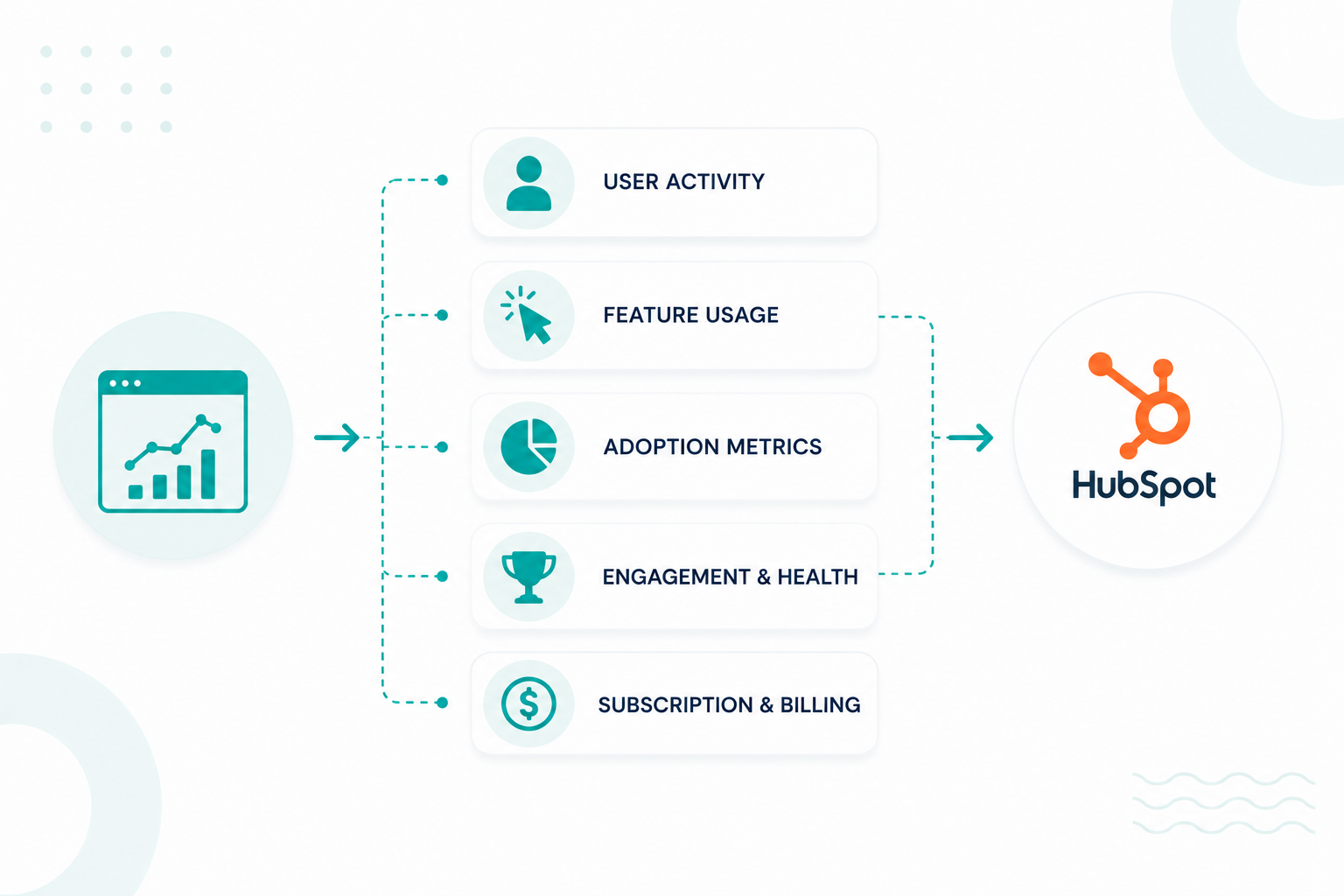
Product data includes the customer and account information generated inside your software, such as product usage signals, feature adoption, onboarding milestones, Product Qualified Lead indicators, customer health metrics, subscription data, billing information, and renewal activity.

Syncing the right product data into HubSpot helps sales, customer success, and revenue teams identify buying intent, monitor customer health, uncover expansion opportunities, and improve retention. However, not all product data belongs in a CRM.

This guide covers the product data SaaS companies should sync into HubSpot, how to organize it, and which data should remain in analytics and engineering systems.

Key Takeaways

  • Sync product usage, feature adoption, customer health, subscription, and renewal data into HubSpot to give teams a complete view of the customer lifecycle.
  • PQL signals and expansion data help sales teams identify high-intent accounts and growth opportunities earlier.
  • Customer health and engagement metrics help customer success teams spot retention risks before they lead to churn.
  • Keep low-value activity logs, technical telemetry, and duplicate data out of HubSpot to maintain clean reporting and effective automation.

The Product Usage Signals You Should Sync First

a professional using HubSpot CRM displaying customer records enriched with product usage data. Panels show login frequency, active users, onboarding completion, feature adoption rates, API usage, team invitations, and workspace growth. Sales and Customer Success teams use the information to identify show icons for this healthy accounts, at-risk customers, and expansion opportunities.

SaaS companies should sync product usage signals that reveal adoption, engagement, activation, and buying intent. These signals help sales, customer success, and revenue teams understand how customers interact with the product and which accounts require attention.

Not every product event belongs in HubSpot. The most useful product data highlights meaningful customer behavior and supports decision-making across the business. A practical starting point is to focus on four categories of product activity.


Product Data Category

Examples

Business Value

Activation Events

Account created, onboarding completed, first project created, first integration connected

Measures successful onboarding

Engagement Metrics

Login frequency, active users, session activity

Tracks ongoing product usage

Feature Adoption

Advanced feature usage, workflow creation, API utilization

Reveals product maturity

Growth Signals

Team invitations, usage increases, workspace expansion

Identifies expansion opportunities

Activation Events

Activation events represent the first meaningful value a user receives from the product. For a project management platform, activation may occur after a user creates a project. For a marketing automation platform, activation may occur after the first campaign launches. For a customer support platform, activation may occur after the first ticket is processed.

These milestones provide stronger insight than simple signups because they demonstrate that users have reached an important point in the customer journey.

Examples of activation events include:

  • Onboarding completed
  • First project created
  • First workflow launched
  • First integration connected
  • First successful collaboration activity

Accounts that reach activation milestones often deserve greater attention from sales and customer success teams because they have already experienced value from the product.

Engagement Metrics

Engagement metrics help software companies understand whether customers continue using the platform regularly after activation. Common engagement metrics include:

  • Weekly active users
  • Monthly active users
  • Login frequency
  • Session activity
  • Time spent on the platform
  • Team participation

These signals provide insight into customer involvement and product dependency. A customer who actively uses the platform every week typically presents a stronger retention profile than a customer whose activity has declined significantly.

Adding engagement data to HubSpot gives teams visibility into customer behavior alongside contact, company, and revenue information.

Feature Adoption Signals

Feature adoption data shows how deeply customers use the platform. Common feature adoption signals include workflow creation, dashboard usage, reporting utilization, API adoption, integration usage, and collaboration feature usage.

These metrics help customer success teams identify opportunities for additional education and support. They also provide insight into how customers progress beyond basic platform usage.

Growth Signals

Growth signals indicate that an account may be increasing its investment in the product. Examples include team invitations, user growth, workspace expansion, increased usage volume, consumption threshold milestones, and premium feature exploration.

Product usage data becomes significantly more valuable once it moves beyond activity tracking and begins identifying customer intent.

How Product Qualified Leads and Expansion Data Improve Revenue Teams

Product Qualified Leads (PQLs) and expansion signals help revenue teams identify accounts that have already demonstrated value inside the product.

Unlike traditional lead qualification methods that rely on marketing activity, PQLs are based on product behavior. A prospect who actively uses the platform, reaches activation milestones, and engages with core features often provides a clearer indication of purchase intent than someone who simply downloads content or attends a webinar.

The growing adoption of PQL programs is supported by strong conversion performance. A certain report states that Product Qualified Leads often convert at rates between 15% and 30% because users have already experienced value from the product and demonstrated buying intent through their behavior.

Common Product Qualified Lead Signals

Software companies typically build PQL models around specific actions that indicate product value and growing commitment.

PQL Signal

What It Indicates

Onboarding completed

User reached initial value

Core feature adoption

Product engagement is increasing

Team invitations

Broader organizational adoption

Multiple active users

Growing account engagement

Integration setup

Deeper product commitment

Usage threshold reached

Potential need for a larger plan

Premium feature interaction

Interest in advanced capabilities

These signals help revenue teams focus on accounts that are actively engaging with the product rather than relying solely on traditional lead scoring methods.

Expansion Data Reveals Growth Opportunities

Expansion data helps SaaS companies identify customers that may be ready for additional products, higher-tier plans, or increased usage. Common expansion indicators include:

  • Rapid user growth
  • Increased product consumption
  • Consistent adoption across teams
  • Premium feature usage
  • New departments using the platform
  • Approaching usage limits

For example, an account that has doubled its active users and consistently engages with advanced features may represent a stronger expansion opportunity than an account with minimal growth and limited adoption.

Product Data Helps Prioritize Revenue Efforts

Not every account deserves the same level of attention. Product data helps revenue teams focus on accounts that show the strongest signs of momentum. This creates a more efficient approach to sales and account management because resources can be directed toward opportunities supported by actual customer behavior.

Revenue teams can use product data to:

  • Prioritize high-intent prospects
  • Identify expansion opportunities
  • Support account planning
  • Improve forecasting accuracy
  • Understand customer adoption trends

This visibility creates stronger alignment between product engagement and revenue strategy. For SaaS companies pursuing product-led growth, PQLs and expansion signals represent some of the most valuable data that can be synced into HubSpot because they connect customer behavior directly to pipeline creation, account growth, and recurring revenue.

What Customer Health and Retention Metrics Should Be Connected to HubSpot

Product Adoption Metrics

Product adoption metrics measure how successfully customers incorporate the software into their daily operations. These are the common adoption metrics you may include:

  • Percentage of activated users
  • Onboarding completion status
  • Integration usage
  • Workflow creation
  • API utilization
  • Adoption of key product features

These metrics help teams determine whether customers are receiving value from the platform.

Customer Engagement Indicators

Engagement indicators help teams monitor the strength of customer relationships and identify shifts in product usage patterns. There are some of the useful engagement signals:

Engagement Metric

Insight Provided

Weekly active users

Ongoing platform engagement

Monthly active users

Long-term customer activity

Login frequency

Consistency of product usage

Session activity

Depth of engagement

Usage growth

Increasing customer investment

Significant declines across these metrics can indicate reduced product value, changing business priorities, or emerging retention concerns.

Support and Service Metrics

Support interactions provide valuable context that product activity alone cannot capture. Important customer service metrics include:

  • Open support tickets
  • Escalated issues
  • Resolution times
  • Customer satisfaction scores
  • Support volume trends
  • Onboarding assistance requests

A customer may demonstrate healthy product adoption but still face challenges that impact long-term retention. Support data helps uncover those issues before they become larger problems.

Research from PwC found that 32% of customers would stop doing business with a brand they love after a single bad experience. This highlights the importance of including customer experience signals alongside product data.

Churn Risk Signals

Common churn risk signals include:

  • Declining product activity
  • Reduced feature adoption
  • Incomplete onboarding
  • Increased support requests
  • Negative customer feedback
  • Falling engagement levels

Tracking these signals inside HubSpot helps customer success teams proactively identify accounts that may require additional attention.

Building a Customer Health Score

Companies can combine customer success metrics into a health score that provides a single view of account health. A typical health score may include:

Health Score Component

Example Signals

Product Adoption

Feature usage, onboarding completion

Engagement

Active users, login consistency

Customer Experience

Support activity, satisfaction

Account Growth

User expansion, usage growth

Revenue Status

Renewal stage, subscription status

Health scores help teams evaluate customer relationships more consistently and identify trends that may not be obvious from individual metrics alone.

For SaaS companies focused on retention, customer health metrics create a stronger foundation for customer success planning, account management, and long-term growth.

Where Subscription, Billing, and Renewal Data Should Be Managed in HubSpot

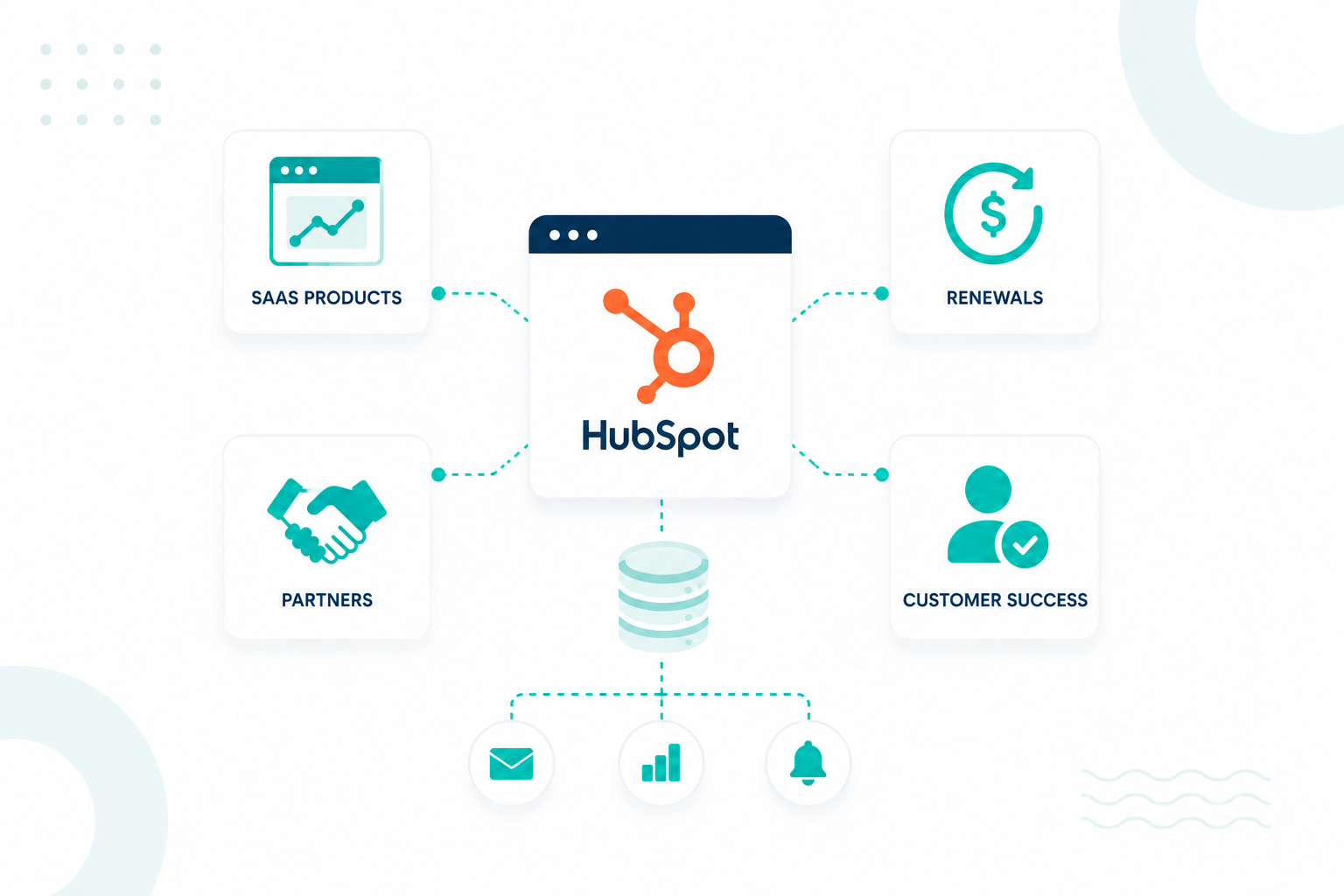
Subscription, billing, and renewal data should be connected to the HubSpot records that sales, customer success, revenue operations, and leadership teams use most often. This creates a single source of truth for customer relationships, account value, and recurring revenue performance.

ChatGPT Image Jun 15, 2026, 07_37_27 PM

Product usage data explains how customers engage with the platform. Subscription and billing data provide the commercial context behind that engagement. Bringing both together helps teams understand customer value more clearly.

For SaaS companies, this visibility supports forecasting, account planning, customer retention, and revenue growth.

Subscription Data Provides Account Context

Subscription data helps teams understand what customers have purchased and how their accounts are structured. Common subscription fields include:

Subscription Data

Purpose

Plan tier

Identifies the customer's package

Product package

Shows purchased solutions

Contract start date

Tracks the customer lifecycle stage

Contract end date

Supports renewal planning

Account status

Identifies active and inactive accounts

Seat allocation

Measures purchased capacity

Add-on products

Highlights additional purchases

Billing Data Supports Revenue Visibility

Billing data helps connect customer activity to financial performance. Many SaaS companies sync:

  • Monthly recurring revenue (MRR)
  • Annual recurring revenue (ARR)
  • Contract value
  • Invoice status
  • Payment history
  • Subscription upgrades
  • Subscription downgrades

This information supports revenue reporting, forecasting, customer segmentation, and account prioritization.

Renewal Data Helps Teams Plan Ahead

Renewal data provides visibility into upcoming customer decisions and contract milestones. Useful renewal fields include renewal date, renewal stage, contract term, renewal owner, renewal risk level, expansion opportunity status, and customer health status.

Connecting these data points to HubSpot helps teams coordinate retention efforts more effectively and maintain visibility into future revenue opportunities.

When Product Usage Data Should Trigger HubSpot Workflows

Product data should trigger HubSpot workflows and automations whenever customer behavior requires a business response. The most effective automations connect product activity to sales engagement, customer success actions, retention efforts, and revenue operations.

Syncing product data into HubSpot creates visibility. Automation helps teams act on that information consistently and at scale.

Without automation, teams often rely on manual reviews of customer activity, adoption trends, and account health indicators. This manual effort can create delays and inconsistencies across customer-facing teams. HubSpot reports that sales professionals using automation and AI save more than two hours per day, highlighting how automated workflows help organizations respond more quickly to important customer signals.

What Product Data Should Stay Out of HubSpot

Companies should keep low-value activity data, technical telemetry, and duplicate metrics out of HubSpot. These data types rarely support sales, customer success, retention, expansion, or revenue operations and can make reporting and automation more difficult to manage.

Low-Value User Activity

Many product events may provide limited value inside HubSpot because they do not always indicate customer health, buying intent, product adoption, or account growth. Activities such as individual button clicks, page scrolls, mouse movements, session recordings, navigation paths, and repeated interface interactions can generate large volumes of data without offering clear business insights.

These events are often valuable for product analytics, user experience research, and feature optimization. However, they may be less useful for sales, customer success, or revenue operations teams, which typically rely on higher-level customer and account signals to support decision-making.

Technical and Engineering Data

Technical product data generally belongs in engineering and observability platforms rather than HubSpot.

Examples include:

  • Database performance metrics
  • Application error logs
  • Infrastructure monitoring events
  • System status updates
  • Debugging information

These metrics help engineering teams monitor application performance, but typically do not contribute to customer lifecycle management.

Duplicate Metrics and Properties

Duplicate data can create reporting inconsistencies and workflow conflicts. Common examples include:

Data Issue

Example

Duplicate metrics

Multiple versions of active users

Redundant properties

Several fields tracking the same value

Conflicting lifecycle indicators

Different systems define customer stages differently

Overlapping health score inputs

Multiple calculations using the same signals

Maintaining a single source of truth helps improve reporting accuracy and operational consistency.

Data That Does Not Support Action

A simple way to evaluate product data is to ask: “Can a team take meaningful action based on this information?”

If the answer is no, the data likely belongs in a product analytics platform, data warehouse, or engineering system rather than HubSpot.

According to Gartner research, poor data quality costs organizations an average of $12.9 million annually. Keeping HubSpot focused on actionable business signals helps reduce complexity, improve reporting accuracy, and support more effective automation.

Turn Product Data Into a More Connected Customer Experience!

Product data gives SaaS teams the context they need to understand what customers are actually doing inside the product. By connecting key usage signals, customer health metrics, subscription data, and renewal information to HubSpot, teams can make better decisions across sales, customer success, and revenue operations.

Bringing the right data into HubSpot helps teams spot expansion opportunities, identify customers who may need support, and build stronger retention processes.

If your organization needs help connecting product data with HubSpot, at Campaign Creators, we help organizations build scalable HubSpot systems that bring customer, product, and revenue data together.

Frequently Asked Questions

Can HubSpot store custom product usage properties?

Yes. HubSpot supports custom properties that can store product usage metrics such as active users, feature adoption rates, onboarding status, and health scores.

How often should product data sync with HubSpot?

The ideal frequency depends on the use case. High-priority events such as PQL signals and churn alerts often benefit from near real-time syncing, while reporting data may only require daily updates.

What is the difference between product data and CRM data?

Product data reflects how users interact with a software platform, while CRM data focuses on contacts, companies, deals, and customer relationships.

Should trial user activity be synced into HubSpot?

Yes. Trial activity can help sales teams identify Product Qualified Leads and prioritize prospects who are actively engaging with the product.

How much does it cost to hire Campaign Creators?

Yes. Many SaaS companies use HubSpot to track Product Qualified Leads, manage customer journeys, and support expansion efforts driven by product engagement.

Which HubSpot objects are commonly used for product data?

Most software companies store product data within contact, company, deal, subscription, and custom object records, depending on their data model.