










Skip to the main content.

WEBSITE GROWTH & CONVERSION

• Web Design & Development


• SEO & AEO


• Conversion Rate Optimization


• Lead Generation Strategies


HUBSPOT SUPPORT & ENABLEMENT

• HubDesk


• HubSpot Training


• HubSpot Change Management


• HubSpot AI Agent Implementation

IMPLEMENTATION & INTEGRATIONS

• Technology Consulting


• HubSpot Migration Services


• HubSpot Integration Development


• HubSpot Integration Library


• HubSpot & Aircall Integration


• HubSpot & Trustpilot Integration


• Klaviyo Onboarding and Setup


• Custom AI Agent Development

FREE TOOLS & ASSESSMENTS

• AEO Auditor


• HubSpot Al Readiness Scorecard


• HubSpot Al Solutions Design


LEARN & WATCH

• View All Resources


• Ebooks & Templates


• Webinars On-Demand


• Expert Videos

Leisure, Travel & Tourism Success Story

How RedWeek Replaced a Generic Deal Pipeline With 2 Custom HubSpot Objects to Run Its Timeshare Marketplace

RedWeek, a timeshare rental and resale marketplace, was spun off as a standalone company after a private equity acquisition and inherited a stack built for its former parent. HubSpot’s standard Deal pipeline could not represent its listings and bookings, so Campaign Creators built two custom objects, Listings and Bookings, across a three-hub Marketing, Sales, and Service Hub Enterprise deployment.

154-1

0

Listings and bookings per day the two custom objects carry

0

Custom properties built across Listings, Bookings, and Contacts

0

Separate financial properties set on every Booking

Red Week Logo-1

RedWeek has operated an online timeshare marketplace from Orlando, Florida since 2002. In a 2024 release, the company reported bookings up 25% year over year and rental revenue paid out to owners up 33%. The platform now reaches over 4.2 million registered users and travelers, and over 200,000 owners.

Growth at that pace puts weight on the data underneath it. Every booking ties an owner’s listing to a renter, and affiliated brokers add listings of their own. The rental amount belongs to the owner, which leaves RedWeek’s revenue in fees, commissions, and memberships. After a private equity acquisition spun it off as a standalone business, RedWeek kept running that marketplace on a marketing and data stack built for its former parent.

Industry

Leisure, Travel & Tourism

Tools Used
  • Marketing Hub Enterprise

  • Sales Hub Enterprise

  • Service Hub Enterprise

Services
  • Multi-Hub Enterprise Onboarding

  • Custom Object Data Modeling

  • API Integration Build


The Challenge

For years, RedWeek operated on a CRM structure inherited from its former parent company following a private equity spinoff. HubSpot's standard object model treated every customer interaction as a generic Deal, which did not reflect RedWeek's actual business: timeshare listings posted by owners and bookings made by renters.

Each day the business ran without a model built for its own transactions was a day RedWeek's team worked around HubSpot, not in it, reconciling listings and bookings the CRM could not represent on its own and losing access to the owner-specific marketing campaigns the business needed to grow.

Hero Image Templates (65)

A Generic CRM Model Was Working Against RedWeek's Own Business:

1. No Model for Listings or Bookings.

HubSpot's standard Deal pipeline could not represent RedWeek's actual marketplace transactions, and some transaction records had no corresponding booking record at all. This made deal-based reporting structurally unreliable for the business the system was supposed to track.

2. No Owner/Renter Segmentation.

Contacts were not separated by their role as timeshare owners versus renters. This closed off owner-specific campaigns such as notifying owners of underpriced "twin" listings or re-engaging past owners in high-demand locations.

3. Revenue Reporting Mixed With Non-Revenue Figures.

A standard Deal-amount field could not exclude owner payouts, refunds, and broker discounts from reported revenue. This left RedWeek without a reliable figure for actual company revenue versus pass-through payments.

4. Legacy Tooling Sized for a Different Company.

RedWeek inherited Marketo and Tealium licenses sized for its former parent company after the spinoff, including cross-domain tracking capability it no longer needed. This left the business paying for martech capacity that didn't match its own, smaller scale.

5. Service Data Disconnected From Sales and Marketing.

Customer service ran in Zendesk with no connection to HubSpot. This left RedWeek's team without a unified view of a customer across support, sales, and marketing touchpoints.

[DRAFT QUOTE — PENDING AE APPROVAL] "RedWeek's business wasn't a standard HubSpot deal flow, so we built around what they actually sell: listings and bookings, not generic sales opportunities." [DRAFT QUOTE — PENDING AE APPROVAL]

Britt Shank,
Account Executive, Campaign Creators
 

Why RedWeek Chose Campaign Creators

RedWeek needed a partner who would look past HubSpot's standard object model and design a data structure around its own marketplace, not force its business into a generic CRM template. The engagement required:

  • Custom object design for listings and bookings, including handling for records without an assigned owner

  • Owner, renter, and broker contact segmentation across the existing Contact and Company model

  • Revenue reporting logic that could exclude owner payouts, refunds, and broker discounts

  • A Zendesk-to-HubSpot integration path that did not require an added Operations/Data Hub subscription

  • Multi-hub Enterprise onboarding across Marketing, Sales, and Service Hub, including branding, pipelines, and email sending domain setup

Campaign Creators holds Elite Solutions Partner status with HubSpot and brought that platform depth to a marketplace business whose data structure didn't fit a standard implementation.

How Campaign Creators Built a Custom Object Model for RedWeek's Marketplace

Campaign Creators sequenced the engagement from discovery through a dedicated system design review before building anything, since RedWeek's two-sided marketplace model didn't match a standard HubSpot implementation.

architecture

Listings and Bookings as Two Custom Objects

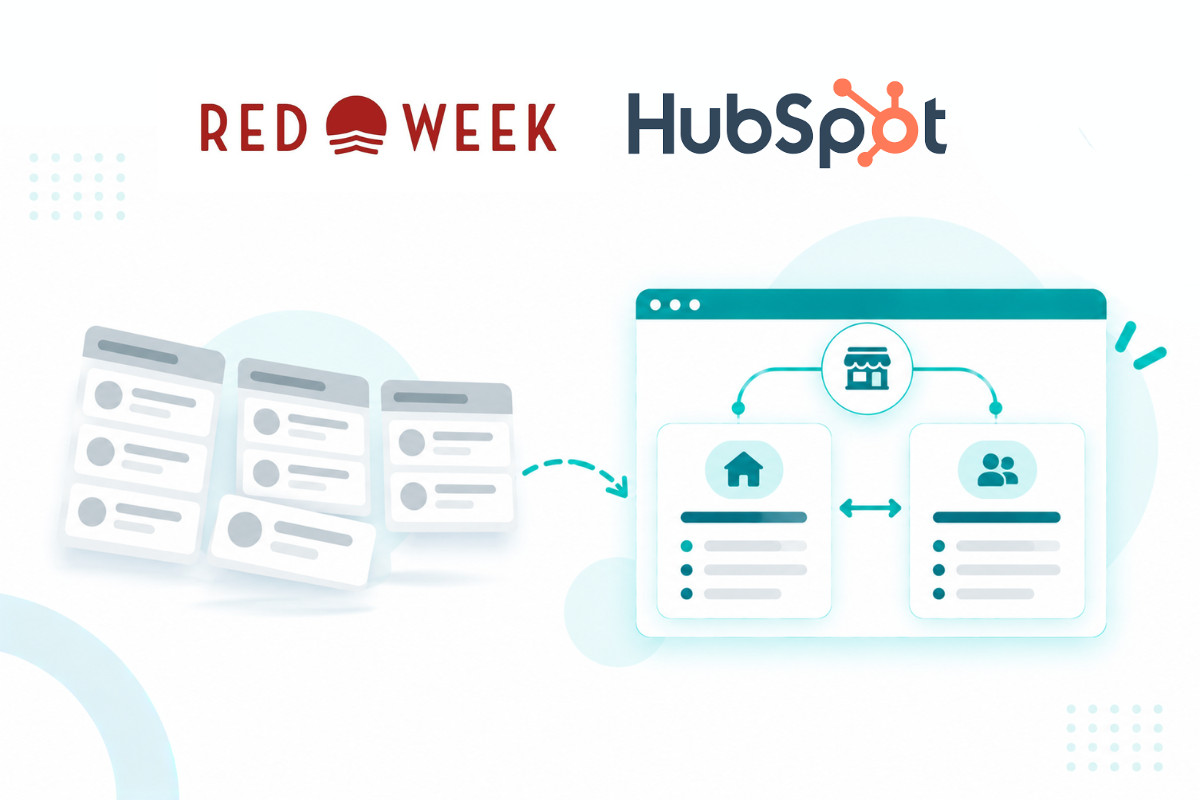
RedWeek's actual transactions, timeshare listings and bookings, had no object built to represent them, and forcing them into the standard Deal pipeline had already produced transaction records with no corresponding booking record. Campaign Creators built two custom objects, Listings and Bookings, with properties specific to each: resort, unit type, pricing, and status flags including a "twin"/lowest-price indicator for Listings; check-in/out, guest, fees, and owner payout for Bookings, associated to Contacts in owner or renter roles and to Companies in broker or affiliate roles. RedWeek's sales, marketing, and service teams can now report on and automate around its actual marketplace activity, in place of a generic deal pipeline that never matched the business.

Migrate

Zendesk Data Into HubSpot Without a Data Hub Subscription

RedWeek needed Zendesk ticket and contact data inside HubSpot without adding an Operations/Data Hub subscription at an estimated $800 a month. Campaign Creators built a one-way, API-based Zendesk-to-HubSpot sync for contacts and tickets in place of native field mapping, documented for RedWeek to activate once its team defines which custom ticket fields to map. RedWeek gains a path to unified service data without an added recurring hub cost, activated on its own timeline.
 

Insert Cloud Link_48px_teal_light

Marketo Lists Loaded Ahead of RedWeek’s Own Sync

RedWeek's existing owner and suppression data lived in Marketo, in lists sized for its former parent company, not its own marketplace. Campaign Creators migrated RedWeek's Marketo-sourced owner and suppression lists into HubSpot by CSV ahead of RedWeek's own larger, independently built contact sync. RedWeek's owner data was available inside the new Listings and Bookings model from go-live, without waiting on a longer-running sync project.

Verify

A Provisional Flag for Records With No Owner

A generic contact and deal property set did not capture what RedWeek's listings and bookings actually needed to track, including when a record had no assigned owner. Campaign Creators defined a property set specific to the Listings and Bookings objects, including an is_provisional flag identifying orphaned records without an assigned owner. RedWeek can now queue and report on orphaned listings and bookings separately from fully owned ones, so those records no longer disappear into an undifferentiated list.

assigned

Owner, Renter, Broker, and Affiliate Roles on Every Record

A single generic Contact record view gave every RedWeek team member the same information, no matter if that contact was an owner, renter, or broker. Campaign Creators configured conditional record cards, including an owner-specific card that only surfaces when a Contact's type is set to Owner, alongside association labels distinguishing owner, renter, broker, and affiliate relationships. RedWeek's team sees role-relevant information on each record without manually filtering for it.

Automating Membership

Segmentation Built In for the Campaigns RedWeek Wants to Run

RedWeek's owner and renter campaigns, including notifying owners of underpriced "twin" listings and re-engaging past owners in high-demand locations, depended on segmentation the platform didn't have before this engagement. Campaign Creators built the owner/renter/broker segmentation these campaigns require directly into the Listings and Bookings model, so RedWeek's marketing team can build and launch them without a further data restructuring project. This groundwork, not a pre-built workflow library, was the deliverable at this stage of the engagement.

 
Blog

Training Across Campaigns, Workflows, HubDB, and Attribution

A new object model and three-hub deployment meant RedWeek's team needed to learn both the new structure and day-to-day platform mechanics. Campaign Creators delivered HubSpot training sessions, including one covering campaigns, email building, workflows, dynamic content, HubDB, and UTM/attribution mechanics, supplemented by an outside trainer brought in to extend training capacity. RedWeek's admin team can configure and extend the new system on its own, without depending on Campaign Creators for routine changes.


The Results

The engagement replaced a generic CRM structure with one built around RedWeek's actual marketplace. Key outcomes included:

  • 2 custom objects, Listings and Bookings, now represent RedWeek's core transactions in place of the standard Deal pipeline

  • 3 HubSpot hubs, Marketing, Sales, and Service Hub Enterprise, were deployed with RedWeek's branding, pipelines, and sending domain configured

  • 1 Zendesk-to-HubSpot integration was built via API, avoiding an added Operations/Data Hub subscription

  • Owner and renter contacts are now segmented by role, with association labels distinguishing owners, renters, brokers, and affiliates

  • Orphaned listings and bookings without an assigned owner are flagged and reportable, no longer disappearing into an undifferentiated list

  • Owner and renter record views surface role-specific information in place of one generic layout for every contact

  • RedWeek's team completed HubSpot training covering campaigns, email building, workflows, and attribution reporting

RedWeek now runs its sales, marketing, and service operations on a data model built around what it actually sells, not a generic CRM template.

Connected CRM Workflow in a Modern Office framed

The Impact: A Data Model That Matches RedWeek's Own Marketplace

RedWeek's Listings and Bookings objects now give the business a structural record of its own marketplace, independent of any future reporting or campaign work built on top of it. Because the property set and associations were defined around RedWeek's actual roles, owner, renter, broker, and affiliate, the model can support new campaigns or reports without a structural rebuild. The standard-object pipeline RedWeek used before this engagement could not make that claim.

Solve Marketplace Data Modeling and Multi-Hub Onboarding With Campaign Creators

Businesses with a two-sided marketplace, a service-based transaction model, or data inherited from a parent company often find that HubSpot's standard Deal and Contact structure doesn't match what they actually sell. Closing that gap requires custom object design built around the real transaction, not a generic template, along with the integration and reporting work to make that model usable day to day.

Campaign Creators builds HubSpot implementations around a business's actual operating model, from custom object architecture to multi-hub Enterprise onboarding and the integrations that connect them.

Talk to a HubSpot expert to see how Campaign Creators can build a custom data model around your existing HubSpot tools.

Your HubSpot should work as one system.

Looking to talk with a HubSpot Expert? Whether you’re migrating, mid-build, or stalled after launch, we connect your data, tools, and teams into one system, then optimize it with AI.

HubSpot Solutions Partner Program Elite soc-2-type-2-badge