






Healthcare Success Story
How Carewright Clinical Services Achieved a Single Patient Lifecycle System with a Custom AdvancedMD Integration
Carewright Clinical Services, a nationwide provider of psychological evaluations, psychiatric services, and psychotherapy, tracked patient status in spreadsheets shuffled between Dropbox folders because AdvancedMD, its patient information system, offered no streamlined method for managing it. Campaign Creators connected AdvancedMD to HubSpot through a custom API integration, modeled the patient lifecycle as a ticket pipeline across five HubSpot Pro hubs, and automated communication to patients, providers, and referring clinics. The system now supports 50 users on a single platform with no custom objects, and the engagement has run continuously since February 2, 2023.
.png?width=1200&height=800&name=CC%20Blog%20Images%20(40).png)
0
total system users supported
0
platforms connected through a custom integration
0
database migrated into HubSpot
0
ticket pipeline established

Carewright Clinical Services provides psychological evaluations, psychiatric services, and psychotherapy to patients across diverse age groups. They deliver mental health care nationwide across the United States. The organization employs 25 to 50 people and supports 50 total users inside its operational systems. Clinics refer patients to Carewright's services, making referring healthcare providers a second audience that needs clear, consistent communication alongside patients.
The project originated with Carewright's CEO, who envisioned a transformative system that used automation to improve the efficiency of administrative processes and elevate communication with those referring providers. The organization's goal was to modernize operations so that internal workflow and external collaboration could both support its mission of delivering high-quality mental health care at national scale. That vision defined the work as a Solutions Design engagement spanning both user-focused and process-focused solutions.
Industry
Healthcare
Tools Used
- HubSpot
- AdvancedMD
- Custom API integration
- Dropbox
Services
- CRM Architecture Design
- AdvancedMD Integration
- Data Migration
- Custom Property Setup
- Record View Configuration
- Provider Assignment Automation
- Pipeline Automation
- Training & Documentation
The Challenge
AdvancedMD served as Carewright's patient information system, and while the platform is tailored to the healthcare industry, it presented several significant challenges. It offered no streamlined method for managing the status of existing patients, so the organization's operational tracking lived outside the system holding its patient data.
The consequences compounded from there: duplicated administrative labor, a convoluted and inefficient workflow, fragmented access for clinicians, and referral communication that depended on manual effort the current patient load could not sustain. Left unresolved, every additional patient would have carried the same duplicated work and the same exposure to human error.
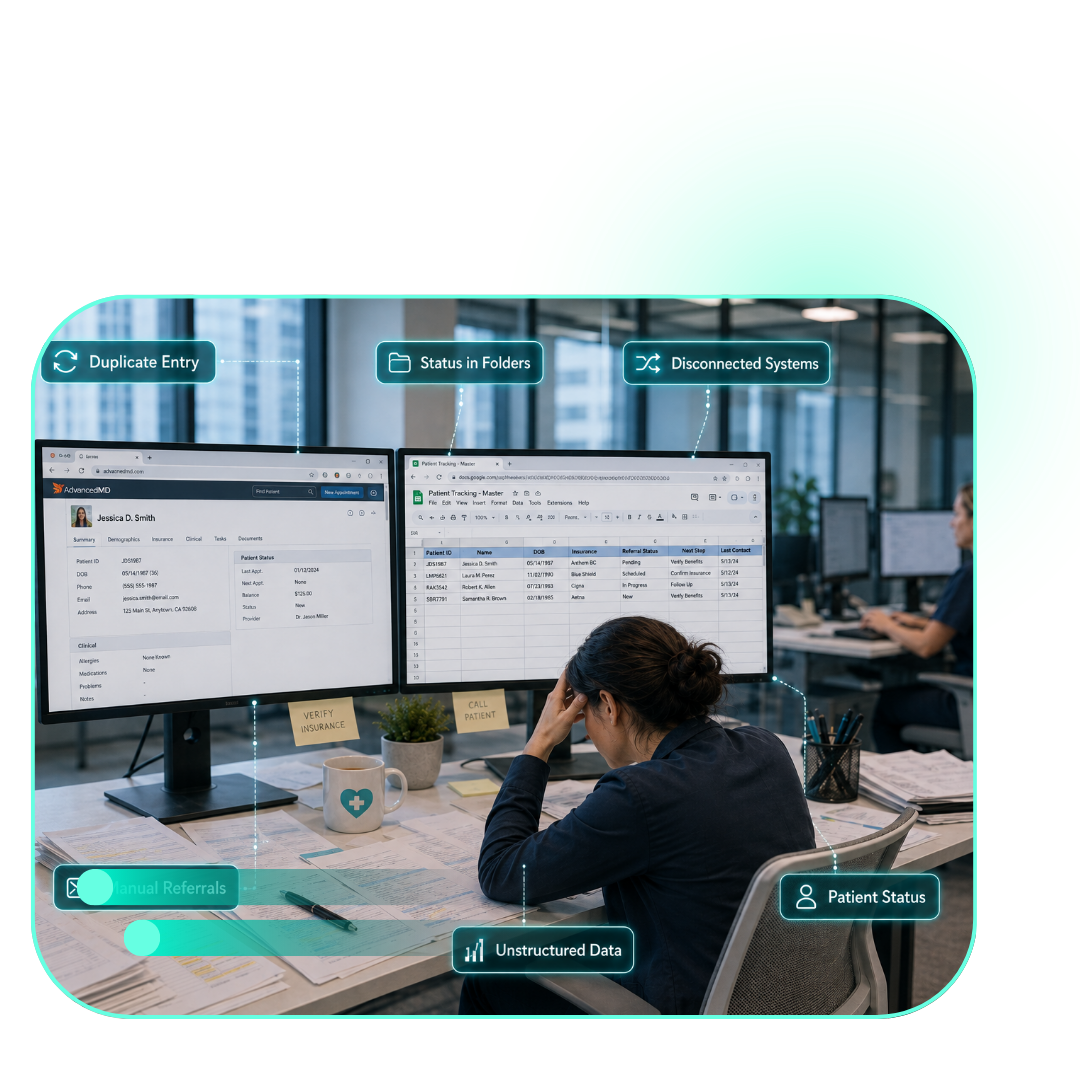
1. No Patient Status Management
AdvancedMD gave staff no streamlined way to track where patients stood in their care journey, forcing status to be reconstructed elsewhere.
2. Duplicate Manual Data Entry
Staff entered patient data into AdvancedMD, then re-entered it across spreadsheets — doubling the work and the risk of error.
3. Status Expressed by File Location
Patient stage was tracked by which Dropbox folder a spreadsheet sat in, making it unreadable to automation and unusable for analysis.
4. Manual Referral Communication
Referring clinics needed automatic updates when patients booked appointments, but manual outreach couldn't scale with patient volume.
5. Fragmented Provider Access
Providers had to move between systems and re-enter existing data just to view records, leave notes, or make updates.
6. Unstructured Reporting Data
Patient and provider data lived in spreadsheets with no structured layer to support scalable, versatile reporting.
"We modeled the patient lifecycle as a ticket pipeline, turning status into a property on the record instead of a file in a folder. That gave us a single source of truth: referral notifications and pipeline updates could trigger automatically, while the AdvancedMD integration ran in parallel to eliminate duplicate data entry at the source."
— Nisha Wendelken
Why Carewright Chose Campaign Creators
The work required two capabilities at once: API-level engineering against a healthcare patient information system, and operational architecture that could translate referral intake, scheduling, provider assignment, report delivery, and billing into a CRM data model usable by administrative staff and clinicians alike. Carewright selected Campaign Creators to deliver both across a five-hub HubSpot Pro deployment.
Campaign Creators' approach centered on client ownership. Every component of the build was documented for Carewright's own team, covering the AdvancedMD field mapping, the migration mapping, the provider assignment logic, and the pipeline workflows, so routine changes would not require agency involvement. The design also stayed inside HubSpot's native capabilities, keeping the system on the ground the client could administer and train new staff on.
Solution: How Campaign Creators Connected AdvancedMD to HubSpot and Automated the Patient Lifecycle

Designing the Patient Management System Architecture
Patient status had no home in AdvancedMD, so the first decision was where the lifecycle would live and what would represent it. Campaign Creators produced a comprehensive system diagram covering the full architecture on the HubSpot platform: custom API integration mechanisms, automated record generation, patient progression through lifecycle stages managed via a ticket pipeline, and a suite of operational automation engineered to optimize workflow efficiency as patients traverse that pipeline.
Modeling the lifecycle as a ticket pipeline turned a patient's stage into a property on a record, which made it readable, reportable, and usable as an automation trigger. No custom objects were used. Keeping the design on standard objects preserved HubSpot's native reporting and automation behavior and kept long-term administration within reach of the client's own team.

Building the AdvancedMD Integration
The duplicate-entry problem could only be solved at the data layer. Campaign Creators built a custom integration between AdvancedMD and HubSpot using the AdvancedMD API and the HubSpot API, authenticated with a Private App token. The integration is critical to operations because it prevents users from having to enter patient details in multiple systems, which decreases both human error and workload.
The build was accompanied by data mapping and developer documentation specifying how data elements in AdvancedMD correspond to data elements in HubSpot, defining the relationships between data fields, their formats, and any conversions required between the two systems. That specificity is what makes the integration maintainable: field-level correspondence is recorded in a reference the client's team can work from, so future changes are made against a documented specification and not against institutional memory.

Migrating Data Off Local Spreadsheets
The client's operational knowledge sat in an array of locally stored spreadsheets covering referring doctors, clinic locations, and patient statuses. Campaign Creators produced a migration mapping that delineated how each of those files would translate into HubSpot objects, then imported the data into the platform.
The sequencing was deliberate. Automating status changes and referral communication becomes possible only once providers, clinics, and patients exist as related records in the CRM. Completing the migration also removed the manual data entry those spreadsheets required and the manual relocation of files that status updates had depended on.
.png?width=80&height=80&name=Round%20Blog%20Thumbnail%20(48).png)
Defining the Property Set
Standard fields alone could not carry the information Carewright's team needed on screen. Campaign Creators used a Fields to be Created worksheet to identify exactly which properties the client's team would require within HubSpot, working from the tasks each role performs daily. Treating the property set as its own exercise gave the record views, workflows, and reporting that depend on those fields a single consistent vocabulary to reference.

Configuring Record Views and Association Labels
A system shared by administrative staff, schedulers, and clinicians cannot present all of them the same screen. Campaign Creators customized the Contact, Company, and Ticket record views so each displays the information relevant to the user viewing the record, reducing the interpretation required to act on a patient's file.
Association labels were configured alongside the views to define how each contact relates to a ticket. These labels are critical for automation because they are what sends the correct information to the correct contact associated with a ticket, the difference between a referring provider receiving a scheduling notice and a patient receiving one meant for their doctor.

Assigning Patients to Providers
Providers needed to view details about the patients they were seeing that day, update details, and leave notes in the CRM without navigating multiple systems. Campaign Creators built a Provider Client Assignment workflow that reads the appointment data synced from AdvancedMD and assigns the corresponding HubSpot records to the appropriate provider.
Permissioning prevents providers from seeing other patient information, a necessary constraint when clinical records live in a shared platform. The workflow logic was documented with instructions Carewright can follow to make the necessary adjustments when onboarding new providers, so clinical staffing changes do not become agency requests.

Automating the Ticket Pipeline
The referral communication Carewright could not sustain manually was the clearest candidate for automation, but the pipeline logic had to reflect the organization's own priorities. Campaign Creators held a series of discussions with the client to understand their KPIs and goals, then formulated the ticket pipeline workflows to automate operational procedures and ensure timely, targeted communication to the appropriate stakeholders.

Building for Adoption
Extensive customization creates an adoption risk: a system tailored to one organization is, by definition, not one new hires already know. Campaign Creators developed a HubSpot training manual with comprehensive, step-by-step instructions for executing most day-to-day tasks, written with particular emphasis on the familiar terminology of the Carewright team and not in generic platform language. Live training supplemented the manual during rollout, and the manual continues to serve both new team members and existing users.
The Results
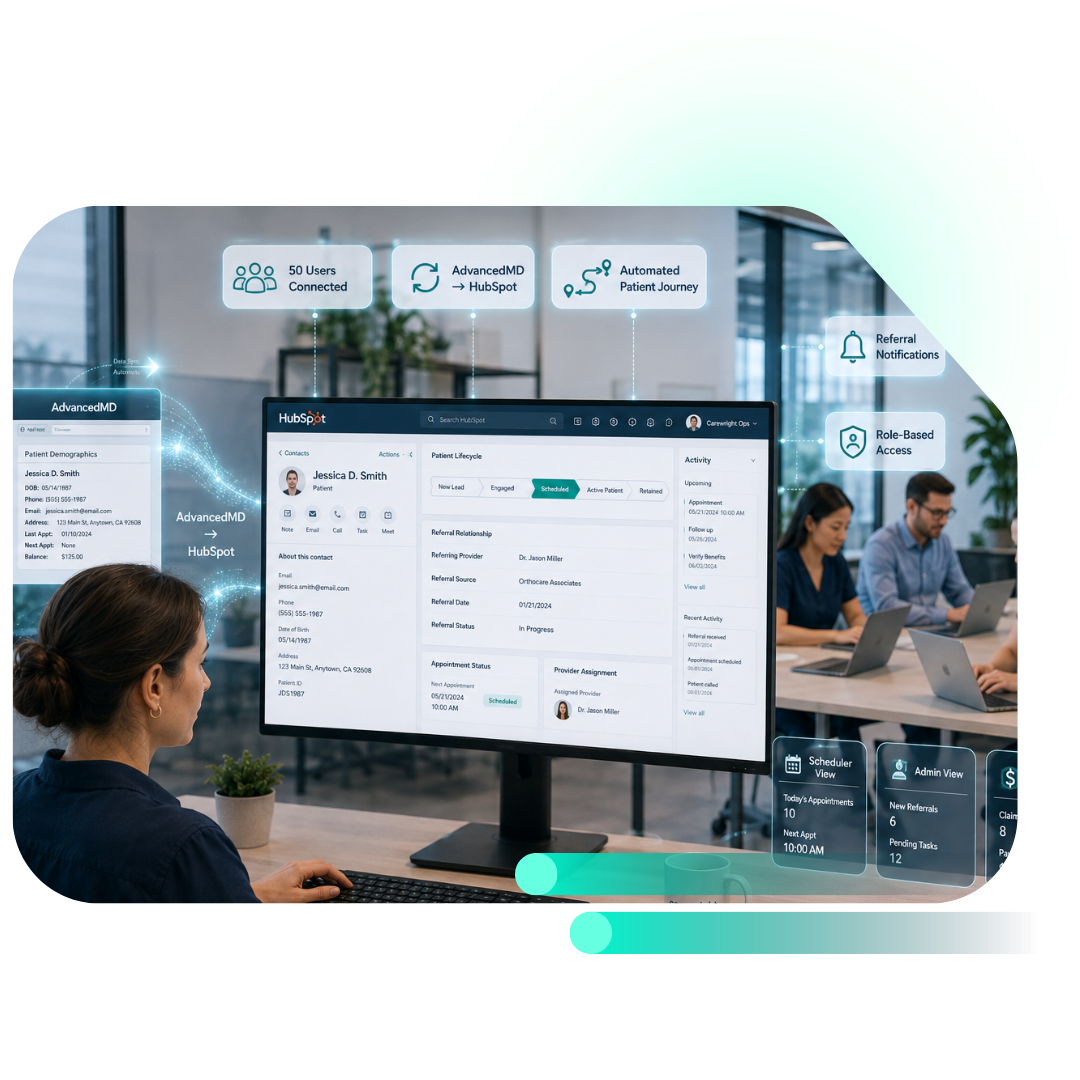
Carewright now manages patient operations from a centralized HubSpot workspace integrated with AdvancedMD.
Key outcomes included:
- 5 HubSpot Pro hubs support 50 users across administrative, scheduling, and clinical roles.
- Patient details entered in AdvancedMD sync to HubSpot through the custom API integration, eliminating most duplicate manual entry between systems.
- Patient lifecycle stage advances automatically in 1 ticket pipeline, replacing spreadsheets shuffled between Dropbox folders.
- 3 categories of locally stored data, covering referring doctors, clinic locations, and patient statuses, exist as related CRM records.
- 3 customized record views present Contact, Company, and Ticket data by role.
- Referring doctors are notified automatically when their patient is scheduled and when the post-appointment report is complete.
- Patients the scheduling team cannot reach by phone receive an automated email.
- The scheduling team is notified of new referrals ready to schedule, and providers are notified of new bookings.
- Providers work from records assigned by synced appointment data, with permissioning limiting each view to their own patients.
- Carewright's team administers the system from documented mapping, workflow instructions, and a training manual in its own terminology.
One system now holds patient records, lifecycle status, referral relationships, and provider assignments, with communication to each audience triggered by the data itself.
Impact:
A Clinical Operations Platform the Client Now Extends Itself
The lasting value of this engagement is structural. Carewright's patient lifecycle, referral relationships, and provider assignments exist as data in one platform, which makes each of them automatable, reportable, and extensible in ways a folder of files never could be.
That foundation was built to be added to. Because the architecture uses standard HubSpot objects and a deliberately defined property set, new automation, new notification paths, and new reporting can be layered on without restructuring the data model. Because the integration mapping and provider assignment logic are documented at field level, the client's own team can onboard a new provider or adjust a mapped field without waiting on the agency.
That is what has happened in practice. The engagement has run continuously since February 2, 2023, and under Campaign Creators' guidance, Carewright has continuously improved the assets the team initially created. The live portal now reflects enhancements beyond what the original documentation captures.
Solve Healthcare System Integration and Patient Lifecycle Tracking With Campaign Creators
When a patient information system holds the data but not the workflow, people absorb the difference. Duplicate entry, tracking spreadsheets, and manual outreach to referral sources fill the gap, and that labor grows with every new patient.
Closing it takes more than adding software. It takes API-level integration between systems of record, a data model built around how clinical and administrative teams actually work, automated communication to patients, providers, and referral partners, and documentation and training that leave the system in the client's hands.
Campaign Creators builds this infrastructure for organizations running specialized industry platforms and complex operational requirements. If your team is integrating an industry-specific system with HubSpot, moving operational tracking out of spreadsheets, or automating communication across patients, providers, and referral partners, we can build the foundation your organization needs to scale. Reach out to us today!