






6 min read

Rolling Out HubSpot & Aircall: A Guide for Sales and Support Leaders

Rolling Out HubSpot & Aircall: A Guide for Sales and Support Leaders

Many sales and support organizations are held back by disconnected tools. Calls, tickets, and customer data live in separate systems, forcing teams to swivel between platforms and leaving customers to repeat information at every touchpoint.

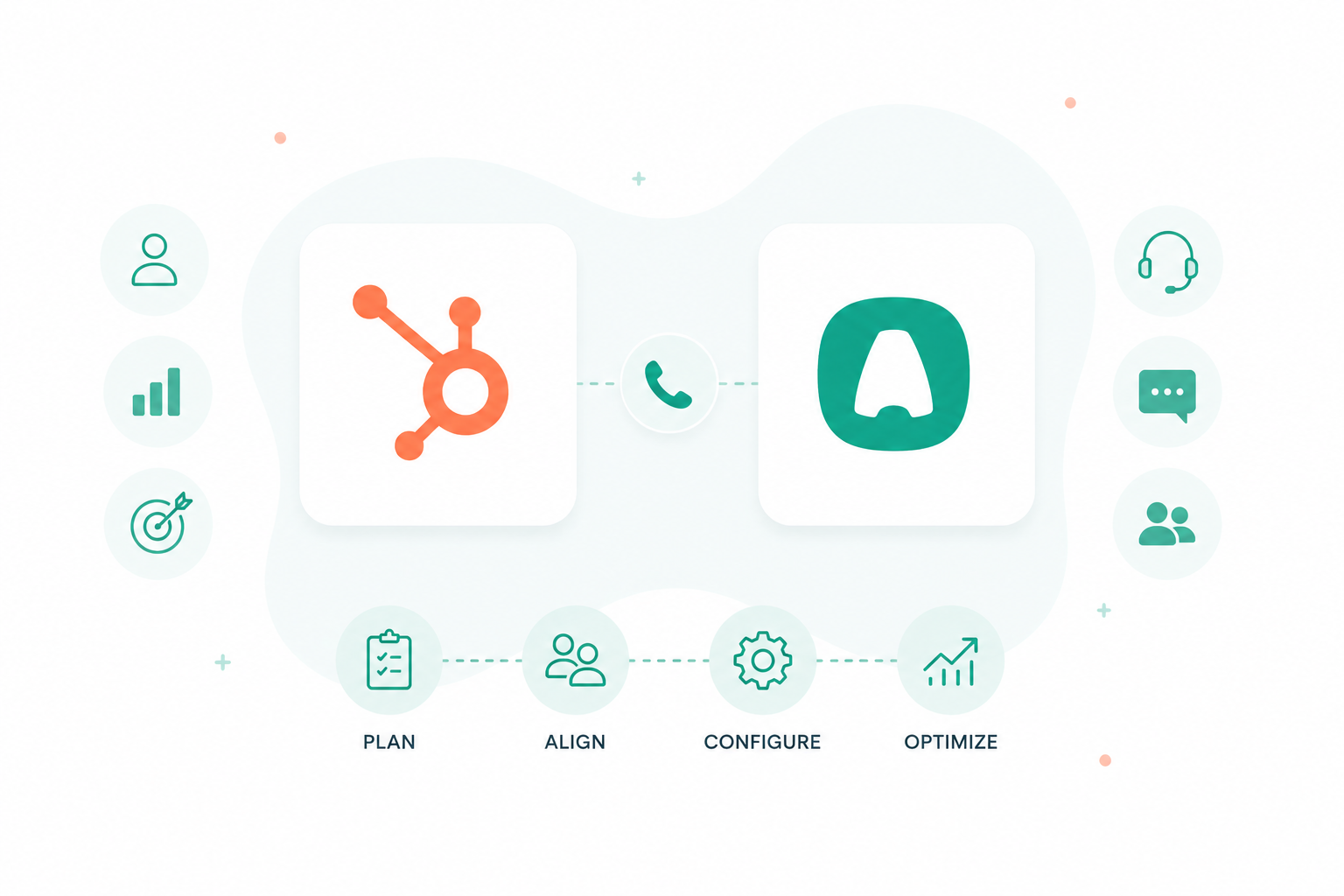
HubSpot and Aircall solve that fragmentation when they’re architected to work together. HubSpot centralizes your customer data, pipeline, and engagement history. Aircall layers on an AI-powered customer communication platform—voice, SMS, MMS, and WhatsApp—that connects directly into your CRM. The result is an omnichannel communication layer that writes cleanly into HubSpot and gives every team access to the same, current source of truth.

In this blog, we’ll walk through how to think about rolling out HubSpot and Aircall—whether in phases or together—and how to align your implementation approach to your team’s capacity, CX goals, and revenue targets.

What Is the HubSpot + Aircall Integration?

What Is the HubSpot and Aircall Integration?

HubSpot is your CRM and revenue system of record. It consolidates customer data, email engagement, deals, tickets, and reporting so marketing, sales, and service operate from one shared view of the customer.

Aircall is an AI-powered customer communication platform built around voice, with robust support for SMS, MMS, and WhatsApp. That multichannel foundation lets your teams engage customers on their preferred channels while maintaining consistent workflows and data hygiene.

With Aircall connected to HubSpot, your teams can:

  • Make and receive calls from anywhere

  • Send and receive SMS and MMS

  • Manage WhatsApp conversations

All while every interaction is logged back to the contact, company, deal, or ticket with notes, tags, outcomes, and analytics.

When you integrate Aircall and HubSpot correctly, they operate as one system rather than two tools. Calls, messages, and key customer context sync in real time. Sales and support teams gain full visibility into every interaction, which:

  • Reduces manual work and duplicate data entry

  • Improves reporting accuracy and SLA tracking

  • Enables a more consistent, personalized customer experience across channels

Ways to Roll Out HubSpot + Aircall

Once you’ve decided to connect HubSpot and Aircall, the next strategic decision is implementation sequencing. Some organizations introduce HubSpot first and layer in Aircall later. Others align stakeholders and go live with both platforms at once.

Both paths can work—but each carries different implications for adoption, CX, and revenue performance. The right choice depends on your team’s bandwidth, change management maturity, and near-term business priorities.

Option 1: Sequential Implementation (HubSpot First, Aircall Later)

Rolling out HubSpot first is often perceived as a lower-risk starting point. It allows your organization to stabilize its CRM, clean data, and standardize core processes before introducing a new communications layer.

From a change management standpoint, this can feel more manageable: one new platform, one primary enablement plan, one set of behaviors to reinforce.

However, there are tradeoffs:

  • Sales teams miss out on click-to-dial, automatic call logging, and integrated text messaging tied directly to deals and sequences. This slows pipeline velocity and introduces more manual admin work.

  • Support teams endure two distinct training and adoption cycles—one for HubSpot, one for Aircall—creating repeated disruptions and delaying the ability to log calls and messages directly into tickets.

  • Customer experience remains fragmented when call and message data lives outside the system of record, forcing agents to recreate context and piece together interactions across multiple tools.

The customer impact is non-trivial. 72% of clients say they attribute poor service experiences to having to repeat themselves to multiple agents. A staggered rollout can prolong those friction points and extend the time it takes to deliver a truly connected experience.

Here’s how the pros and cons break down in more detail:

Pros

The primary benefit of a sequential rollout is focused adoption. Teams can fully absorb HubSpot’s foundational capabilities—lead and account management, deal tracking, ticketing, reporting, and core automation—before layering on integrated calling and messaging.

This reduces cognitive load and makes it easier to design training around specific outcomes (e.g., pipeline visibility, ticket management) rather than spreading attention across two tools. Leadership can stage change in waves, measure adoption, and iterate before introducing the next layer of complexity.


Cons for Sales

For sales, the downside is lost momentum.

Without Aircall in place from day one, reps:

  • Lack native click-to-dial within HubSpot

  • Must log calls manually or work out of a separate system

  • Can’t fully leverage integrated SMS/MMS for follow-up and qualificatio 

This not only consumes valuable selling time, it also delays the benefits of having complete engagement history driving sequences, scoring, and forecasting. Opportunities are more likely to stall when communication data and CRM data are out of sync, and real-time multichannel tracking in HubSpot remains limited.

Cons for Support

Support teams encounter similar friction.

Because Aircall is introduced later:

  • Agents must be retrained and workflows reconfigured a second time

  • Ticket workflows are initially designed without real-time call and message context

  • Customer history remains split across systems, complicating SLA management and QA

This fragmentation makes it harder to manage response and resolution times accurately, and it limits your ability to build consistent, omnichannel experiences early in the program. The service organization ends up optimizing processes twice instead of once.

Option 2: Simultaneous Implementation (HubSpot + Aircall Together)

Launching HubSpot and Aircall together requires more upfront orchestration, but it also compresses the time to value. When the integration is included from the start, you’re architecting a single revenue and service environment rather than bolting on communications later.

Key advantages include:

  • Sales teams get click-to-dial, call and message logging, and deal tracking in HubSpot from day one. They ramp on a complete toolset, not a partial one, and can operate against a single source of truth from their first prospecting call.

  • Support teams gain immediate omnichannel visibility. Tickets, calls, SMS, MMS, and WhatsApp conversations sync into HubSpot, giving agents the context required to resolve issues quickly and consistently.

  • The organization goes through one coordinated onboarding and change management cycle. Training, documentation, and process design are aligned to the integrated environment, which improves adoption and reduces “rework” later.

Operational efficiency improves as well. Once both systems are live and integrated

  • Data syncs in real time, closing gaps between channels and CRM

  • Automation can be designed around actual communication touchpoints

  • Reporting reflects the full customer journey from the outset

The investment is front-loaded in terms of planning, stakeholder alignment, and enablement. Revenue, service, and operations leaders need to be aligned on requirements and ready to make decisions. For organizations that can support that level of readiness, the performance and CX benefits surface much faster.

Here’s a deeper look at the tradeoffs:

Cons

The primary challenge is onboarding complexity.

With a simultaneous rollout:

  • Teams are introduced to CRM workflows and communication workflows at the same time

  • Training agendas are denser, and some employees may feel the learning curve more acutely

  • Managers must choreograph changes across sales, marketing, service, and RevOps concurrently

Without a clear implementation plan, strong internal champions, and structured enablement assets, this can slow early adoption or create uneven usage patterns across teams.

Pros for Sales

For sales, the upside is substantial and immediate.

From day one, reps can

  • Place calls directly from HubSpot

  • Log calls and messages automatically against contacts, companies, and deals

  • Trigger workflows, tasks, and sequences based on real interaction dat

This reduces friction in daily workflows and accelerates time-to-productivity for new reps. Data integrity improves because activity logging is automated instead of optional.

80% of customer support specialists agree that AI and automation tools reduce time spent on manual work like data entry and scheduling. Sales teams feel that same benefit when communication and CRM operate as one system, freeing more time for conversations and follow-up.

Pros for Support

Support organizations also see immediate operational lift.

With the integration live from the start:

  • Calls, texts, WhatsApp messages, and tickets are unified in HubSpot

  • Agents gain a complete view of each customer’s journey before they pick up the phone or respond

  • Supervisors can monitor performance, manage SLAs, and coach using holistic interaction data

Training occurs once around the integrated toolset, which minimizes disruption and avoids retraining teams on “the new way” a second time. With the right architecture and workflows in place, support leaders can begin optimizing CSAT, first response time, and resolution time as soon as the system goes live—rather than waiting for a second implementation phase.


Decision Checklist: Choosing What’s Right for You

Deciding whether to roll out HubSpot and Aircall together or one at a time comes down to your team’s readiness and your business priorities. 

Every organization has different goals, resources, and customer needs, so the right path is the one that best supports your growth and service targets. Here are the questions to ask before making your choice.

Do we have the bandwidth to train sales and support at the same time?

If your team is already stretched thin, taking on two systems at once may feel overwhelming. Training on HubSpot and Aircall together requires extra planning, more time, and careful coordination between sales, support, and operations leaders. 

If you know your staff needs more breathing room, a sequential rollout may make adoption smoother.

Are our CSAT and SLA targets urgent enough to justify immediate integration

If customer satisfaction scores or service-level agreements are under pressure, waiting to add Aircall could make things worse.

Agents without call and message logging and ticket syncs are forced to juggle tools, which slows down response times and hurts the customer experience. In these cases, simultaneous rollout may be worth the extra effort to see results sooner.

Will delaying Aircall slow down revenue or resolution targets?

For sales, every day without integrated communication is a missed chance to speed up the pipeline. 

For support, the delay means longer resolution times and less visibility into customer history. If fast growth and quick service outcomes are top priorities, rolling both tools out together is often the stronger choice.

Are there budgetary or technical blockers to implementing both now?

Sometimes the challenge isn’t team readiness but resources. If your budget only allows for one rollout, or your IT team needs more time to prepare for the integration, starting with HubSpot first might be the more realistic step. 

But keep in mind that 70% of consumers expect company representatives to know their purchase history and previous interactions. If your systems stay disconnected for too long, you risk falling short of customer expectations.


The Balanced Take

Both approaches can work, but the right one depends on your team's situation. A sequential rollout makes sense if resources are limited and you need to pace the change. It gives your staff more time to adapt, even if it means waiting longer for the full benefits.

On the other hand, rolling out HubSpot and Aircall together maximizes ROI earlier. Sales and support teams get the full picture from the start, and customers feel the difference in faster, smoother service across all communication channels.

In the end, the best choice is the one that aligns with your revenue goals and your customer experience priorities.

Need to Fix the System Before You Scale It?

Campaign Creators helps companies design and implement HubSpot and Aircall environments that actually support how their operations work. Whether you're rolling out in phases or rethinking your entire setup, we focus on getting the architecture right first—so your systems perform as expected once they’re live.