.png?width=420&height=121&name=cc-logo-color%20(2024).png "Campaign Creators - logo in dark blue and transparent background")


 Campaign Creators
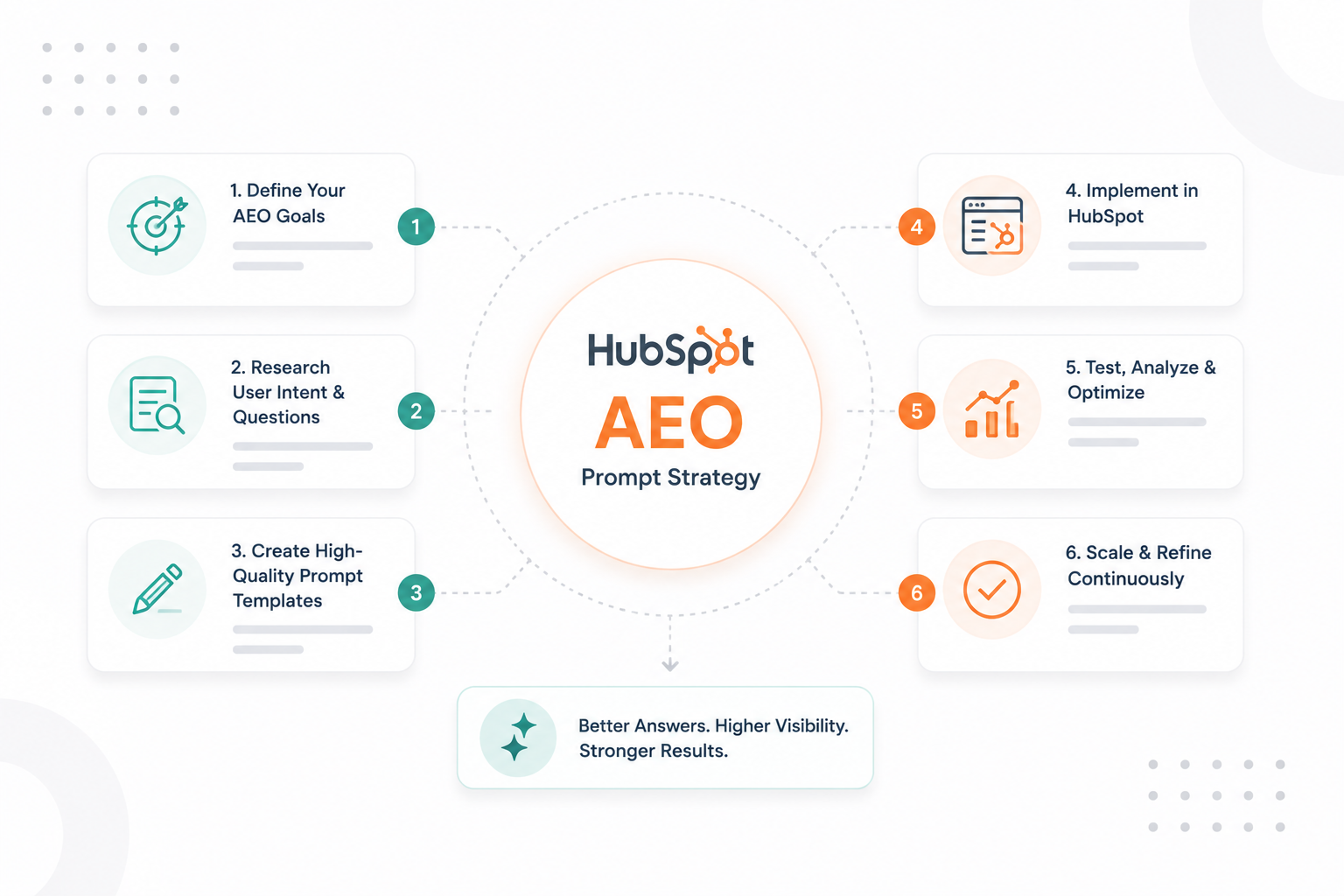
ChatGPT, Google Gemini, and Perplexity are now part of the buying journey, influencing how customers research brands and make decisions. Because of this shift, businesses need to measure whether they appear in AI-generated answers during key research moments. That is where AEO prompt tracking becomes valuable.
An AEO prompt strategy helps you track and analyze the questions buyers ask across AI search platforms so you can measure visibility, identify citation gaps, and improve how AI systems describe your brand.
This guide explains how to build an AEO prompt strategy in HubSpot, structure your prompt library, track the right metrics, and improve citation visibility over time.
Why Does AEO Prompt Tracking Matter in AI Search?
Prompt tracking helps brands understand:
- Presence vs. Position: Whether your business appears in AI-generated responses, not just where a webpage ranks.
- Contextual Characterization: How AI systems describe your brand, such as a market leader, challenger, or trusted source.
- Extractability: Whether your content structure makes it easy for AI systems to lift, summarize, and cite your information directly.
This creates what many teams now describe as the “zero-click funnel,” where answer engines become the first and sometimes only touchpoint before a buyer makes a decision.

Because users often receive answers without visiting websites, traditional SEO metrics like rankings, traffic, and click-through rates no longer fully reflect visibility in AI-driven search environments.
That makes prompt tracking one of the few ways to measure whether your brand is actually surfacing in AI-assisted discovery.
5 Steps to Build an AEO Prompt Strategy Inside HubSpot
1. Define What Visibility Means for Your Business
Before building prompts, define what your company actually wants to measure inside AI search environments.
Some teams care most about educational visibility early in the funnel. Others care more about appearing in comparison prompts, product evaluations, or high-intent purchase research.
Your strategy should identify:
- Which buyer stages matter most
- Which products or services need AI visibility
- Which competitors frequently appear in AI-generated answers
- Which conversion paths influence pipeline and revenue
This creates a clearer framework for deciding which prompts deserve ongoing tracking instead of building a large prompt library without business context.
HubSpot reporting can later connect these prompt categories to lifecycle stages, campaigns, and attribution reporting tied to contacts, deals, and revenue.
2. Build a Prompt Library Using Real Customer Language
Once your goals are clear, build a structured prompt library around how buyers actually search in AI platforms like ChatGPT, Gemini, and Perplexity.
Pull language directly from:
- Sales calls
- CRM notes
- Support conversations
- Customer interviews
- Search query data
- Community discussions
Your prompts should reflect multiple search behaviors across the funnel. A marketing executive may search broader strategic questions, while operational users often search implementation workflows, integrations, pricing comparisons, or troubleshooting queries.
Research around AEO and generative search shows that AI systems favor content that directly answers natural-language questions in clear, machine-readable formats.
Inside HubSpot, these prompts can later be categorized into reporting segments tied to:
- Funnel stages
- Product lines
- Service categories
- Geographic markets
- Customer segments
3. Map Prompts to Lifecycle Stages and Attribution Reporting
A strong AEO strategy measures visibility across the full customer journey rather than treating prompts as isolated searches.
Inside HubSpot, prompts can be aligned to lifecycle stages such as:
- Awareness
- Consideration
- Decision
- Customer expansion
For example, your brand may appear frequently in educational searches but disappear during vendor comparison prompts or implementation-focused questions. That visibility gap often reveals where your content lacks authority, specificity, or structured answers.
HubSpot’s lifecycle stage reporting and attribution models can help connect these visibility patterns to CRM progression and influence revenue outcomes.
This also creates stronger alignment between SEO, content, demand generation, and sales teams because prompt visibility becomes measurable against pipeline performance.
4. Organize Prompt Clusters Around Reporting and Content Gaps
As your prompt library grows, organization becomes less about storage and more about operational reporting. Prompts should be grouped into clusters tied to:
- Intent type
- Topic categories
- Funnel stages
- Competitor comparisons
- Product use cases
- Industry verticals
This makes it easier to identify which topics generate the strongest AI visibility, prompts competitors to dominate, funnel stages lack citation coverage, and pages should support higher-intent prompts.
HubSpot AEO has a recommendation tab that organizes opportunities based on content type, channel, and priority level.
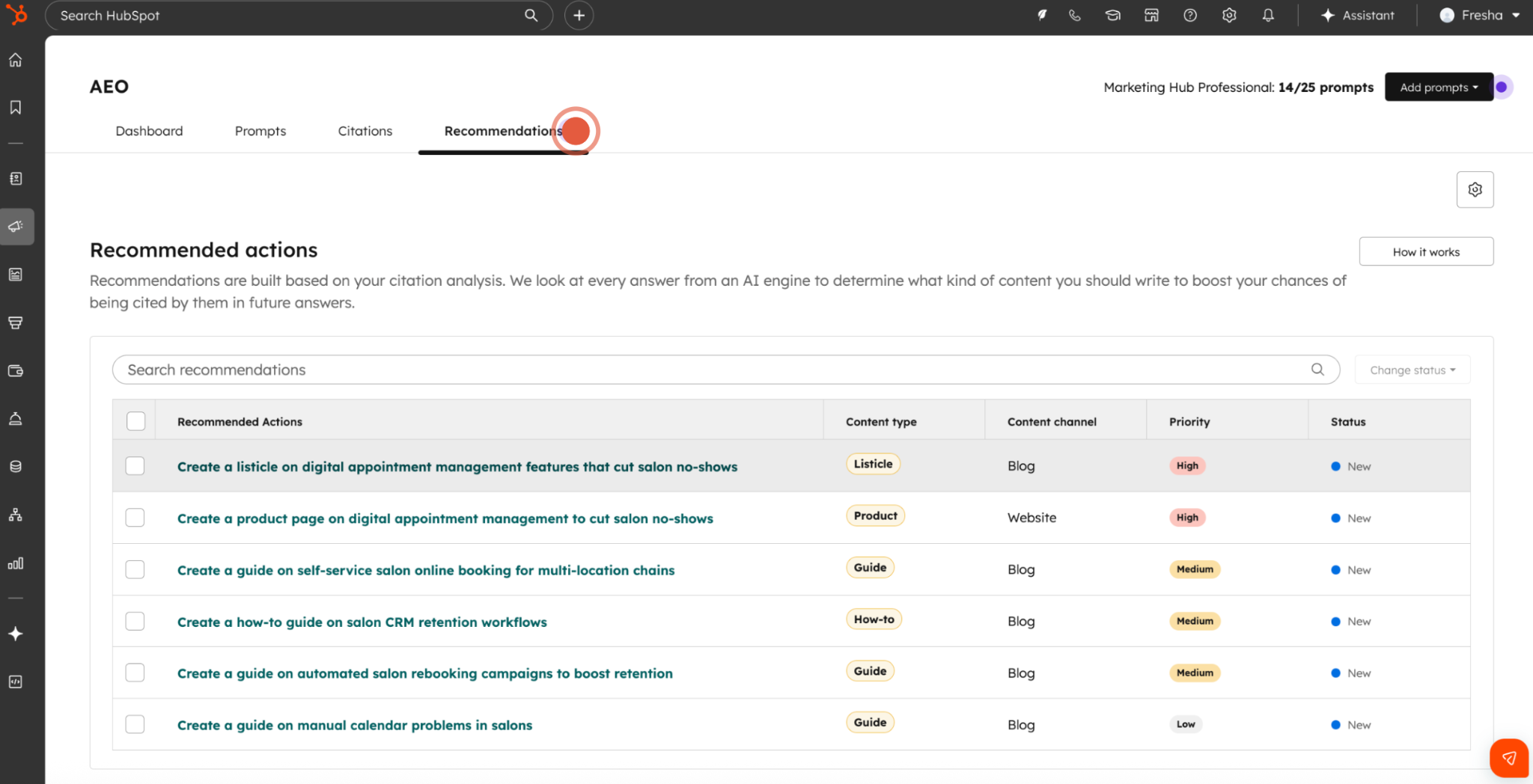
This helps teams quickly connect prompt performance data to content decisions and visibility opportunities across the funnel.
5. Continuously Refine the Strategy With Visibility and Funnel Data
An AEO prompt strategy needs continuous refinement because AI search behavior changes rapidly across engines, prompts, and citation patterns.
Your review process should focus on:
- Emerging buyer questions
- Competitor visibility changes
- Prompt categories are losing citations
- Funnel stages with declining visibility
- Content that no longer aligns with search intent
Teams also need a way to measure whether those changes are affecting business outcomes beyond search exposure alone. HubSpot workflows, reporting dashboards, and attribution analysis can help monitor how AI visibility evolves over time and whether it influences lead quality, lifecycle progression, or revenue attribution.
Learn more about how to use HubSpot AEO in this guide.
The AEO Metrics You Should Track Inside HubSpot
These metrics below do more than measure how often your brand appears in AI-generated answers. They also help you understand how AI platforms describe your business and whether that visibility contributes to revenue.
Core Visibility and Coverage Metrics
Visibility metrics measure whether your brand is appearing in AI-generated answers at all.
- Brand Visibility Score: Tracks the percentage of your tracked prompts that generate AI responses mentioning your brand.
- Coverage by Engine: Measures your visibility separately across platforms like ChatGPT, Gemini, and Perplexity so you can identify platform-specific gaps.
- Citation Frequency: Tracks how often your brand, domain, or specific URLs are cited across your prompt library.
- Citation Placement: Measures where your brand appears within the answer, such as being the first cited source versus appearing lower in the response.
Coverage by engine matters because answer engines do not produce the same results. Your brand may appear frequently in Perplexity because of its web-retrieval system, but have limited visibility in Gemini or ChatGPT for the same query.
Citation Share and Competitive Benchmarking
These metrics help you compare your AI visibility against competitors within your industry.
- Citation Share (Share of Voice): Measures how often your brand appears compared to competitors across all tracked prompts.
- Market Competition (Category Role): Evaluates whether AI platforms position your company as a Leader, Challenger, or Niche Player within your category.
- Innovation Perception: Tracks whether AI describes your brand as an Innovator, Disruptor, or more traditional company.
Citation share functions similarly to organic share of voice in SEO. It helps you identify where competitors are dominating AI-generated conversations on high-priority topics.
Qualitative Perception and Brand Sentiment
AEO also measures how AI systems describe your reputation and authority.
- Sentiment Score: Tracks whether AI-generated descriptions of your brand are positive, neutral, or negative using a scale from -100% to +100%.
- Presence Quality: Measures the strength and depth of your brand mentions, including the authority of the sources influencing AI responses.
- Brand Recognition: Evaluates how well AI systems understand your brand based on training data, citations, and available information online.
Appearing in responses only helps if the platform describes your brand positively and accurately. Consider using HubSpot AI sentiment analysis to monitor whether your brand is positioned favorably, neutrally, or negatively throughout the buyer journey.
CRM Integration and Pipeline Performance
One of the biggest advantages of using AEO inside HubSpot is the ability to connect AI visibility directly to lead generation and revenue performance.
- Referral Traffic from Answer Engines: Tracks visits coming from platforms like Perplexity that provide measurable referral data.
- AI-Informed Pipeline: Measures revenue opportunities influenced by contacts who interacted with your brand after an AI search touchpoint.
- Lifecycle Velocity: Tracks how quickly leads move through CRM stages after exposure to AI-generated answers mentioning your brand.
Together, these insights help your team understand whether AI visibility contributes to lead quality, pipeline growth, and revenue outcomes instead of measuring visibility alone.
How to Improve AI Visibility and Citation Share Over Time
1. Optimize Content Extractability for AI Retrieval
AI systems prioritize content that is easy to extract, summarize, and cite within generated responses.

Pages with concise definitions, structured sections, and answer-first formatting are significantly easier for answer engines to process at the passage level. Long introductions, vague transitions, and oversized text blocks often reduce citation probability because the content becomes harder to isolate cleanly.
Several formatting patterns consistently improve retrieval quality:
- Concise opening summaries
- Comparison tables
- Structured definitions
Passage-level clarity also matters. AI systems frequently retrieve small sections of content rather than entire pages, which means each section should communicate a complete idea without relying heavily on surrounding context.
2. Strengthen Entity Clarity Across Content
Entity clarity helps search engines understand the relationship between your brand, products, services, and topics.
Generative engines rely heavily on semantic relationships and knowledge graph associations when deciding which sources to cite. Clear subject-predicate-object phrasing improves how consistently your brand appears across AI-generated responses.
For example:
- “HubSpot provides AI visibility tracking.”
- “Perplexity retrieves external citations.”
This type of structure helps reinforce category association and reduces ambiguity around what your business actually does.
When entity language changes across pages or platforms, answer engines may struggle to connect those references into a unified brand profile.
3. Expand Citation Signals With Original Information
Original information gives AI systems stronger reasons to reference your content instead of repeating generic summaries already available elsewhere.
Answer engines frequently prioritize pages containing:
- Proprietary statistics
- Benchmark data
- Implementation insights
This is especially important for comparison prompts, strategic research queries, and evaluation-stage searches where AI systems look for differentiated information to strengthen generated responses.
Research-backed insights, measurable outcomes, and unique observations also increase the likelihood of secondary citations across blogs, industry publications, and community discussions, which further strengthen AI visibility over time.
4. Improve Technical Accessibility for AI Crawlers
Many AI crawlers still struggle with JavaScript-heavy rendering, fragmented layouts, hidden content modules, and poor HTML structure. Pages with clean semantic formatting and machine-readable organization are easier to interpret reliably.

The highest-impact improvements usually involve:
- Crawlable HTML structure
- FAQ and organization schema
- Clean heading hierarchy
Schema markup also strengthens contextual understanding around products, services, organizations, authorship, and topical relevance.
Formats such as FAQPage, Article, and Organization schema help reinforce meaning and reduce ambiguity during retrieval.
5. Build Broader Authority Across External Sources
Answer engines frequently pull supporting information from Reddit, LinkedIn, G2, Quora, review sites, and industry publications when generating responses. Strong external references improve trust signals and reinforce market positioning within AI-generated summaries.
This also means AI visibility cannot rely entirely on your website content. You need consistent visibility and participation across the platforms that answer engines repeatedly retrieve information from.
Publishing insights on LinkedIn, contributing to industry discussions, earning reviews, appearing in comparison conversations, and building references across trusted communities all help strengthen how AI systems interpret your authority within a category.
Start Tracking Your Brand’s AI Visibility Today!
Teams that continuously refine their prompt libraries, improve extractability, strengthen authority signals, and align AI visibility reporting with business outcomes will have a stronger position in AI-assisted discovery and category-level conversations over time.
If you want to build a more advanced AEO workflow inside HubSpot, you may also seek guidance from experienced HubSpot professionals and AEO strategists who can help structure your prompt tracking system.
At Campaign Creators, we help businesses implement HubSpot AEO strategies that strengthen AI visibility and optimize content for AI-generated discovery.
