

Skip to the main content.

WEBSITE GROWTH & CONVERSION

• Web Design & Development


• SEO & AEO


• Conversion Rate Optimization


• Lead Generation Strategies


HUBSPOT SUPPORT & ENABLEMENT

• HubDesk


• HubSpot Training


• HubSpot Change Management


• HubSpot AI Agent Implementation

FREE TOOLS & ASSESSMENTS

• AEO Auditor


• HubSpot Al Readiness Scorecard


• HubSpot Al Solutions Design


LEARN & WATCH

• View All Resources


• Ebooks & Templates


• Webinars On-Demand


• Expert Videos

9 min read

How ChatGPT Ads in HubSpot Turn AI Search Into a Measurable Revenue Channel

How ChatGPT Ads in HubSpot Turn AI Search Into a Measurable Revenue Channel

If your buyers ask ChatGPT for vendor recommendations, you can now meet them there with an ad and track what happens next in HubSpot. In September 2026, HubSpot became the first CRM to integrate with ChatGPT Ads, so you can build, launch, and measure ChatGPT campaigns from the same Ads tool you already use for Google, LinkedIn, and Meta.

Here's the part worth paying attention to. ChatGPT now lives inside your CRM as a paid channel, with lead capture, workflow automation, conversion signals, and revenue attribution built in. A click from a ChatGPT conversation can be traced all the way to a contact, a deal, and closed-won revenue.

For B2B teams, that changes how demand generation works. Your buyers are already doing their research in AI assistants, and ChatGPT reached 900 million weekly active users in February 2026. Now you can plan, fund, optimize, and report on AI search with the same confidence you bring to paid search.

Key Takeaways

  • ChatGPT Ads in HubSpot puts AI search inside the CRM, next to Google, LinkedIn, and Meta.
  • Clicks from ChatGPT ads become tracked contacts that can enter workflows the moment they convert.
  • HubSpot sends lifecycle stage changes back to ChatGPT Ads, so the platform optimizes toward closed deals.
  • Ads reach only Free and Go users in select markets for now, so ChatGPT works best as one channel in a broader paid mix.

What Changed When HubSpot Added ChatGPT Ads?

hubspot-and-chatgpt-ads-integration

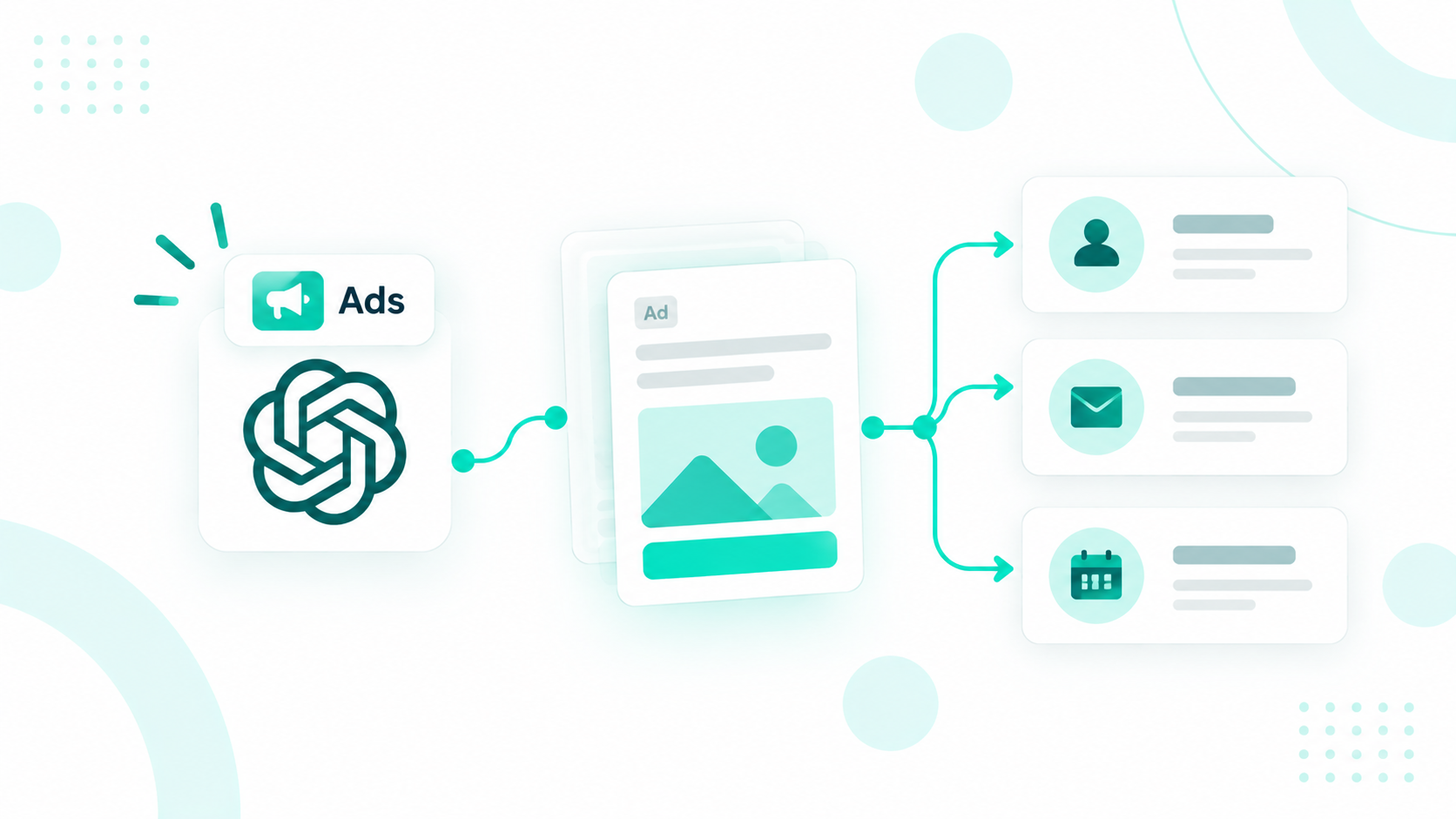
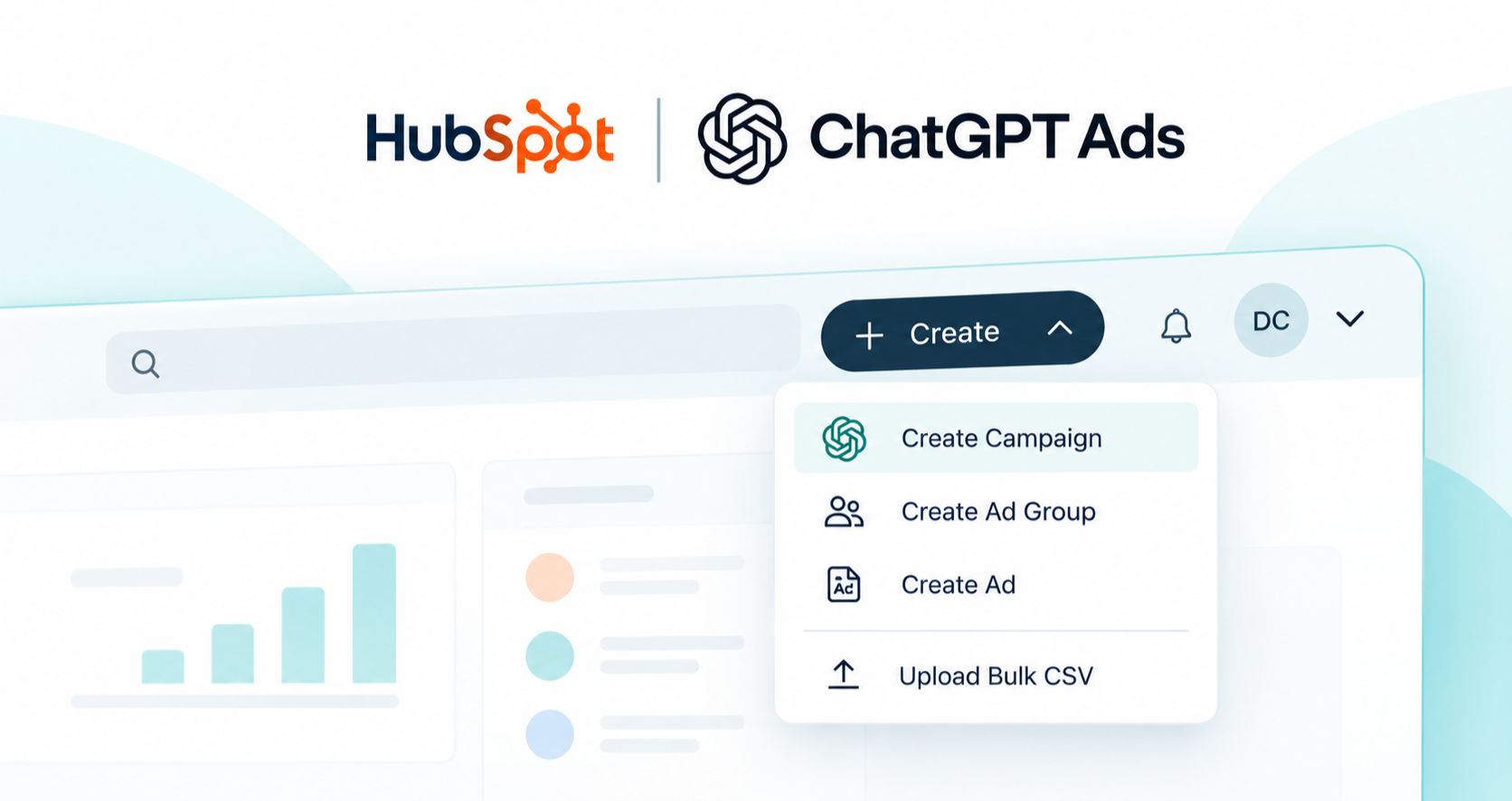
HubSpot now runs ChatGPT Ads from its Ads tool and connects every ChatGPT click, lead, and deal to the CRM. Teams can connect a ChatGPT Ads account, build campaigns, add creative, set budgets, and schedule ads without leaving HubSpot.

OpenAI announced the partnership on September 16, 2026, and CMSWire reported that HubSpot became OpenAI's first CRM partner, with Shopify as its first ecommerce partner. The same release introduced AI tools for creating ads and a test of a new format called Sponsored Agents.

Before the integration, ChatGPT advertisers worked in OpenAI's own Ads Manager, with measurement built around a pixel and the Conversions API. Now each ChatGPT touchpoint lives on the same CRM record as email, events, sales calls, and every other channel. ChatGPT runs inside the system that decides lead routing, nurture, and budget.

What Is an AI-Native Demand Generation System?

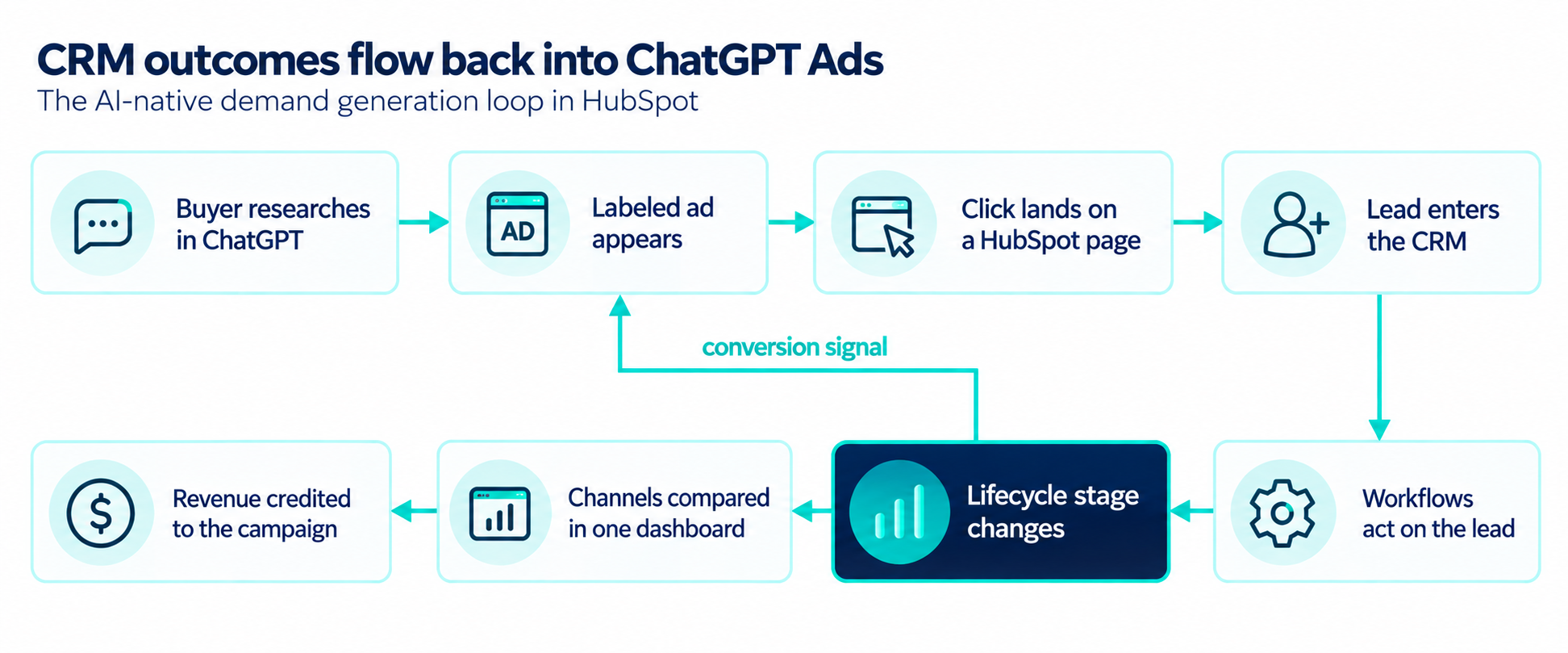
An AI-native demand generation system treats AI assistants as a full channel in the funnel, connected to the CRM in both directions. Buyers discover the company in an AI conversation, the CRM captures and acts on their engagement, and CRM outcomes flow back to the ad platform and into revenue reporting.

ai-native-demand-generation-loop-in-hubspot

The top row is the buyer's path into HubSpot, and the bottom row is what HubSpot does with the lead once it arrives.

The loop is what makes the system AI-native. Each campaign teaches the CRM which conversations produce customers, and the CRM teaches the ad platform which buyers to reach next.

Layer

Traditional Stack

AI-Native System

AI search

Tracked as referral or direct traffic, if at all

Managed as a paid and organic channel inside the CRM

Lead capture

Generic landing pages and forms

Pages and forms matched to the conversation topic

Follow-up

One nurture track for every source

Workflows triggered by ChatGPT ad engagement

Ad optimization

Tuned toward clicks or form fills

Trained on lifecycle stages and closed deals

Measurement

Separate dashboards per channel

One attribution model across every channel


How Does a Buyer Move From ChatGPT Into the CRM?

A buyer researches a problem in ChatGPT, sees a labeled ad, clicks through to a HubSpot page or lead form, and becomes a contact record in the CRM.

Discovery Happens Inside the Conversation

Buyers now do a large share of early vendor research in AI assistants. Forrester's Buyers' Journey Survey found generative AI tools were the single most cited meaningful interaction for researching purchases. A buyer asking ChatGPT how to clean up a CRM after an acquisition, or which agencies handle Marketo migrations, is building a shortlist before any vendor sees a site visit.

The Ad Appears Below the Answer

ChatGPT shows ads at the bottom of an answer when a sponsored product or service is relevant to the current conversation. Ads are clearly labeled, and HubSpot's launch post notes that they never influence ChatGPT's answers or expose conversation data to advertisers. The ad reaches buyers while they are still working through the problem.

The Click Lands in HubSpot

A click can lead to a HubSpot landing page or a ChatGPT Ads lead gen form. With auto-tracking turned on, HubSpot appends UTM parameters to ChatGPT Ads URLs and links each click to a contact and its deals. That tracking is what separates a paid ChatGPT click from an anonymous AI referral.

The Lead Enters the CRM

Lead gen form submissions from ChatGPT Ads create HubSpot contacts automatically. The record keeps the source and campaign, then collects every later touch. Sales sees the path back to the first ChatGPT interaction, and marketing can segment ChatGPT-sourced leads from day one.


How Does HubSpot Act on a ChatGPT Lead?

HubSpot enrolls ChatGPT leads in workflows and sends their lifecycle progress back to ChatGPT Ads as conversion signals. Both processes run off the same contact record.

Ad Engagement Triggers Workflows

Contacts who engage with ChatGPT ads can enroll in HubSpot workflows the moment they enter the CRM. Follow-up can then match the exact topic of the ad. A lead from a campaign about HubSpot migrations can route to a migration specialist, receive a migration-specific nurture sequence, and get a higher lead score for arriving with active research intent. Speed counts here, since the buyer is still mid-evaluation.

Lifecycle Changes Become Conversion Signals

HubSpot ad conversion events send data from the CRM back to ChatGPT Ads when a contact's lifecycle stage changes or a form is submitted. Teams can sync the stages that reflect real business value, such as sales qualified lead, opportunity, and customer. ChatGPT Ads then uses those signals to optimize toward closed deals. Contacts shared this way need recorded consent, so the consent property in HubSpot has to be accurate before the sync goes live.


How Can Marketers Compare ChatGPT With Google, LinkedIn, and Meta?

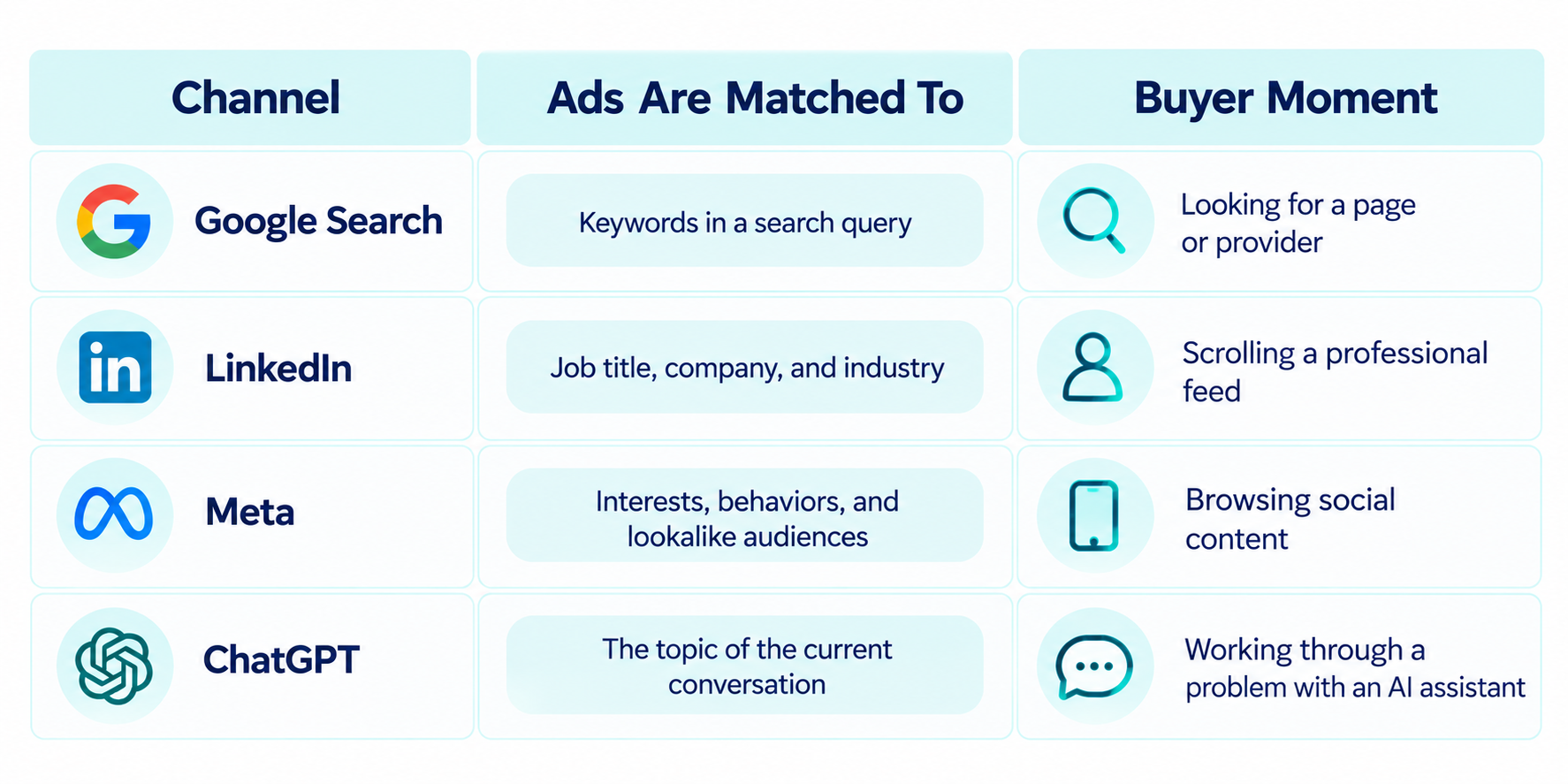
Marketers can compare ChatGPT with Google, LinkedIn, and Meta in HubSpot's ads dashboard, where every paid channel shares one view and one set of CRM metrics. OpenAI's setup guide points advertisers to HubSpot's Analyze tab for this comparison.

Each channel reaches buyers at a different moment, which is why a shared view helps.

comparison-google-search-linkedin-meta-chatgpt

Click-through rate and cost per click say little across channels with such different targeting models. The metrics that guide budget are cost per qualified lead, opportunity rate, sales cycle length, and revenue per dollar spent, and each one depends on CRM data. A ChatGPT campaign with a higher cost per click can still win on cost per opportunity when its clicks come from buyers deeper in their research.


Can Attribution Connect a ChatGPT Ad to a Closed Deal?

Yes. ChatGPT Ads plug into HubSpot's existing attribution model, so a ChatGPT touch earns credit on the same terms as a Google or LinkedIn touch.

That credit is important in B2B, where few deals close from one interaction. Forrester found that an average of 13 internal stakeholders and nine external participants influence a B2B purchase. A buyer might discover a company through a ChatGPT ad, read a LinkedIn post from its CEO a week later, and convert through a branded Google search a month after that. Multi-touch attribution in HubSpot keeps the ChatGPT ad in that path. A standalone ads dashboard would show the click and miss the deal.

Model choice shapes how much credit ChatGPT earns. First-touch and U-shaped models reward the channel that opened the journey, which is often where ChatGPT sits. Comparing a first-touch view with a linear view shows if ChatGPT is opening new deals or assisting deals already in motion.

Revenue reporting also changes how teams defend spend. Leadership can see closed-won revenue influenced by ChatGPT campaigns in the same report as every other channel, which turns a channel experiment into a budget line with evidence behind it.


What Happens When AI Search Becomes a Measurable CRM Channel?

Connected Ideas in a Modern Office

AI search gets budgeted, optimized, and judged like any other revenue channel. Until now, marketers tracked AI search through brand mentions, citation share, and referral traffic, while many buyers formed opinions in ChatGPT without ever clicking through. A paid ChatGPT channel inside the CRM adds pipeline numbers to that picture, and three things shift as a result.

Budget Follows Pipeline Proof

AI search used to compete for budget with soft metrics. With CRM-connected ChatGPT Ads, a team can show cost per opportunity and influenced revenue for AI search in the same report used to fund Google and LinkedIn. Channels that prove pipeline tend to keep their budget, and ChatGPT can now join that group.

AEO and Paid Media Feed Each Other

Organic answers and paid placements show up in the same environment, so each one informs the other. CRM data from ChatGPT campaigns reveals which conversation topics produce opportunities, and those topics become priorities for AEO content. AEO tracking shows where a brand already appears in AI answers, and paid campaigns can cover the high-value topics where it does not.

Buyers also cross-check what AI tells them. In a recent study, 20% of buyers felt less confident in a decision after running into unreliable AI information. Since ads never influence answers, earned visibility still depends on content that AI assistants trust and cite, and a brand that shows up in both places gives that buyer two signals.

CRM Hygiene Drives Ad Performance

Conversion signals from HubSpot train ChatGPT's ad delivery. If lifecycle stages are inconsistent, or deals are missing contact associations, the ad platform learns from the wrong outcomes and spends against them. RevOps work such as stage definitions, deduplication, and deal associations now has a direct effect on media efficiency.


What Makes a ChatGPT Campaign Work?

A ChatGPT campaign works when the ad, the offer, and the landing page all continue the conversation the buyer is already having. The buyer arrives mid-research, so every piece should move that research forward.

Ads are matched to the topic of the current conversation, so campaigns should be organized around the problems buyers ask about. A HubSpot partner might run separate campaigns for CRM migrations, lead routing fixes, and AI readiness, each with its own message. OpenAI also offers an optional AI text-customization feature that rephrases headlines and descriptions to fit the flow of a conversation.

Offers that continue research fit this environment best. Diagnostics, scorecards, migration checklists, pricing breakdowns, and side-by-side comparisons give the buyer a concrete next step. A generic demo request asks for a commitment the buyer may not be ready to make yet.

Visitors from ChatGPT usually arrive with context, since they just read an AI summary of the category. Landing pages for this channel work best when they skip the category basics and lead with proof, specifics, and one clear action. Keep forms short, and use a ChatGPT Ads lead gen form when the offer needs no extra page.


What Are the Limits of ChatGPT Ads Today?

ChatGPT Ads still reach a limited audience, stay away from some topics, and run partly in beta, so they work best as a tested addition to an existing paid mix.

The Audience Skews to Free Plans

At launch, ads reached ChatGPT Free and Go users in the US, Canada, Europe, the UK, Australia, New Zealand, India, and Japan. Plus, Pro, and Business subscribers do not see ads. Some B2B decision makers work in paid ChatGPT plans, so ChatGPT Ads will miss part of the buying committee for now.

Some Topics Are Off Limits

OpenAI's ad principles keep ads away from sensitive or regulated topics such as health, mental health, and politics, and ads do not show to users under 18. Healthcare and other regulated B2B companies should confirm their campaign topics qualify before setting a budget.

The Tools Are Still Maturing

ChatGPT Ads in HubSpot launched in public beta, and Sponsored Agents remain a test with select US advertisers. Early campaigns will run on smaller volumes, and benchmarks for cost per lead and conversion rate are still forming. Teams should treat the first quarter as a learning budget.


How Should Teams Prepare Their CRM for ChatGPT Ads?

Teams should clean up the CRM data that ChatGPT Ads now learns from, then set up the events and workflows that act on new leads. A clean setup makes the first test budget produce usable data.

  1. Standardize lifecycle stages. Agree on what counts as a marketing qualified lead, sales qualified lead, and opportunity, since these stages now act as ad signals.
  2. Fix deal associations. Link deals to the contacts and companies that influenced them, or attribution will undercount ChatGPT's role.
  3. Confirm consent data. Check the consent property before syncing conversion events to ChatGPT Ads.
  4. Sync deep-funnel conversion events. Send stages such as sales qualified lead and customer so optimization learns from revenue outcomes.
  5. Create a dedicated workflow branch. Route, score, and nurture ChatGPT-sourced leads based on the ad topic.
  6. Judge results on pipeline. Run a fixed test budget through at least one full sales cycle and compare cost per opportunity across channels.


Where Does ChatGPT Fit in a Demand Generation Strategy?

ChatGPT fits into your demand generation strategy as a measurable channel, connected to your CRM and judged on revenue. Your buyers are already asking AI assistants for help, and HubSpot's integration gives you a way to show up in those conversations, follow up the moment someone converts, and prove what the channel brings in.

The teams that see results first will be the ones whose CRM is ready to train the ads and credit the revenue. That's where Campaign Creators can help. As a HubSpot Elite Solutions Partner, we help B2B teams assess AI readiness, design CRM architecture, tighten lifecycle stages and attribution through RevOps, and build conversion-focused landing pages, so your ChatGPT campaigns run on data you can trust.

If you're thinking about testing ChatGPT Ads, we'd love to help you get your HubSpot portal ready.

Frequently Asked Questions

Which HubSpot Plans Include ChatGPT Ads?

ChatGPT Ads in HubSpot is in public beta for Marketing Hub Free, Starter, Professional, and Enterprise accounts. A ChatGPT Ads account is also required to connect.

How Do You Connect ChatGPT Ads to HubSpot?

In HubSpot, open Settings, go to Tools, then Marketing, then Ads, and select ChatGPT Ads from the list of ad networks. Sign in to an existing ChatGPT Ads account or create one, then complete the authorization flow.

What Contact Data Does HubSpot Share With ChatGPT Ads?

HubSpot shares only what a conversion event is set to send. Teams choose the contact fields used for matching, such as email, phone, or name, and limit sharing to contacts who gave consent. They can also choose to share every contact who reaches the selected lifecycle stage or only contacts who interacted with ads.

What Are Sponsored Agents?

Sponsored Agents are a test ad format OpenAI announced on September 16, 2026. A user who taps an ad can open a labeled chat with an AI agent backed by that business, then follow a link to its website. The test runs with select advertisers in the US.

How Do ChatGPT Ads Differ From HubSpot's ChatGPT Connector?

The connector brings HubSpot data into ChatGPT, so users can pull up customer and sales information while working there. The ChatGPT Ads integration runs in the opposite direction, bringing ChatGPT campaigns, leads, and conversion data into HubSpot.

Is There an Ad Spend Match for New Advertisers?

The AI Growth Bundle from HubSpot and OpenAI includes a ChatGPT ad spend match of up to $500 after September 30, 2026, plus discounts on HubSpot Starter and ChatGPT Business seats. Terms apply.

How to Integrate Facebook Lead Ads With Your CRM

How to Integrate Facebook Lead Ads With Your CRM

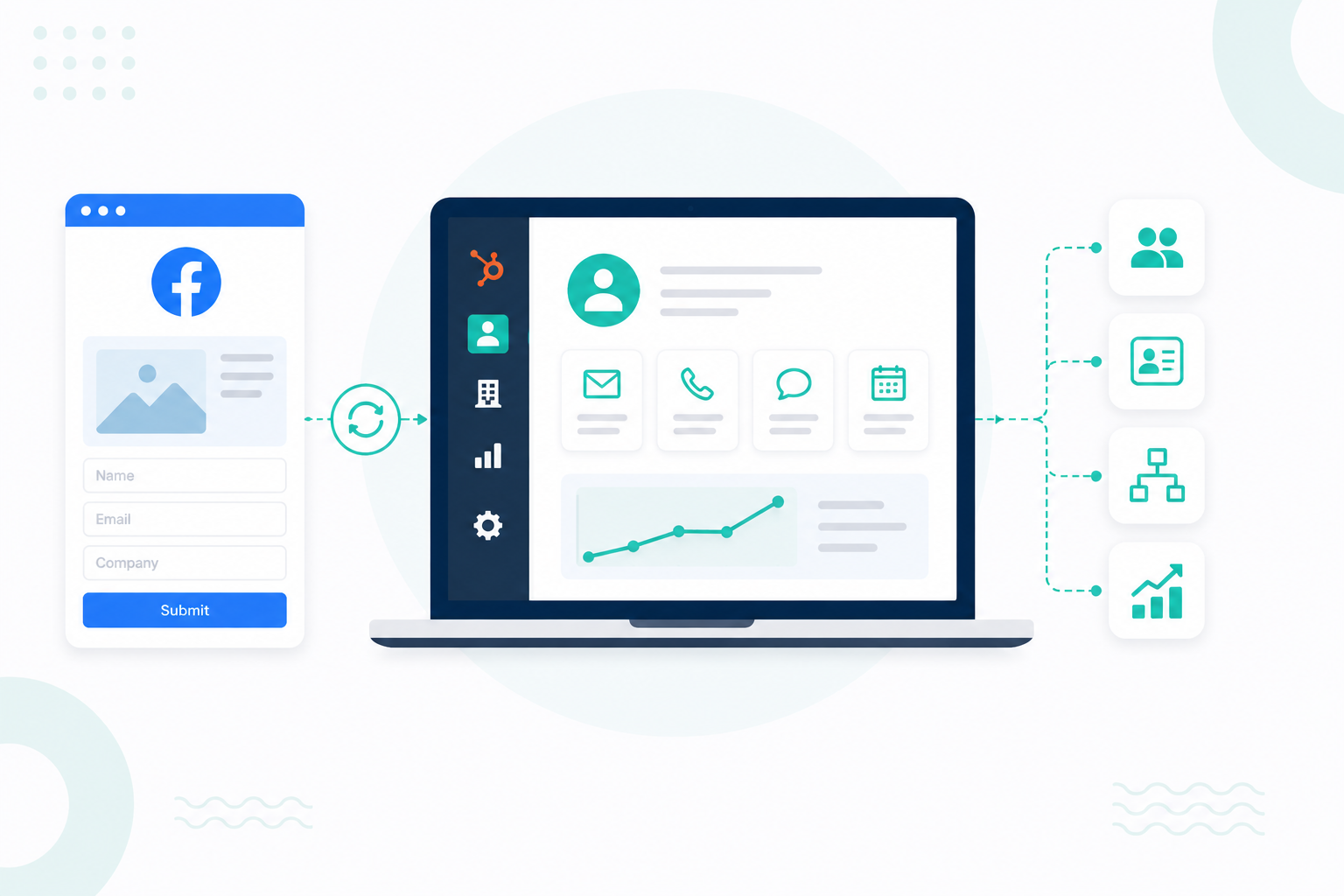
Facebook Lead Ads can produce a steady flow of prospects, but a lead sitting in Meta is not a lead your sales team can work with. Someone still has...
Read More
What Is HubSpot Work and How AI Is Changing Where Business Work Happens

What Is HubSpot Work and How AI Is Changing Where Business Work Happens

HubSpot Work is HubSpot’s new AI-powered workspace for managing business work alongside your CRM. It connects everyday business workflows to the data...

Read More
How to Use HubSpot's Facebook Ads Integration

How to Use HubSpot's Facebook Ads Integration

HubSpot's native Facebook Ads integration connects a Meta ad account to your CRM so you can report on campaigns, apply HubSpot tracking to supported...

Read More