

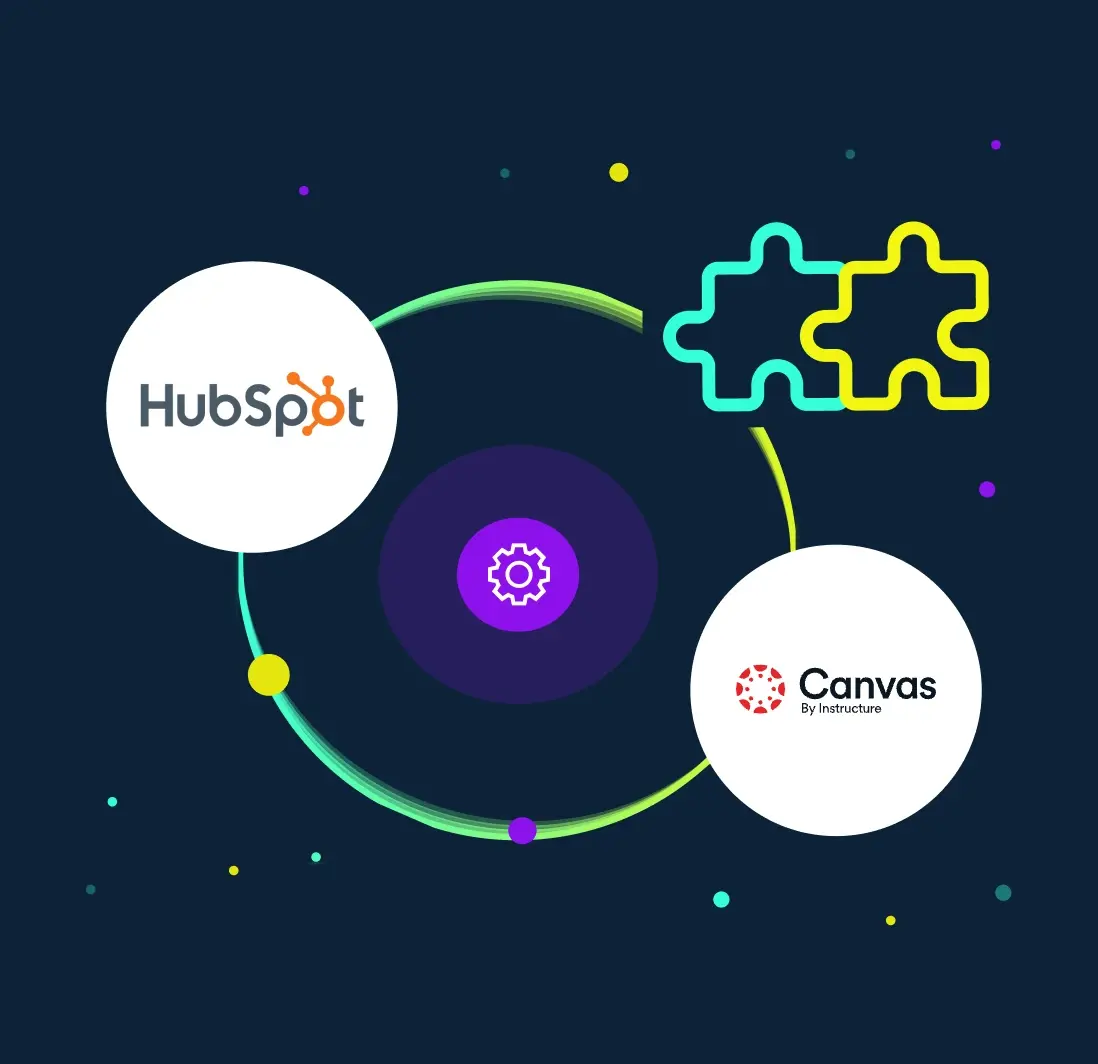
Canvas LMS × HubSpot
How continuing education units, professional learning businesses and universities can bring Canvas enrollments, course progress, completions and certificates into HubSpot, so marketing, sales and learner success teams see what each learner is doing and can act on it, and how a closed deal in HubSpot can enroll a learner in Canvas.
Does Canvas integrate with HubSpot?
Canvas is Instructure's learning management system. It records who is enrolled in which course, how far they have progressed, whether they completed, and, through Canvas Catalog, what they bought and which certificates they earned. HubSpot is where the business that sells and supports that learning runs its marketing, sales and renewals.
Public documentation. The client's own admin issues credentials, with no vendor approval needed.
Open API. The REST API is documented publicly. The institution's Canvas admin issues a developer key.
Based on the vendor's public documentation. Access terms are confirmed with the vendor and the client in discovery.
Canvas pushes enrollment and completion events as they happen, so HubSpot can act on learning activity the same day.
Campaign Creators assessment
Canvas exposes a well-documented REST API with OAuth 2.0, a Live Events stream that posts enrollment, course progress, completion and grade events to an HTTPS endpoint or a queue, and Canvas Data 2 for bulk history. Institutions that sell courses through Canvas Catalog add the Catalog API, which covers catalog courses, programs, orders, enrollments and completed certificates. CC builds a sync module that turns these into HubSpot contacts, a course catalog, enrollment records and revenue, and lets HubSpot enroll a learner when a deal closes. The main decision is privacy: for degree students, course records are education records, so the institution decides which learning signals HubSpot may hold.
Ratings are CC judgments from Instructure's public developer documentation. Event subscriptions, Catalog licensing and developer key settings are confirmed against the client's Canvas instance during discovery.
Completion events arrive as they happen
Live Events include enrollment_created, enrollment_updated, course_progress and course_completed, with the learner's email and requirement counts, so HubSpot does not wait for a nightly report.
Events can arrive twice or out of order
Instructure documents that Live Events delivery is not ordered and can repeat. The sync module reads the current enrollment from the REST API before writing, so a late event cannot overwrite newer data.
Privacy rules come first
For credit-bearing students, course activity is part of the education record under FERPA. The registrar or privacy lead signs off which fields reach HubSpot, and grades stay out unless approved.
Which Canvas APIs does the integration use?
Seven parts of Canvas matter to HubSpot. Four carry the integration, two support it, and one is a privacy decision the institution makes.
Canvas REST API
OAuth 2.0 · developer keysUsers, courses, sections and enrollments, read and written with an OAuth token issued against a developer key the institution's Canvas admin creates.
GET /api/v1/courses/:course_id/enrollmentsPOST /api/v1/courses/:course_id/enrollmentsfor write-back- Cost-based throttling with remaining quota in response headers
Live Events
HTTPS or SQS · Canvas or Caliper formatCanvas posts selected events to an endpoint CC hosts, in Canvas JSON or the IMS Caliper format, with an option to sign each payload as a JWT.
- Enrollment, course, grade, submission and user events
- Endpoint must answer within 15 seconds
- Failed deliveries retried up to six times
Enrollments & completion
enrollment_* · course_progress · course_completedEnrollment state for each learner in each course, progress through module requirements, and the moment a course is completed.
- States: active, invited, completed, inactive, deleted
- Requirement count and completed count
- Completion time from
progress.completed_at
Canvas Catalog
Catalog API · storefront, orders, certificatesThe storefront many continuing education teams use to publish courses and programs, take registrations and payments, and issue certificates.
- Catalog courses, programs and enrollments
- Orders for paid registrations
- Completed certificates per learner
Engagement signals
last_activity_at · total_activity_time · scoresLast activity, total time in course and current score show who is engaged and who is drifting, for renewals and learner success outreach.
- Activity rolled up per learner
- Scores only where approved
- Feeds HubSpot lists and health views
Canvas Data 2
DAP API · snapshot and incrementalBulk access to Canvas tables through Instructure's Data Access Platform. Used once to load history, and for reconciliation checks.
- Client ID and secret from Instructure Identity Services
- Full snapshot, then incremental changes
- JSONL output loaded by the integration layer
Learner records in HubSpot
FERPA · institution decisionFor degree-seeking students, enrollments, scores and submissions are education records. The institution decides what HubSpot may hold; non-credit learners may follow different rules.
- Separate rules for credit and non-credit learners
- Status flags rather than grades
- Written field list in the SOW
How does the Canvas HubSpot integration work?
Canvas sends Live Events to a CC-hosted endpoint. The integration layer checks the signature, reads the current record from the REST API, matches the learner, applies the privacy rules and writes to HubSpot. HubSpot workflows call back into Canvas or Catalog to enroll learners.
Canvas owns the learning record
Enrollment state, progress, completion and scores are official in Canvas. HubSpot reads them and never edits them.
HubSpot owns the relationship
Inquiries, purchases outside Catalog, account ownership and renewals live in HubSpot. A won deal is what tells Canvas to enroll someone.
Read before you write
Every event is checked against the current REST API record, so repeated or out-of-order events cannot write stale data.
What does Canvas HubSpot integration setup involve?
Each phase ends on a gate the client signs off before the next begins. Enrollments and completions go live first, then Catalog revenue and write-back.
Discovery & privacy rules
List the Canvas accounts, course types and learner groups in scope, whether Canvas Catalog is licensed, and which teams use HubSpot. Agree with the registrar or privacy lead what learner data HubSpot may hold.
Canvas access
The Canvas admin creates a developer key, authorizes the integration user, sets up the Live Events subscription to CC's endpoint, and issues Catalog and Canvas Data 2 credentials if in scope.
Identity & ownership rules
Agree how learners match (email, then SIS user ID), how courses map to HubSpot course records, and which system owns each field.
HubSpot data model
Activate the Courses object, create the Course Enrollment custom object, association labels, order and renewal pipelines and the Canvas property group in a sandbox.
Build
Build the event receiver, record fetcher, identity resolver, privacy filter, HubSpot writer and enroll bridge, with idempotent writes and an error replay queue.
Backfill
Load course catalog and enrollment history for an agreed window from Canvas Data 2 or the REST API, then compute learner rollups once.
Workflows, parallel run & launch
Build onboarding, progress nudges, completion follow-up and renewal workflows with sends paused, run two weeks in parallel, then switch on.
What does the Canvas HubSpot integration sync?
Field names follow Instructure's public REST API, Live Events and Catalog API documentation. Exact payloads are confirmed against the client's Canvas instance during the access phase.
| Canvas field | HubSpot property | Object | Direction | Notes |
|---|---|---|---|---|
| Learners · contacts | ||||
| user.email (Live Events) / user login | Contact | CNV → HS | Match key, then SIS user ID. | |
| user.id | cnv_user_id | Contact | ↔ Both | Stored so write-back can enroll the same user. |
| sis_user_id | cnv_sis_user_id | Contact | CNV → HS | Only visible with SIS permission. |
| user.name | firstname, lastname | Contact | CNV → HS | Fill blanks only; HubSpot edits stay in HubSpot. |
| New learner from HubSpot | Canvas or Catalog user | User | HS → CNV | Created when a deal closes and no user exists. Confirm account permissions in discovery. |
| Courses · catalog | ||||
| course.id, name | Course record (hs_course_name) | Courses object | CNV → HS | One record per Canvas course. |
| sis_course_id | cnv_sis_course_id | Courses object | CNV → HS | Links courses to the institution's SIS. |
| course.account_id | cnv_account_id | Courses object | CNV → HS | Separates departments or sub-accounts. |
| Catalog course or program | cnv_catalog_program | Courses object | CNV → HS | From the Catalog API courses and programs. |
| Enrollments & completion | ||||
| enrollment.id | cnv_enrollment_id | Course Enrollment | CNV → HS | Unique key on the custom object. |
| enrollment_state / workflow_state | cnv_enrollment_state | Course Enrollment | CNV → HS | active, invited, completed, inactive, deleted. |
| type | cnv_enrollment_type | Course Enrollment | CNV → HS | Student, teacher, observer. Teachers can sync to an instructor list. |
| progress.requirement_completed_count / requirement_count | cnv_progress_pct | Course Enrollment | CNV → HS | Computed percent from course_progress. |
| progress.completed_at | cnv_completed_at | Course Enrollment | CNV → HS | From course_completed. |
| last_activity_at | cnv_last_activity_at | Course Enrollment | CNV → HS | Read from the Enrollments API. |
| total_activity_time | cnv_total_activity_minutes | Course Enrollment | CNV → HS | Seconds converted to minutes. |
| grades.current_score | cnv_current_score | Course Enrollment | CNV → HS | Only where the institution approves. Off by default. |
| count of completed enrollments | cnv_courses_completed | Contact | CNV → HS | Computed in the integration layer. |
| Catalog revenue & certificates | ||||
| Catalog order | Order | Order | CNV → HS | Paid registrations; confirm order fields in discovery. |
| Catalog order items | Line items | Line item | CNV → HS | One per course or program purchased. |
| Completed certificate | cnv_certificate_earned, cnv_certificate_date | Course Enrollment | CNV → HS | From the Catalog completed certificates endpoint. |
| Closed-won deal | enrollment (POST) | Enrollment | HS → CNV | Enrolls the learner in the purchased course or Catalog listing. |
How are authentication and API limits handled?
Canvas access is issued by the institution's Canvas admin. Values Instructure does not publish are marked for confirmation.
| Topic | Canvas | HubSpot |
|---|---|---|
| Authentication | OAuth 2.0 against a developer key issued by the institution's Canvas admin. Access tokens last one hour and are renewed with the original refresh token. Applications used by more than one person must use OAuth, not manual tokens. | Private app access token or OAuth 2.0 public app, scoped per object. |
| Interfaces | Canvas REST API (/api/v1/: users, courses, sections, enrollments), Canvas Catalog API (courses, programs, enrollments, orders, completed certificates), and Canvas Data 2 through the DAP API. | REST APIs: CRM objects, Courses object, custom objects, commerce objects, associations. |
| Live Events | Delivered to HTTPS (each event a POST, optionally signed as a JWT with keys published at a JWKS endpoint) or to an SQS queue, which cannot be FIFO. Canvas or Caliper IMS format. | HubSpot signs its own webhooks with a v3 signature. |
| Delivery behavior | The endpoint must return a 2xx within 15 seconds. Failures are retried up to six times, then recorded as failed. Delivery is not ordered and can repeat. | Client retries with backoff on 429. |
| Rate limits | Cost-based quota that refills over time. Each response carries X-Request-Cost; throttled requests return 429. One request at a time is unlikely to be throttled. Exact quota: not published. Confirm with Instructure. | Per-10-second burst and daily limits by subscription tier. |
| Bulk data | Canvas Data 2 credentials (client ID and secret) are created in Instructure Identity Services. Snapshot once, then incremental queries. | CRM imports and batch endpoints for large loads. |
| Catalog API access | Requires a Canvas Catalog license. Token setup: confirm with Instructure. | Orders and line items available on all hubs; custom objects need Enterprise. |
What should you plan for, and what does the integration unlock?
Severity reflects impact on the SOW, not technical difficulty alone.
Challenges to plan for
Course activity for credit-bearing students is part of the education record. The institution decides which fields HubSpot holds, and grades stay off unless approved in writing.
Live Events are not ordered and may be delivered more than once. The sync module de-duplicates by event and reads the current enrollment before every write.
Some institutions use SIS IDs or login IDs rather than personal emails. Match rules run email first, then SIS user ID, and unmatched learners go to a review list.
Orders and certificates come from Canvas Catalog. Without it, revenue comes from HubSpot deals or another payment record, and completion is taken from Canvas course completion.
Canvas measures progress and completion against module requirements. Courses built without requirements need a completion rule agreed per course, such as a final score or end date.
Canvas can deactivate a Live Events subscription after a large number of failures. The receiver queues events before processing and alerts on errors, so it always answers within 15 seconds.
Opportunities in HubSpot
A completed course triggers the next course, program or certification offer, timed to the learner's actual progress.
Account managers see how many of a client's learners enrolled, progressed and completed, so group contracts renew on evidence.
When a deal is won, HubSpot enrolls each learner in the right course, so onboarding starts the same day without manual admin.
Learners who stall get reminders and a check-in from learner success before they drop out.
Certificates earned land on the contact, ready for alumni marketing, referrals and continuing education credit reminders.
Enrollments, completions and revenue by course sit beside marketing source and pipeline, so leaders see which programs pay off.
From first click to certificate, on one record.
HubSpot runs the relationship and Canvas runs the learning. The sync module keeps both sides current at each step.
- Interest: HubSpot captures the inquiry or Catalog visit and nurtures by course and topic.
- Purchase: a Catalog order or a won HubSpot deal enrolls the learner in Canvas.
- Learning: enrollment state, progress and activity update the Course Enrollment record and drive nudges.
- Completion: the completion and certificate trigger follow-up, upsell and renewal workflows.
Which HubSpot properties does the integration create?
All custom properties use the cnv_ prefix in a Canvas property group. Progress and totals are computed in the integration layer so every report agrees.
| Internal name | Label | Object | Type | Source / logic |
|---|---|---|---|---|
| cnv_user_id | Canvas User ID | Contact | Single-line text | user.id; unique |
| cnv_sis_user_id | Canvas SIS User ID | Contact | Single-line text | sis_user_id |
| cnv_courses_completed | Courses Completed | Contact | Number | Count of completed enrollments |
| cnv_sis_course_id | SIS Course ID | Courses object | Single-line text | sis_course_id |
| cnv_enrollment_id | Canvas Enrollment ID | Course Enrollment | Single-line text | enrollment.id; unique |
| cnv_enrollment_state | Enrollment State | Course Enrollment | Dropdown | enrollment_state |
| cnv_progress_pct | Progress % | Course Enrollment | Number | requirement_completed_count ÷ requirement_count |
| cnv_completed_at | Completed At | Course Enrollment | Date and time | progress.completed_at |
| cnv_last_activity_at | Last Activity | Course Enrollment | Date and time | last_activity_at |
| cnv_total_activity_minutes | Time in Course (min) | Course Enrollment | Number | total_activity_time ÷ 60 |
| cnv_certificate_earned | Certificate Earned | Course Enrollment | Single checkbox | Catalog completed certificates |
| cnv_current_score | Current Score | Course Enrollment | Number | grades.current_score; only if approved |
Interactive scope builder
Choose the Canvas data for this engagement and the direction each field syncs. Required fields are the keys the integration cannot run without. Copy the summary into the SOW or a reply to the client.
Scope summary
Sources & verification
Based on public documentation. Event payloads, developer key settings and Catalog access are confirmed against the client's Canvas instance in the access phase.
- Instructure Developer Docs: Live Events data service setup
- Instructure Developer Docs: Live Events course events
- Instructure Developer Docs: Live Events enrollment events
- Instructure Developer Docs: Enrollments API
- Instructure Developer Docs: Canvas Data 2 DAP getting started
- Instructure Developer Docs: Canvas Catalog API
- Instructure: Canvas Catalog
- HubSpot Developers: Courses object
Canvas HubSpot integration FAQ
Does Canvas integrate with HubSpot?
Yes. Canvas has a publicly documented REST API with OAuth 2.0, a Live Events stream that posts enrollment, progress and completion events as they happen, and Canvas Data 2 for bulk history. Campaign Creators builds a custom integration on these, using a developer key issued by the institution’s Canvas admin.
What data syncs between Canvas and HubSpot?
Learners sync to HubSpot contacts, courses to a course catalog, and enrollments to a Course Enrollment custom object with status, progress, completion and certificate. Where Canvas Catalog is licensed, orders and completed certificates sync too, and a closed deal in HubSpot can enroll a learner in Canvas.
Which system owns which data?
Canvas owns the learning record: enrollment state, progress, completion and scores are official in Canvas, and HubSpot reads them and never edits them. HubSpot owns the relationship, including inquiries, purchases outside Catalog, account ownership and renewals. For credit-bearing students, the institution decides which learner data HubSpot may hold.
What does setting up the Canvas HubSpot integration involve?
Seven phases, each closed by a client sign-off: discovery and privacy rules, Canvas access (a developer key and a Live Events subscription), identity and ownership rules, the HubSpot data model, the build, backfill, and workflows with a two-week parallel run before launch.
How long does the integration take and what does it cost?
Timeline and cost depend on the Canvas accounts, course types, learner groups and fields in scope (for example whether Canvas Catalog is licensed, the institution’s privacy rules and write-back from HubSpot). Campaign Creators confirms these in discovery and provides a fixed scope before the build starts.
Ready to Get More From HubSpot?
Whether you’re implementing HubSpot, optimizing what you already have, connecting systems, or scaling your customer experience, we’ll help you figure out the right next step.