






Manufacturing Success Story
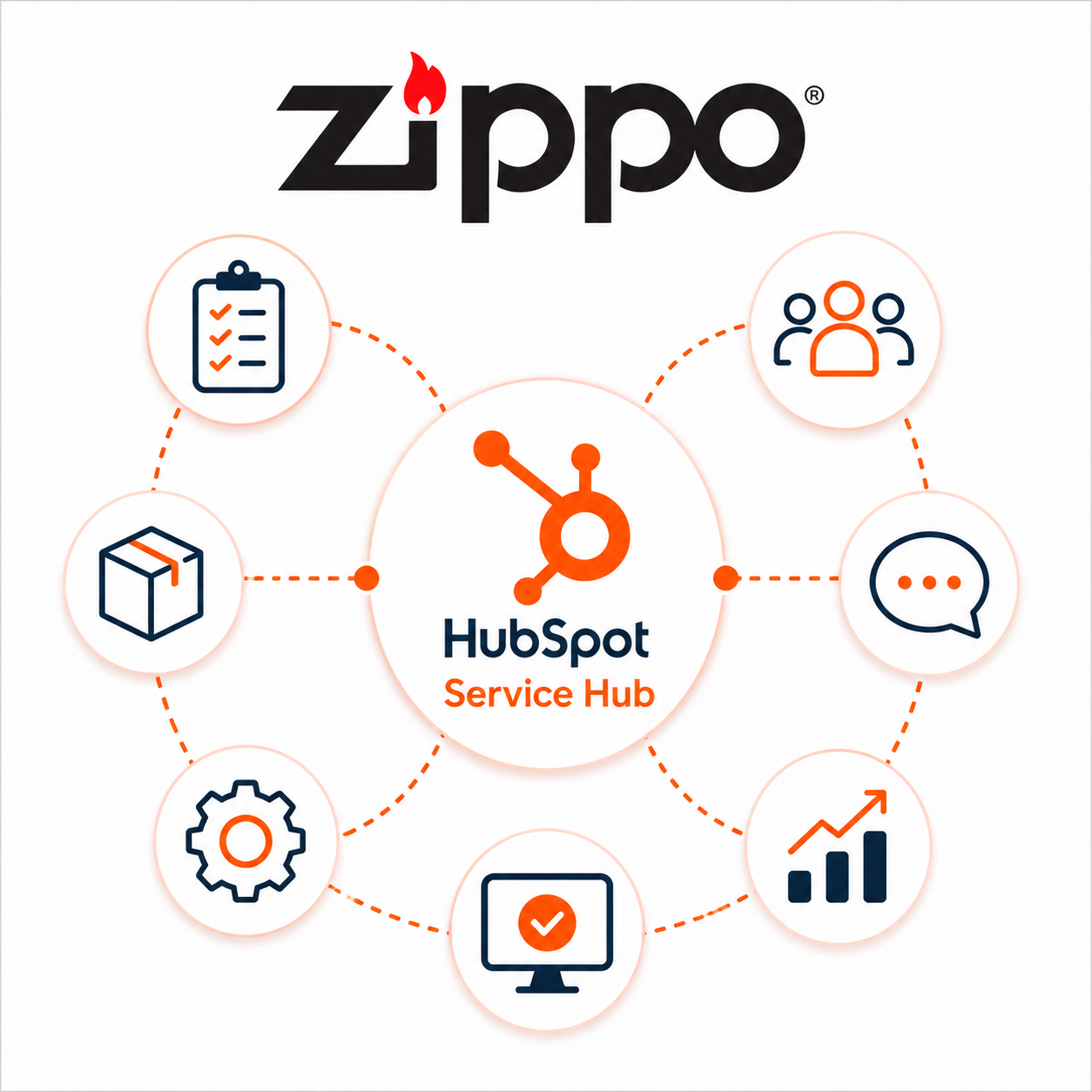
How Zippo Unified Repair Operations and Customer Service in HubSpot Service Hub
Zippo, along with its Case and Northern Lights brands, operated in a service environment that went far beyond email and ticket resolution. Many support interactions involved physical products moving through repair facilities, manual inspections, warranty checks, shipping coordination, and follow-ups across multiple brands. These were not stand-alone digital conversations but operational processes that depended on accuracy, timing, and coordination across teams.
0M
customer records unified
0%
conversion rate
0K
junk contacts removed
+0
companies cleaned

Zippo, alongside its Case and Northern Lights brands, operated a complex service environment where customer support extended beyond digital interactions into physical repair workflows. As volume increased, disconnected systems, including Salesforce, a modified ERP, and manual processes, created data silos, limited visibility, and operational inefficiencies across teams.
With a fixed deadline to exit Salesforce, Zippo needed a solution that could unify service operations without disrupting peak-season performance. Campaign Creators partnered with Zippo to architect and implement a HubSpot Service Hub environment designed around how repair and service workflows actually function.
The result was a unified system that aligned customer service, repair tracking, and data across brands. Custom architecture enabled item-level repair visibility within a single interaction, while automation, integrations, and improved data quality reduced manual effort and increased operational clarity.
Zippo successfully migrated with zero downtime, establishing a scalable service platform built to support both digital and physical operations.
Industry
Manufacturing
Tools Used
- HubSpot CRM & Service Hub
- Shopify
- Aircall
- Modified ERP system
- Miro
Services
- CRM migration
- System architecture
- Custom objects
- Workflow design
- Data cleanup
- Integration setup
- Service automation
The Challenge
Zippo’s service operations had outgrown the systems supporting them. Disconnected platforms, manual workflows, and fragmented data made it difficult to manage complex repair processes or deliver consistent customer service. As volume increased, these gaps created operational strain across teams and limited visibility for leadership. Compounding the issue was a fixed deadline to exit Salesforce, requiring a solution that could unify systems without disrupting ongoing operations.
- Disparate Platforms Supporting One Broken Customer Journey
- Repair Workflows That Didn’t Fit CRM Assumptions
- High Volume, Messy Data, and Limited Visibility
- A Hard Deadline With No Margin for Error

Disparate Platforms Supporting One Broken Customer Journey
Zippo’s service environment was split across multiple systems that were never designed to operate together. The Case repair team relied on Salesforce Service Cloud to manage tickets and evaluations. The Zippo repair team operated inside a modified ERP system that depended on manual data entry and paper documentation. Consumer Relations teams worked across Salesforce, Shopify, Google Docs, spreadsheets, and internal tools to resolve a single inquiry.
This fragmentation made it difficult to deliver consistent service. A customer’s order history might live in Shopify, repair status in an ERP, communication history in Salesforce, and internal instructions in Google Docs. Agents spent significant time searching for information rather than resolving issues. Data silos limited visibility across brands and teams, creating blind spots in reporting and decision-making.
Repair Workflows That Didn’t Fit CRM Assumptions
A core operational challenge stemmed from how repairs were tracked. Customers often sent multiple items in a single shipment, especially for knife repairs under the Case brand. Legacy systems treated each item as a separate case or ticket. This approach created multiple disconnected records for what was, in fact, a single customer interaction.
Repair teams needed to track each physical item through stages such as received, evaluated, repaired, and returned. At the same time, shipments often needed to wait until all items were complete so they could be returned together.
Standard CRM ticket structures were not designed for this level of item-level tracking within a single customer interaction, which forced teams to perform manual reconciliation and status checks.
High Volume, Messy Data, and Limited Visibility
Years of operating across disconnected platforms led to inconsistent, unreliable data. Salesforce contained duplicate contacts, placeholder company records, and outdated information that no longer reflected active customers. Missed calls frequently generated empty tickets, inflating reported workload and distorting performance metrics. Knowledge lived in Google Sheets that were difficult to search, update, or govern.
Ticket volume remained high, particularly around order and repair status. Approximately 3,500–4,000 customers contacted Zippo each year requesting tracking information that was not easily accessible in the CRM. Each inquiry required manual lookups and responses, straining the Consumer Relations team and reducing time available for complex cases.
A Hard Deadline With No Margin for Error
Compounding these operational challenges was a non-negotiable deadline. Zippo’s Salesforce contract was set to expire in October. The new system had to be live before that date, with no service disruption. Any downtime risked missed inquiries, delayed repairs, and potential safety escalations related to product issues.
The migration needed to happen without disrupting daily operations or overwhelming teams during peak season. Failure would not only impact customer experience but also internal confidence in the platform and the migration effort itself.
"Thanks to this project, our repair workflows became visible and our data became trustworthy. Our agents gained clarity rather than juggling disconnected systems, and our leadership gained confidence in reporting instead of questioning its accuracy."
— Zippo Team
Why Zippo Chose Campaign Creators
Zippo chose Campaign Creators because the engagement began with operational reality rather than platform configuration. Instead of starting with predefined HubSpot features, the focus was on understanding how service and repair actually worked across brands.
- End-to-End Process Discovery
- Future-State Workflow Alignment
- Phase-Based Prioritization
- Transparent Technical Tradeoffs
Solution
.png?width=80&height=80&name=CC%20Square%20Hero%20Image%20(32).png)
End-to-End Process Discovery
The team reviewed existing documentation, then moved into live walkthroughs with key stakeholders. These discovery sessions examined the full repair lifecycle, from customer intake and warranty validation to repair execution and return shipping. This approach surfaced operational gaps that would not have been visible solely from requirements, particularly where physical workflows collided with digital systems.
.png?width=80&height=80&name=CC%20Square%20Hero%20Image%20(33).png)
Future-State Workflow Alignment
Visual collaboration became central to alignment. Campaign Creators and Zippo’s stakeholders used Miro to co-create future-state workflows. Ticket routing logic, repair pipelines, and form behavior were mapped visually, allowing stakeholders to see how data and decisions would flow before any configuration work began. This process reduced ambiguity and prevented misinterpretation between teams.
.png?width=80&height=80&name=CC%20Square%20Hero%20Image%20(34).png)
Phase-Based Prioritization
Campaign Creators also brought structure to the prioritization process. With the Salesforce deadline approaching, not every request could be delivered in Phase 1. The team worked with Zippo to define what was mission-critical for launch and what could be safely deferred. High-risk integrations, including barcode scanning and ShipStation, were intentionally moved into a Phase 2 roadmap to protect stability and ensure a successful initial launch.
.png?width=80&height=80&name=CC%20Square%20Hero%20Image%20(35).png)
Transparent Technical Tradeoffs
Throughout the process, Campaign Creators remained transparent about technical constraints. Limitations in native HubSpot integrations for Shopify, telephony, and barcode scanning were discussed openly. Rather than imposing incomplete solutions, the team proposed practical alternatives that aligned with operational needs and the realities of the timeline. This transparency built trust and avoided late-stage surprises.
The Results
A Successful Salesforce Exit With Zero Downtime
Campaign Creators guided Zippo off Salesforce before the October deadline without service disruption. Open tickets were migrated using a delta strategy that excluded duplicate and low-quality data. Agents transitioned to HubSpot immediately with no impact on daily operations.
Efficiency Gains Across Service and Repair Teams
Approximately 1.1 million customer records from three Shopify storefronts were unified into a single system. Agents gained full visibility across brands, reducing context switching and response time. Automation replaced repetitive manual tasks, while intelligent routing improved triage and response speed for critical inquiries.
Data Quality and Customer Experience Improvements
More than 1,700 junk contacts and 100 placeholder companies were removed during migration, improving data integrity. Reporting accuracy increased after eliminating empty, missed-call tickets. During UAT, the new Case warranty form achieved nearly a 50% conversion rate, reflecting a stronger customer experience.

The Impact: From Disconnected Tools to a Unified Service Operation
Campaign Creators designed a unified HubSpot architecture aligned to Zippo’s physical repair workflows, using a custom parent-child ticket structure to track multiple items within a single customer interaction. Brand-specific pipelines preserved operational differences while maintaining centralized reporting.
A phased implementation ensured a stable Salesforce exit, prioritizing core functionality and deferring complex integrations. Practical solutions bridged platform limitations, including Shopify visibility, telephony routing with Aircall, and interim workflows for repair tracking.
Automation, structured knowledge bases, and intelligent routing reduced manual effort, improved visibility, and created a more consistent experience for both agents and customers.
Building a Service Platform That Could Finally Support the Work
Zippo’s migration to HubSpot was never about replacing Salesforce with another tool. It was about building a system that could finally support the reality of physical repairs, multiple brands, and high-volume customer interactions without forcing teams into workarounds.
The project demonstrated that complex service operations can be unified when technology follows how work actually happens. Repair workflows became visible. Data became trustworthy. Agents gained clarity rather than juggling disconnected systems. Leadership gained confidence in reporting instead of questioning its accuracy.
What could have been a risky, deadline-driven migration became a stabilizing moment for the organization. By prioritizing the right foundation, strategically deferring complexity, and aligning teams through visual planning and phased delivery, Zippo exited Salesforce on time and positioned its service organization for long-term scalability.
For organizations managing service alongside physical operations, this case shows that success comes from disciplined planning, honest prioritization, and a partner who understands both the systems and the people expected to use them every day.
Work With Campaign Creators
Ready to get the most out of HubSpot? Campaign Creators helps companies design and implement HubSpot systems that align with how their operations actually function. From planning and migration to reporting and adoption, the focus is on building systems that support long-term performance.